Upgrading a slim desktop or small-form-factor PC can be challenging when standard graphics cards are too tall, too long, or too power-hungry. The best low-profile graphics cards deliver a practical balance of performance, compatibility, cooling, and power use in compact systems.
This roundup compares 10 options ranging from basic display adapters and HTPC cards to modern GeForce RTX models for 1080p gaming. Before buying, confirm your case clearance, power supply, available slot width, and the included low-profile mounting bracket.
Best 10 Low Profile Graphics Cards Picks for 2026
Best Gaming Pick

- 6GB GDDR6 memory and 1492 MHz boost clock
- Dual-fan low-profile design
- HDMI 2.1a and DisplayPort 1.4a outputs
Best For: Compact gaming desktops
Best Professional Workstation Pick

- Supports one 5K or up to four 4K displays
- 4GB GDDR5 with a 128-bit interface
- Up to 50W maximum power consumption
Best For: Multi-monitor SFF workstations
Best High-Performance Pick

- 8GB GDDR7 with Blackwell architecture
- 2580 MHz OC boost clock and DLSS 4
- DisplayPort 2.1a and HDMI 2.1 outputs
Best For: High-performance compact gaming PCs
Best Budget SFF Pick

- 35W TDP with no external power connector
- 4GB GDDR5 and 128-bit memory interface
- Single-fan low-profile design
Best For: Low-power mini PCs and basic displays
Compact 4K Display Pick
MSI GeForce GT 1030 4GB Low Profile
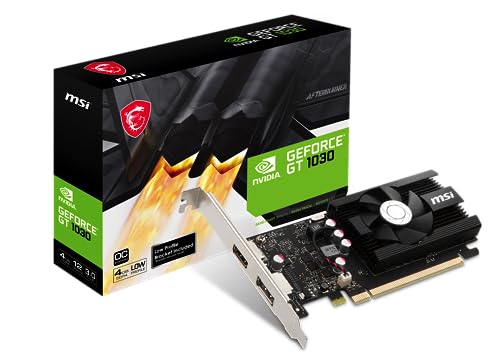
- 4GB DDR4 memory and 1430 MHz boost clock
- DisplayPort 1.4a and HDMI 2.0b outputs
- Supports up to 3840×2160 resolution
Best For: Compact desktops and everyday 4K display use
Multi-Output Budget Pick

- 4GB DDR3 memory with a 902 MHz core clock
- HDMI, DisplayPort, and VGA outputs
- Includes low-profile brackets for SFF and HTPC cases
Best For: Entry-level compact PCs needing flexible display connectivity
Performance Upgrade Pick
maxsun GTX 1050 Ti Low Profile

- 4GB GDDR5 memory with a 128-bit bus
- Slim 6.5-by-2.71-inch SFF design
- HDMI and DisplayPort support up to 7680×4320
Best For: Compact PCs needing a stronger dedicated graphics upgrade
Best Budget Legacy Upgrade

- 4GB DDR3 memory for everyday multitasking
- HDMI, DVI, and VGA triple-display output
- Slot-powered design needs no external connector
Best For: Older desktops, office work, media playback, and light gaming
Best Low-Profile Gaming Pick

- 6GB GDDR6 memory with Ampere architecture
- DLSS and Tensor Core support for compatible games
- Compact 6.65-inch design with HDMI 2.1 and DisplayPort
Best For: SFF gaming PCs and compact builds needing modern graphics
Best Balanced Everyday Upgrade

- 4GB GDDR5 memory for office and light gaming use
- HDMI, DVI-D, and VGA support up to three monitors
- Low-profile, slot-powered design for SFF and ITX PCs
Best For: Compact desktops, multi-monitor workstations, and light gaming
Best Gaming Pick – MSI GeForce RTX 3050 LP 6G OC
The MSI GeForce RTX 3050 LP 6G OC is a practical choice among low profile graphics cards for compact gaming desktops that need modern NVIDIA features without a full-size card. It combines 6GB of GDDR6 memory, a 1492 MHz boost clock, and a dual-fan design in a 6.9-by-2.7-inch profile.
Best For: Compact gaming PCs and users who want an RTX 30-series card with HDMI 2.1a and DisplayPort connectivity.
Pros:
- 6GB of GDDR6 memory with a 96-bit interface
- Supports up to 3840×2160 resolution
- Includes two HDMI 2.1a outputs and one DisplayPort 1.4a output
- Three-year warranty
Cons:
- 1492 MHz boost clock is modest compared with newer RTX models
- Uses a dual-fan cooler, which may require more internal space than single-fan designs
Choose this card when you want a balanced compact gaming upgrade with useful modern display outputs. Its 6GB memory capacity gives it an advantage over entry-level 4GB options, while the low-profile dimensions suit smaller desktops.
Best Professional Workstation Pick – AMD Radeon Pro WX 4100
The AMD Radeon Pro WX 4100 is one of the more specialized low profile graphics cards in this group, built for professional display and workstation workloads. It offers 4GB of GDDR5 memory, a 128-bit interface, up to 2.4 TFLOPS of compute performance, and support for multiple high-resolution displays.
Best For: Small-form-factor workstations, multi-monitor setups, and professional applications involving rendering, transcoding, or signal processing.
Pros:
- Supports one 5K display or up to four 4K displays
- 4GB GDDR5 memory with a 128-bit interface
- Up to 50W maximum power consumption
- Includes four mini-DisplayPort-to-DisplayPort adapters and an SFF bracket
Cons:
- Uses older GDDR5 memory
- Provides mini-DisplayPort outputs rather than full-size HDMI
- Designed more for professional workloads than gaming
The WX 4100 makes the most sense when display density and workstation compatibility matter more than gaming-focused features. Its included adapters and low power draw simplify installation in a compact professional system.
Best High-Performance Pick – ASUS GeForce RTX 5060 LP BRK
The ASUS GeForce RTX 5060 LP BRK is the most advanced option here for buyers seeking low profile graphics cards with current-generation features. Its Blackwell architecture, 8GB of GDDR7 memory, DLSS 4 support, and 2580 MHz OC boost clock make it suited to demanding compact builds.
Best For: High-performance small-form-factor gaming systems that need a compact RTX 50-series card and modern display support.
Pros:
- 8GB of GDDR7 memory
- NVIDIA Blackwell architecture and DLSS 4 support
- 2580 MHz OC boost clock
- DisplayPort 2.1a and HDMI 2.1 outputs
Cons:
- May be more capability than needed for basic desktop or display use
- Three-fan cooling design may be less suitable for extremely tight interiors
For a compact PC where performance and newer standards are priorities, this ASUS card is the strongest feature set in the roundup. IP5X dust resistance, dual ball fan bearings, and a three-year warranty add practical durability features.
Best Budget SFF Pick – 51RISC Radeon RX 550 LP 4GB
The 51RISC Radeon RX 550 LP is a straightforward budget option among low profile graphics cards for older or modest compact desktops. Its 35W TDP, single-fan cooler, and 4GB of GDDR5 memory make it suitable for systems where low power use and easy installation are more important than high-end performance.
Best For: Mini PCs, low-power desktops, and basic gaming or 4K display output without an external power connector.
Pros:
- 35W TDP and no external PSU power connector required
- 4GB GDDR5 memory with a 128-bit interface
- Single-fan design intended for quieter operation
- Includes DisplayPort and HDMI outputs
Cons:
- Older RX 550 platform is less suited to demanding modern gaming
- Uses PCIe 3.0 and a listed PCI-Express x8 interface
- Two-year limited warranty is shorter than some alternatives
This card is a sensible fit for upgrading a compact computer with a limited power supply. It prioritizes low consumption, a short-form-factor design, and simple display connectivity rather than the performance or features of newer RTX cards.
Compact 4K Display Pick – MSI GeForce GT 1030 4GB Low Profile
The MSI GeForce GT 1030 4GB DDR4 is a practical choice for buyers seeking low profile graphics cards for compact desktop upgrades, media playback, and everyday display use. It combines a 1430 MHz boost clock with DisplayPort 1.4a and HDMI 2.0b outputs in a single-fan design.
Best For: Small-form-factor desktops needing a compact card with 4K UHD display support.
Pros:
- 4GB of DDR4 memory with a 64-bit interface
- DisplayPort and HDMI outputs support up to 3840×2160 resolution
- Single-fan design and PCI-Express x16 interface
- Includes a three-year warranty
Cons:
- DDR4 memory and a 64-bit bus are modest for demanding graphics workloads
- Only two listed display outputs are included
This MSI card is best viewed as a compact display and general-purpose upgrade rather than a high-performance gaming solution. Its 4K output support and straightforward connectivity make it a sensible fit for compatible space-constrained systems.
Multi-Output Budget Pick – Glorto GeForce GT 730 4GB
The Glorto GeForce GT 730 is one of the more basic low profile graphics cards for SFF desktops and HTPCs. Its 4GB DDR3 memory, half-height brackets, and HDMI, DisplayPort, and VGA connectivity make it flexible for older or compact systems.
Best For: Entry-level SFF and HTPC upgrades requiring multiple legacy and modern display connections.
Pros:
- Includes 4GB of DDR3 memory and a 902 MHz core clock
- Provides dual HDMI plus DisplayPort and VGA connectivity
- Supports up to four screens through NVIDIA Surround technology
- Includes low-profile brackets for compatible compact cases
Cons:
- Older DDR3 memory and PCI Express 2.0 x8 interface limit its modern performance profile
- Maximum listed resolution is 2560×1600
- Designed for entry-level use rather than demanding gaming
The GT 730 stands out for connection flexibility and broad case compatibility. It is a reasonable fit when display expansion and low-profile installation matter more than current-generation graphics performance.
Performance Upgrade Pick – maxsun GTX 1050 Ti Low Profile
The maxsun GeForce GTX 1050 Ti offers a stronger specification set than basic low profile graphics cards, pairing 4GB of GDDR5 memory with a 128-bit bus and a boost clock up to 1392 MHz. Its slim 6.5-by-2.71-inch design is intended for Mini and small-form-factor PCs.
Best For: SFF desktop owners seeking a more capable low-profile graphics upgrade with HDMI and DisplayPort.
Pros:
- 4GB GDDR5 memory with a 128-bit interface
- Supports PCIe 3.0 x16 and lists compatibility with PCIe x8 systems
- Slim low-profile design measures 6.5 by 2.71 inches
- HDMI and DisplayPort support multi-monitor output and resolutions up to 7680×4320
Cons:
- Only HDMI and DisplayPort outputs are listed, with no VGA connection
- Single-fan cooling may require careful case airflow in a compact enclosure
- System clearance and compatibility should be checked before installation
With faster GDDR5 memory and a wider bus, this maxsun model is the performance-oriented option in the group. Its compact dimensions make it attractive for compatible SFF systems, provided the case and power requirements are verified.
Best Budget Legacy Upgrade – SOYO GeForce GT 740 4GB
For older desktops that need a compact graphics upgrade, the SOYO GT 740 is one of the more practical low profile graphics cards. Its 4GB of DDR3 memory, triple-display output, and slot-powered design suit office work, media playback, and light gaming without requiring a new power supply.
Best For: Reviving older or slim desktop PCs for 1080p office work, streaming, multitasking, and light gaming.
Pros:
- 4GB memory and a 128-bit bus support smooth 1080p playback and everyday multitasking.
- HDMI, DVI, and VGA outputs support modern displays and legacy monitors or projectors.
- Draws power from the PCIe slot, with no external power connector required.
- Low-noise fan and heatsink are suited to office PCs and HTPC use.
Cons:
- DDR3 memory and older GT 740 hardware limit it to light gaming and basic graphics workloads.
- Maximum listed display resolution is 1920×1080.
- Some systems may require BIOS legacy-video or Above 4G Decoding adjustments after installation.
The SOYO GT 740 makes the most sense when compatibility, low power use, and legacy display connections matter more than modern gaming performance. It is a straightforward choice for extending the useful life of an older slim desktop.
Best Low-Profile Gaming Pick – maxsun GeForce RTX 3050 6GB
The maxsun RTX 3050 brings substantially newer graphics hardware to compact systems. Among these low profile graphics cards, it stands out with 6GB of GDDR6 memory, Ampere architecture, DLSS support, and modern HDMI 2.1 and DisplayPort 1.4a connectivity.
Best For: Small-form-factor gaming PCs and compact builds that need stronger dedicated graphics performance and modern display support.
Pros:
- 6GB of GDDR6 memory and RTX 3050 Ampere architecture provide the strongest performance profile in this group.
- DLSS and dedicated Tensor Cores can help boost supported game performance.
- Short low-profile dimensions of 6.65 by 2.71 inches suit slim SFF and mini PC cases.
- HDMI 2.1 and DisplayPort 1.4a support multi-monitor setups and resolutions up to 8K.
Cons:
- It uses a PCIe x8 4.0 connection, so buyers should verify motherboard and case compatibility.
- Its single-fan design and compact format may require careful airflow planning in tightly packed cases.
- Modern gaming capability comes with a more specialized use case than basic office-oriented cards.
Choose the maxsun RTX 3050 when compact dimensions and gaming features are priorities. Its GDDR6 memory, DLSS support, and current digital outputs make it the most capable option here for a small gaming or performance-focused PC.
Best Balanced Everyday Upgrade – QTHREE Radeon RX 550 4GB
The QTHREE Radeon RX 550 offers a useful middle ground for compact desktops. This low profile graphics card combines 4GB of GDDR5 memory, three display outputs, and low-power operation for office productivity, entertainment, and light gaming in SFF or ITX systems.
Best For: Compact desktops needing affordable multi-monitor support and a step up from integrated graphics.
Pros:
- 4GB of GDDR5 memory and a 6000 MHz memory speed support everyday use and light gaming.
- HDMI, DVI-D, and VGA outputs can drive up to three monitors simultaneously.
- Low-profile format and included low-profile brackets simplify installation in SFF and ITX cases.
- No external power supply is required, helping keep power consumption low.
Cons:
- RX 550 hardware is intended for light gaming and general workloads rather than demanding modern games.
- The listed warranty description is 30 days.
- Its PCI Express x8 3.0 interface may require checking available motherboard slot support.
The QTHREE RX 550 is a sensible choice for users who want more display flexibility and dedicated graphics without a major system rebuild. It is particularly appealing for compact office, entertainment, and light-gaming machines.
How We Picked the Best Low Profile Graphics Cards
We selected cards across several use cases rather than ranking performance alone. The list includes entry-level GPUs for office PCs and home-theater systems, older cards that can provide an affordable upgrade, professional workstation hardware, and newer RTX models suited to gaming. We considered GPU generation, video memory, port selection, power requirements, cooling design, and the likelihood of fitting a small-form-factor case.
Specifications can vary by manufacturer and seller, so verify the exact model, bracket configuration, and power connectors before ordering. Some listings may include both full-height and half-height hardware, while others require a separate bracket.
Quick Comparison
For the strongest modern gaming performance in this selection, the ASUS GeForce RTX 5060 LP is the obvious performance-focused choice if your system supports its power and cooling requirements. The MSI and Maxsun RTX 3050 models offer a more moderate route to 1080p gaming, while the Radeon RX 550 and GTX 1050 Ti are better suited to lighter games and general upgrades.
The GT 1030, GT 730, and GT 740 are primarily display and media cards. They can work well in older office PCs, HTPCs, and systems that need multiple outputs, but they are not ideal choices for demanding modern games. The Radeon Pro WX 4100 is the specialist option for compatible professional applications and workstation workflows.
Key Buying Factors for Low-Profile Graphics Cards
Physical Fit and Bracket
Measure the available card length, height, and thickness inside your case. A low-profile card may still occupy two slots, and some compact cases have limited room around the PCIe connector. Make sure a half-height bracket is included or available.
Power and Cooling
Check whether the card draws power solely from the PCIe slot or needs an auxiliary connector. Confirm that your power supply has enough capacity and the correct cables. Compact coolers can run warmer and louder, especially in systems with restricted airflow.
Performance and Memory
Match the GPU to your workload. Newer RTX cards are preferable for current games and features such as hardware ray tracing, while basic cards are sufficient for video playback, office work, and extra monitors. More VRAM helps with higher-resolution textures, but it does not compensate for a weak GPU.
Display Connectivity
Review the HDMI, DisplayPort, VGA, and DVI outputs you actually need. For 4K displays, confirm the supported refresh rate and connection standard rather than relying only on the card’s advertised maximum resolution.
Who Should Buy Which Low Profile Graphics Cards?
Choose an RTX 5060 LP for the best overall gaming potential, assuming your compact PC has adequate power and ventilation. Pick an RTX 3050 LP for a balanced 1080p upgrade. The RX 550 or GTX 1050 Ti makes more sense for budget gaming and older systems, while the GT 1030, GT 730, or GT 740 fits basic display, media, and office duties. Select the Radeon Pro WX 4100 when certified workstation software and professional driver support matter more than gaming performance.