Running multiple monitors can make work, trading, content management, and multitasking far more efficient—but the right graphics card must match your display count, connectors, resolution, and PC case.
We selected 10 graphics cards for multiple monitors, ranging from compact entry-level models to higher-capability options with four or more HDMI outputs. Use the guide below to narrow the list based on compatibility and everyday workload.
Best 10 Graphics Cards for Multiple Monitors Picks for 2026
Six-Screen Specialist

- Six native HDMI outputs
- Supports up to six displays simultaneously
- No external power connector required
Best For: Trading, monitoring, signage, and six-screen office installations
Simple Four-HDMI Upgrade

- Four independent HDMI display outputs
- 4GB DDR3 memory
- Powered directly through the PCIe slot
Best For: Standard desktops needing an easy four-screen productivity upgrade
Compact 4-Screen Value

- Up to four-screen output
- HDMI, DP, and VGA ports
- Low-profile brackets included
Best For: Basic multi-monitor office and HTPC setups
Four-HDMI Office Setup

- Four HDMI display outputs
- Up to 4K at 60Hz
- No external power connector
Best For: Four-screen office and stock-monitoring workstations
Low-Power Productivity Pick

- Up to four monitor support
- Two HDMI, DP, and VGA outputs
- 30W design with no external power
Best For: Budget multi-monitor office PCs and compact systems
Six-Screen Workstation Pick
- Six native HDMI outputs for up to six monitors
- 4GB GDDR5 memory for productivity workloads
- PCIe slot powered with no external connector
Best For: Six-screen office, trading, monitoring, and signage setups
Compact Quad-Display Pick
GTX 750 4-HDMI Low-Profile GPU

- Four HDMI ports for simultaneous multi-monitor use
- Low-profile design for compatible compact desktops
- 4K 60Hz support on a compatible single display
Best For: Four-screen productivity setups in small-form-factor PCs
Quiet Home-Office Pick
GT 740 Quad-HDMI Graphics Card
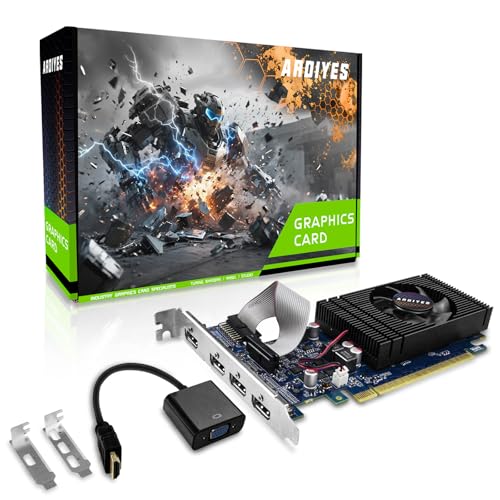
- Four HDMI ports support a quad-monitor setup
- Low-profile design with both bracket types included
- Silent cooling for offices and home theater PCs
Best For: Quiet four-screen office, signage, or HTPC installations
Budget Quad-Display Pick – maxsun GeForce GT 730 4GB
For buyers seeking graphics cards for multiple monitors, the maxsun GT 730 offers four HDMI outputs in a compact ITX, single-slot design. It supports four simultaneous displays, with up to 3840×2160 resolution at 30Hz, making it suited to productivity-focused setups.
Best For: Office desktops, multi-screen workstations, and users needing four HDMI monitor connections in a compact card.
Pros:
- Four HDMI outputs support four simultaneous monitors
- Compact ITX, single-slot form factor
- Fanless passive cooling and solid capacitors
- Includes 4GB of GDDR3 memory
Cons:
- Maximum listed 4K output is 30Hz
- Requires a PCIe x16 or x8 slot and a 200W-or-greater power supply
- Older GT 730 and GDDR3 platform is aimed at display work rather than demanding graphics
This card is a practical choice when four HDMI connections and small-case compatibility matter more than high-performance gaming. Check your power supply and available slot before buying.
Six-Screen Specialist – Radeon R7 350 6 HDMI
The Radeon R7 350 stands out among graphics cards for multiple monitors with six native HDMI outputs. It can drive up to six displays at once, with support listed up to 1920×1080 at 60Hz per display on compatible systems and monitors.
Best For: Trading desks, monitoring stations, digital signage, and office workstations requiring up to six direct HDMI connections.
Pros:
- Six native HDMI outputs
- Supports up to six simultaneous displays
- 2GB of GDDR5 memory
- PCIe x16 installation without an additional power connector
Cons:
- Designed around a PCIe x16 slot
- Listed multi-display support targets 1080p at 60Hz per screen
- Older Radeon R7 350 platform is intended for everyday display workloads
Choose this model if the priority is maximizing the number of HDMI-connected screens with minimal adapter use. Its six-output layout is particularly useful for information-dense, non-gaming environments.
Simple Four-HDMI Upgrade – GT 730 4GB GDDR3
This GT 730 is a straightforward option for graphics cards for multiple monitors, combining four independent HDMI outputs with 4GB of DDR3 memory. It draws power from the PCIe slot, so installation does not require an external power cable.
Best For: Standard desktop users building four-screen trading, programming, digital-signage, or multitasking workstations.
Pros:
- Four independent HDMI outputs
- 4GB of DDR3 memory for multi-window workloads
- PCIe-slot powered with no external power connector
- Standard-profile design for many desktop cases
Cons:
- Not suitable for small-form-factor cases, according to the supplied notes
- 90-day warranty
- DDR3 memory and GT 730 graphics are suited to display productivity rather than demanding applications
Its main appeal is uncomplicated four-screen expansion without extra adapters or power cabling. Confirm that your case accepts the standard-profile card and has a compatible PCI Express slot.
Quad-4K Productivity Choice – VisionTek Radeon RX 550 4GB
The VisionTek RX 550 is a stronger productivity-oriented choice among graphics cards for multiple monitors, offering four HDMI outputs and support for four 4K displays at once. Its 4GB of GDDR5 memory and 50W bus-powered design suit office, trading, and signage systems.
Best For: Financial trading PCs, digital signage, and Windows 11-compatible office desktops needing four high-resolution displays.
Pros:
- Supports four 4K displays simultaneously
- Four HDMI outputs and 4GB of GDDR5 memory
- 50W bus-powered design requires no extra cabling
- Single-slot, full-height form factor and 3-year limited warranty
Cons:
- Requires a standard full-height desktop installation
- Recommended power supply is 350W or larger
- Not positioned as a high-end gaming graphics card
For users who want four high-resolution screens from a recognized productivity-focused card, the RX 550 is the most capable fit in this group. Verify case clearance, operating-system compatibility, and power-supply capacity before installation.
Compact 4-Screen Value – Glorto GeForce GT 730 4G
For basic productivity and several displays, the Glorto GT 730 is a practical option among graphics cards for multiple monitors. It provides HDMI, DisplayPort, and VGA outputs, supports up to four screens through NVIDIA Surround, and includes low-profile brackets for compatible SFF and HTPC builds.
Best For: Office work, light multimedia, and compact PCs needing up to four displays.
Pros:
- Supports up to four-screen output with HDMI, DisplayPort, and VGA connectivity.
- Includes 4GB DDR3 memory and supports Windows 11.
- Low-profile design and included brackets suit SFF and HTPC installations.
Cons:
- DDR3 memory and the older GT 730 platform are aimed at entry-level use.
- Maximum output varies by connector, with VGA listed at up to 2048×1536.
This card makes the most sense when display quantity, compatibility, and compact installation matter more than modern gaming performance. Check your case clearance, available PCI Express slot, and required connector resolutions before buying.
Four-HDMI Office Setup – RX560 4GB Multi Monitor Card
The RX560 is built around a straightforward four-display setup, making it a strong candidate for graphics cards for multiple monitors in offices, trading desks, and productivity workstations. Its four HDMI ports support up to 3840×2160 at 60Hz, while the card draws power from the PCI Express slot without an external connector.
Best For: Four-HDMI office, stock-monitoring, and light-gaming systems.
Pros:
- Offers four HDMI outputs for a simple multi-screen installation.
- Supports up to 3840×2160 at 60Hz according to the supplied specifications.
- Uses PCI Express slot power and includes a cooling fan.
Cons:
- All outputs are HDMI, so adapters may be needed for other monitor inputs.
- The full-height card measures approximately 7.09 by 4.72 inches.
- It is positioned as an entry-level card rather than a high-end gaming GPU.
Choose this model when your monitors already use HDMI and you want four matching outputs with 4K/60Hz capability. Confirm the full-height clearance and compatibility with your operating system before installation.
Low-Power Productivity Pick – QTHREE GeForce GT 730 4GB
The QTHREE GT 730 focuses on affordable multi-monitor productivity in both full-size and compact computers. With two HDMI ports, DisplayPort, and VGA, it can drive up to four monitors while using a low-profile design and a stated 30W power draw.
Best For: Budget office PCs and compact systems that need several display outputs.
Pros:
- Supports up to four monitors through two HDMI ports, DisplayPort, and VGA.
- Low-profile design with two brackets supports compact-case installation.
- Uses 30W of power and requires no external power connector.
Cons:
- The listed maximum display resolution is 2560×1440.
- DDR3 memory and the GT 730 platform are intended for basic display and light multimedia use.
- Requires an available PCI Express x8 lane slot and a 300W-or-greater power supply.
This is a sensible choice for extending an older or compact PC with multiple displays while keeping power demands low. Verify the motherboard slot, case bracket arrangement, and monitor inputs before purchasing.
Six-Screen Workstation Pick – R7 350 6-HDMI Graphics Card
If you need graphics cards for multiple monitors, this Radeon R7 350 model stands out for its six native HDMI outputs. It is aimed at productivity-focused setups such as trading desks, office workstations, monitoring systems, and digital signage, with up to 1920 × 1080 at 60Hz per display on compatible systems.
Best For: Users who need to connect up to six HDMI monitors directly from one graphics card.
Pros:
- Six native HDMI outputs support up to six simultaneous displays.
- 4GB of GDDR5 memory supports everyday productivity and multi-window work.
- Uses a PCIe x16 slot and does not require an external power connector.
- Supports Windows 7, 8, 10, 11, and Vista according to the supplied specifications.
Cons:
- Maximum listed per-display support is 1920 × 1080 at 60Hz on compatible setups.
- Requires an available PCIe x16 slot and six HDMI-connected monitors.
- The card is rated at approximately 60W and is designed for productivity rather than demanding gaming.
Choose this card when the number of direct HDMI connections matters most. Its six-output design simplifies large multi-screen installations, while the slot-powered setup can make integration easier in compatible desktops.
Compact Quad-Display Pick – GTX 750 4-HDMI Low-Profile GPU
For graphics cards for multiple monitors in a compact desktop, this low-profile GTX 750 provides four HDMI outputs and can drive four displays simultaneously. It also supports up to 3840 × 2160 at 60Hz on a compatible single-display setup, making it useful for productivity systems that combine several screens with one higher-resolution monitor.
Best For: Small-form-factor desktop users building a four-monitor office, trading, or monitoring workstation.
Pros:
- Four HDMI outputs support four simultaneous monitors.
- Low-profile, dual-slot design is intended for compatible compact PCs.
- Supports 4K at 60Hz on a compatible single-display setup.
- Draws power from the PCIe slot without requiring an additional power cable.
Cons:
- The approximately 1.57-inch thickness requires two expansion-slot spaces.
- Case dimensions, operating system, PCIe slot, power supply, and monitor connections require verification before purchase.
- Its multi-monitor focus is better suited to office and productivity use than demanding graphics workloads.
This is a practical choice when four displays are enough and the host computer has limited internal space. Confirm both the low-profile fit and two-slot clearance before ordering, since compact cases can vary considerably.
Quiet Home-Office Pick – GT 740 Quad-HDMI Graphics Card
This GT 740 is a straightforward option among graphics cards for multiple monitors, offering four built-in HDMI ports for a quad-monitor setup. Its low-profile form factor, included half-height and full-height brackets, and silent cooling make it suitable for offices, trading desks, digital signage, and home theater PCs.
Best For: Buyers who want a quiet, compact four-monitor card for everyday work or multimedia use.
Pros:
- Four HDMI ports enable a quad-monitor setup without additional display adapters.
- Low-profile design fits compatible small-form-factor cases.
- Includes both low-profile and standard brackets for installation flexibility.
- Silent cooling and hardware-accelerated video decoding suit noise-sensitive multimedia environments.
Cons:
- The supplied specifications list a maximum display resolution of 1920 × 1080, while also referencing 3840 × 2160 support; verify the intended resolution for your setup.
- Requires a compatible desktop with a PCI Express slot.
- The listed warranty is 90 days.
This card makes the most sense for quiet, everyday multi-screen computing rather than high-performance graphics work. The included brackets are useful for flexible desktop installation, but resolution expectations should be confirmed before purchase.
How We Picked the Best Graphics Cards for Multiple Monitors
We focused on the features that matter most for multi-display setups: the number and type of video outputs, supported resolutions, graphics memory, physical size, PCIe compatibility, cooling, and practical value. We also included cards with different port layouts because a six-HDMI card suits a different buyer than a low-profile model with HDMI, DisplayPort, and VGA.
Port counts should be verified against the manufacturer’s specifications before purchase. Some listings use similar GPU names with different memory types, output configurations, or form factors.
Quick Comparison
| Best For | What to Prioritize | Models to Consider |
|---|---|---|
| Four-monitor office setup | Four independent outputs and stable drivers | RX 550, GTX 750, GT 740, quad-HDMI GT 730 |
| Six-monitor installation | Six physical outputs and adequate motherboard support | Radeon R7 350 models |
| Small-form-factor PC | Low-profile bracket, short length, modest power draw | Glorto GT 730, QTHREE GT 730, GTX 750 low profile |
| Basic productivity | Affordable card with sufficient display outputs | GT 730 variants |
Key Buying Factors for Graphics Cards for Multiple Monitors
Outputs and Adapters
Count the ports you will use, not just the advertised maximum displays. HDMI simplifies connections to modern monitors and televisions, while DisplayPort can support higher refresh rates and daisy-chaining on compatible equipment. Avoid relying on passive adapters unless the card and monitor combination explicitly supports them.
Resolution and Refresh Rate
Four 1080p screens are substantially easier to drive than several 4K displays. Check maximum resolution per output, refresh-rate limits, and whether all ports can operate simultaneously at your intended settings. For office applications, entry-level cards are often adequate; gaming across multiple high-resolution monitors requires considerably more performance.
Case, Slot, and Power Compatibility
Low-profile cards are designed for slim desktops, SFF systems, and some HTPCs, but they may require the included low-profile bracket. Also check the card’s length, slot width, PCIe interface, and whether your power supply has the required capacity or connector. Older PCIe generations are generally backward-compatible, but motherboard clearance and BIOS support still matter.
Workload and Driver Support
For spreadsheets, web apps, surveillance dashboards, and documents, display connectivity is usually more important than gaming speed. If you plan to edit video, use 3D software, or play games, prioritize a newer or faster GPU with sufficient VRAM and current driver support.
Who Should Buy Which Graphics Cards for Multiple Monitors?
Choose a six-HDMI Radeon R7 350 if your priority is connecting many HDMI monitors with minimal adapter use. A quad-HDMI RX 550, GTX 750, or GT 740 is a better fit for a straightforward four-screen workstation where you want one cable per display. GT 730 models are suitable for basic multi-monitor productivity and budget upgrades, especially when the PC has limited power or space.
For compact desktops, select a clearly labeled low-profile card and confirm that the correct bracket is included. Buyers seeking gaming performance should look beyond this entry-level-focused group and select a modern GPU based on the games, resolutions, and refresh rates they intend to run.