The best audio mixers make it easier to combine microphones, instruments, music, and computer audio while giving you practical control over levels, effects, and routing.
This roundup covers compact analog boards, USB-equipped mixers, digital systems, and gaming-focused controls so you can match the mixer to your setup and budget.
Best 10 Audio Mixers Picks for 2026
Best for Flexible Digital Mixing
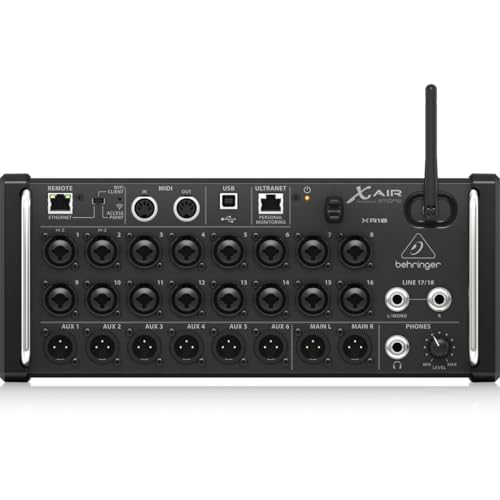
- 18-channel digital mixer with 12 buses
- 16 programmable MIDAS-designed preamps
- Built-in Wi-Fi and 18 x 18 USB interface
Best For: Live sound, studio work, and tablet-controlled mixing
Best Compact Analog Mixer

- 10-input mixer with USB connectivity
- SPX digital effects and one-knob compressors
- Rugged powder-coated metal chassis
Best For: Small live, rehearsal, and recording setups
Best for Beginner Streaming

- XLR mic input with 48V phantom power
- Independent controls for key streaming channels
- Custom effects, voice modes, and RGB lighting
Best For: Single-mic gaming, livestreaming, and content creation
Best Simple USB Streaming Mixer

- Eight-input analog mixer
- Stereo USB interface for computer or mobile device
- Directly mixes PC or gaming audio into streaming output
Best For: Straightforward streaming, podcasting, and recording
Compact Routing Pick
LZSIG 4-Channel Mini Audio Mixer
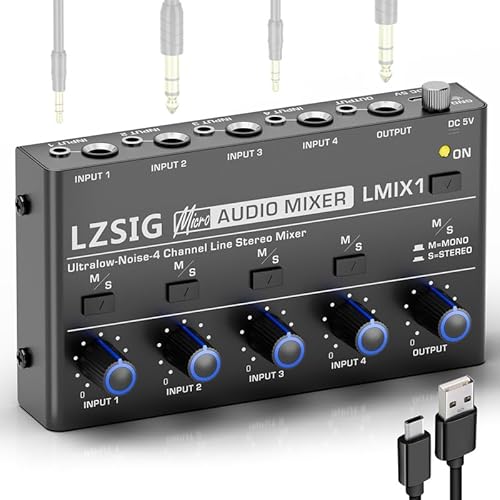
- Combines four audio sources into one output
- Mono/stereo switching with 3.5mm and 6.35mm support
- Low-noise design for compact setups
Best For: Basic sub-mixing, gaming, and instrument setups
Streaming and Recording Pick

- 10 channels for mics, instruments, phones, and computers
- Bluetooth playback and multi-mode USB recording
- 24 effects with tap tempo and Onyx mic preamps
Best For: Live streaming, podcasting, and band practice
Feature-Packed Value Pick
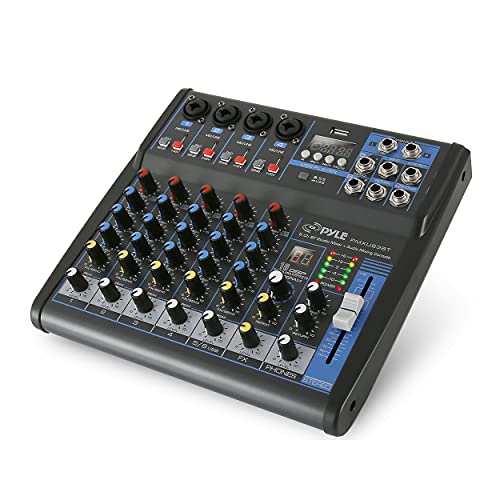
- Six channels with XLR and 1/4-inch inputs
- Bluetooth, USB, flash-reader, and MP3 playback
- Adds phantom power, 3-band EQ, and DSP effects
Best For: Karaoke, live gigs, DJ use, and flexible playback
Best Value Audio Mixer

- Four XLR inputs with +48V phantom power
- Bluetooth and USB playback support
- 3-band EQ and 16 DSP effects
Best For: Home karaoke, streaming, and small live setups
Best Slim Audio Mixer

- Ultra-thin 1.57-inch design
- Bluetooth 5.0 and MP3/USB playback
- Eight channels with reverb and +48V phantom power
Best For: Karaoke, events, conferences, and space-conscious setups
Best for Larger Setups
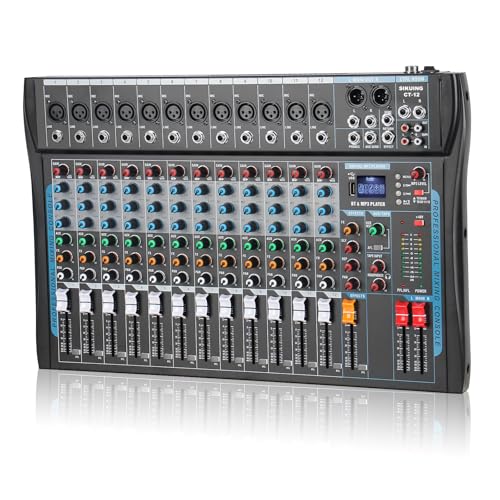
- Twelve mic inputs for larger productions
- Bluetooth and USB mixing and recording
- 3-band EQ, 16 DSP effects, and headphone output
Best For: DJs, bands, studios, events, and live streaming
Best for Flexible Digital Mixing – Behringer X AIR XR18
The Behringer X AIR XR18 is a capable choice among audio mixers for live sound and studio work when you want tablet-based control. It combines 18 channels, programmable MIDAS-designed preamps, built-in Wi-Fi, and an 18 x 18 bidirectional USB interface.
Best For: Live performers, studios, and users who prefer wireless control from an iPad or Android tablet.
Pros:
- 18-channel, 12-bus digital mixing platform
- 16 programmable MIDAS-designed microphone preamps
- Built-in tri-mode Wi-Fi router avoids the need for an external router
- 18 x 18 USB interface supports direct recording
Cons:
- Tablet control may be less convenient for users who prefer physical faders
- Its advanced feature set may be more than basic setups require
The XR18 stands out when remote control, extensive channel capacity, and USB recording matter more than a traditional mixer layout. Its 7.1-pound design also keeps it reasonably portable for a digital mixer with this feature set.
Best Compact Analog Mixer – Yamaha MG10XU
The Yamaha MG10XU is a practical option among audio mixers for smaller live, rehearsal, and recording setups. Its 10 inputs, USB connectivity, SPX digital effects, three-band EQ, high-pass filters, and one-knob compressors provide useful hands-on control in a compact format.
Best For: Musicians, small venues, and home users who want straightforward physical controls with built-in effects.
Pros:
- 10-input layout with USB connectivity
- Built-in SPX digital effects
- Three-band EQ and high-pass filters help shape and clean up signals
- Rugged, impact-resistant powder-coated metal chassis
Cons:
- Offers fewer channels than larger digital mixers
- Its 7.7-pound chassis is less lightweight than some compact alternatives
The MG10XU is a sensible fit if you value familiar knobs and faders over tablet control. Its compressors and effects make it especially useful for quickly refining vocals, guitars, bass, and other common sources.
Best for Beginner Streaming – FIFINE Ampligame SC3
The FIFINE Ampligame SC3 is one of the more streaming-focused audio mixers here, with an XLR microphone input, 48V phantom power, individual channel controls, and front-panel mute and monitoring buttons. It also adds customizable sound-effect buttons, voice-changing modes, and RGB lighting.
Best For: New streamers, gamers, and creators using a single microphone with Mac or Windows.
Pros:
- XLR input with built-in 48V phantom power for compatible condenser microphones
- Separate controls for microphone, line in, headphones, and line out
- Front mute and monitor buttons support convenient live operation
- Includes customizable sound effects and voice-changing modes
Cons:
- USB microphones are not supported through the XLR input
- XLR cable is not included
- Designed primarily for one-microphone streaming rather than multi-channel production
The SC3 prioritizes accessible streaming controls over traditional multi-channel mixing. It is a good starting point for creator setups, particularly when physical faders, simple routing, and fun vocal effects are more important than extensive inputs.
Best Simple USB Streaming Mixer – Behringer XENYX 802S
Behringer XENYX 802S Premium Analog 8-Input Mixer with USB Streaming Interface
Check Price On AmazonThe Behringer XENYX 802S is a compact analog option among audio mixers for streaming, podcasting, and recording. It provides eight inputs, analog mixing and equalization, direct PC or gaming-sound mixing, and a stereo USB interface for connecting a computer or mobile device.
Best For: Streamers and podcasters who want a straightforward analog mixer with USB connectivity.
Pros:
- Eight-input analog mixing layout
- Stereo USB interface supports computer or mobile-device connection
- Can mix PC or gaming audio directly into the streaming output
- Provides analog equalization for hands-on sound shaping
Cons:
- Offers fewer inputs and less advanced routing than larger digital mixers
- Analog controls may require more manual setup than software-controlled alternatives
The XENYX 802S makes sense for users who want physical analog controls without giving up USB connectivity. Its focused feature set is well suited to basic streaming and podcast workflows where simple computer-audio integration is the priority.
Compact Routing Pick – LZSIG 4-Channel Mini Audio Mixer
For simple audio mixers setups, the LZSIG Mini Audio Mixer combines up to four connected sources into one stereo or mono output. Its compact design, support for 3.5mm and 6.35mm cables, and low-noise circuitry make it practical for basic home, gaming, instrument, or sub-mixing applications.
Best For: Combining several line-level sources in a compact setup.
Pros:
- Mixes up to four sources, including keyboards, guitars, computers, CD players, and gaming consoles.
- Supports both mono and stereo operating modes.
- Accepts 3.5mm and 6.35mm TRS/TS connections without adapters.
- Uses low-noise components and a power-management chip designed to reduce ground noise.
Cons:
- The power adapter is sold separately.
- It is intended for line mixing rather than a full-featured live-sound console.
The LZSIG is a focused choice when you need extra routing flexibility without a large control surface. Confirm your power-supply requirements before buying, especially if you want the cleanest possible output.
Streaming and Recording Pick – Mackie ProFX10v3+ Mixer
The Mackie ProFX10v3+ is one of the more versatile audio mixers here for live streaming, podcasting, band practice, and small performances. It pairs 10 channels with Bluetooth playback, USB-C recording, Onyx mic preamps, and an effects engine with 24 effects and tap tempo.
Best For: Users who want one mixer for live sound, wireless playback, and computer recording.
Pros:
- Provides 10 channels for microphones, instruments, phones, and computers.
- Supports Bluetooth playback and multi-mode USB recording.
- Includes 24 GigFX+ effects with tap tempo.
- Features Onyx preamps on every microphone channel.
Cons:
- It is larger and more involved than a basic line mixer.
- The corded-electric design requires a dedicated power connection.
Choose the ProFX10v3+ if recording and streaming features matter as much as mixing. Its channel count and connectivity offer room for varied setups, while the built-in effects add flexibility for live use.
Feature-Packed Value Pick – Pyle PMXU63BT 6-Channel Mixer
The Pyle PMXU63BT is a practical choice among audio mixers when you want Bluetooth, USB playback, microphone inputs, and basic tone shaping in one console. Its six channels, +48V phantom power, built-in MP3 player, and 3-band EQ suit live gigs, karaoke, DJ use, and studio-ready setups.
Best For: Performers and hobbyists seeking broad playback and input options at a compact size.
Pros:
- Offers six channels with XLR and unbalanced 1/4-inch inputs.
- Supports Bluetooth streaming from phones and tablets.
- Includes USB, flash-reader, and MP3 playback functionality.
- Provides +48V phantom power, 3-band EQ, LED peak indicators, and DSP effects.
Cons:
- Its frequency specification is listed as 80 KHz, below the Mackie’s listed 96 KHz.
- The feature set may be more than needed for simple line-level mixing.
- It uses a corded power supply rather than battery operation.
With multiple playback methods and microphone-focused features, the PMXU63BT is well suited to flexible event and performance setups. The rugged steel chassis and sealed controls are useful additions for regular on-stage or karaoke use.
Best Value Audio Mixer – 6-Channel Bluetooth DSP Mixer
This six-channel audio mixer is a practical choice for karaoke, streaming, recording, and small live setups. It combines four XLR inputs, Bluetooth playback, USB support, 3-band EQ, and built-in DSP effects in one corded console.
Best For: Home karaoke, small performances, streaming, and basic studio recording.
Pros:
- Four XLR inputs support condenser microphones with switchable +48V phantom power.
- Bluetooth and USB support make it easy to play or mix external audio.
- Includes 3-band EQ, gain controls, independent faders, and 16 DSP effects.
Cons:
- It has only six channels, so larger setups may need more input capacity.
- The manufacturer lists a 90-day warranty.
- Operation errors may result in no sound, so setup requires attention to the controls.
This is a feature-packed, compact option for users who want flexible connectivity and onboard effects without moving to a larger console. Its six-channel layout is best suited to modest rigs rather than complex productions.
Best Slim Audio Mixer – CT-80S 8-Channel Mixer
This eight-channel audio mixer stands out for its ultra-thin 1.57-inch design while still offering Bluetooth, MP3/USB input, reverb, and +48V phantom power. It is designed for flexible use with microphones and instruments in home, event, and live-music environments.
Best For: Family KTV, campus events, conferences, bands, and users who want a slim console.
Pros:
- Eight channels provide more connection capacity than a basic six-channel mixer.
- Built-in Bluetooth 5.0, MP3/USB input, and song-name display support convenient playback.
- Supports cable, wireless, and condenser microphones, as well as instruments.
- Includes reverb and +48V phantom power for expanded audio options.
Cons:
- The supplied details do not specify individual channel EQ controls or a DSP effect count.
- The unit uses a 110V American plug, which may limit compatibility in other regions.
- At 3.3 kg, it is less lightweight than some compact mixers.
Choose this model when a slim footprint and eight-channel capacity matter more than advanced production controls. The LED display and built-in playback features are especially useful for karaoke and event-oriented setups.
Best for Larger Setups – CT-12 12-Channel DSP Mixer
This 12-channel audio mixer is built for users who need substantial input capacity for live performance, studio work, streaming, or events. It adds Bluetooth and USB connectivity, 3-band EQ, 16-bit DSP effects, headphone monitoring, and +48V phantom power.
Best For: DJs, bands, studios, live streams, conferences, weddings, and karaoke setups requiring more inputs.
Pros:
- Twelve mic inputs provide room for larger microphone and instrument setups.
- Bluetooth and USB connections support playback, mixing, and recording with external devices.
- Offers 3-band EQ, independent gain and volume controls, LED indicators, and 16 DSP effects.
- Includes headphone output, balanced XLR inputs, and +48V phantom power.
Cons:
- The supplied notes do not provide dimensions or weight for transport planning.
- It is a corded mixer rather than a battery-powered option.
- The feature set may be more than needed for very small two- or three-source setups.
The CT-12 is the strongest fit here for buyers who expect their audio setup to grow. Its 12-channel layout and monitoring features offer useful headroom for multi-microphone productions, while Bluetooth, USB, and onboard effects keep everyday connections convenient.
How We Picked These Audio Mixers
We selected these Audio Mixers to represent the most common buying needs: home recording, livestreaming, podcasting, gaming, DJ use, karaoke, rehearsals, and small live performances. We considered channel count, input variety, USB or Bluetooth connectivity, phantom power, onboard effects, monitoring options, portability, and ease of use.
Because specifications and included accessories can vary by seller or revision, confirm the current listing before buying—especially when you need a particular USB function, wireless feature, or microphone connection.
Quick Comparison
| Best For | What to Look For | Recommended Type |
|---|---|---|
| Home recording | USB connection, clean preamps, monitoring | USB mixer or audio interface mixer |
| Livestreaming and podcasts | Simple routing, mute controls, headphone output | Compact USB mixer |
| Gaming | Fast volume control, chat and game mixing | Dedicated gaming mixer |
| Live sound | More channels, phantom power, reliable controls | Analog or digital multichannel mixer |
| Karaoke and DJ use | Bluetooth, media playback, effects | Feature-rich analog mixer |
Key Buying Factors for Audio Mixers
Channel Count and Inputs
Count the sources you will connect at the same time, not just the number of people using the mixer. A microphone, guitar, keyboard, playback device, and computer can quickly use several inputs. Leave room for future additions if your setup is likely to grow.
USB, Bluetooth, and Routing
USB is useful for recording, playback, streaming, and sometimes multitrack production. Bluetooth is convenient for background music but does not replace a proper recording connection. Check whether the mixer sends the main mix, separate channels, or only stereo audio over USB.
Phantom Power and Microphone Support
Condenser microphones typically need 48V phantom power, while some dynamic microphones do not. If you use multiple microphone types, look for clear input specifications, suitable gain range, and balanced connections to reduce noise.
Effects, Monitoring, and Controls
Built-in reverb and other effects can simplify live vocals and karaoke. Headphone monitoring, mute buttons, independent level controls, and low-latency operation matter for streaming and recording. Digital mixers offer deeper routing and remote control, but analog mixers are often faster to learn.
Size, Noise, and Power
Choose a compact board for a desk or portable rig, and a larger mixer when you need more hands-on control. Look for dependable build quality and low-noise operation, particularly when recording quiet sources or using sensitive microphones.
Who Should Buy Which Audio Mixers?
Choose a digital mixer if you need remote control, extensive routing, multiple monitor mixes, or a flexible live-performance setup. Choose a compact USB mixer for podcasting, home recording, and straightforward livestreaming. Choose a gaming mixer when quick access to game, voice-chat, microphone, and stream levels is the priority.
Choose an analog mixer if you prefer physical knobs, simple signal flow, and reliable operation without an app. Smaller boards suit basic two- or three-source setups, while six- to twelve-channel models are better for karaoke, rehearsals, small events, and growing studios. Before ordering, verify the number of mic preamps, stereo inputs, USB behavior, phantom-power design, and the outputs required by your speakers or headphones.