The best audio mixers with USB interface make it easier to connect microphones, instruments, computers, and playback sources in one flexible setup. They can simplify recording, livestreaming, podcasting, and small live performances without requiring a separate USB interface.
Our roundup covers compact mixers for simple two-channel workflows, versatile models with built-in effects, and larger boards suited to multiple microphones or instruments. Use the guide below to match channel count, connectivity, controls, and features to your setup.
Best 10 Audio Mixers with USB Interface Picks for 2026
Versatile Analog Hub

- XENYX preamps and compressors
- British-style three-band EQs
- USB audio with XLR output
Best For: Musicians and small recording setups needing hands-on analog control
Streaming Control Center

- 2x4 USB-C interface with loopback
- Bluetooth audio for calls and backing tracks
- GigFX+ effects and 24-bit/192 kHz support
Best For: Streamers, podcasters, and small-gig performers
Flexible Recording Mixer

- 10-channel analog mixer
- 4x4 USB interface up to 96 kHz
- Two switchable hi-Z inputs
Best For: Home recording and small ensembles needing instrument flexibility
Simple Streaming Mixer

- Eight-input analog mixer
- Stereo USB for computer or mobile
- Mixes PC and gaming audio into streams
Best For: Streamers and podcasters wanting simple stereo USB connectivity
Feature-Packed Pick

- Eight channels with USB recording
- Bluetooth and MP3 playback built in
- 48V phantom power and LED display
Best For: Karaoke, live music, conferences, and versatile home setups
Streaming Specialist
Behringer XENYX 502S USB Mixer
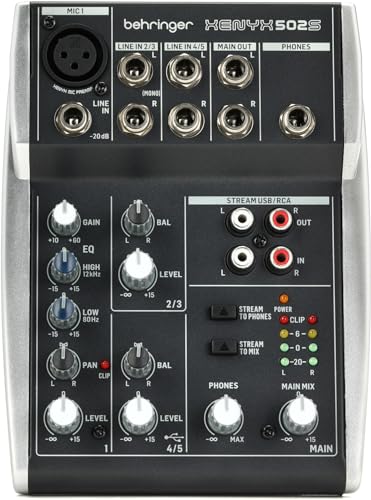
- Stereo USB interface for computer or mobile
- Five-input compact analog design
- Mixes PC and gaming audio into streams
Best For: Streaming, podcasting, and compact home recording
Live-Use Value

- Eight channels with XLR and 1/4-inch inputs
- Bluetooth, USB-A MP3, and DSP effects
- Rugged chassis with +48V phantom power
Best For: DJ setups, live gigs, stage performance, and karaoke
Established Studio Workhorse

- 12 inputs with four phantom-powered mic preamps
- Four one-knob compressors and British-style EQ
- Built-in USB interface with software and plug-ins
Best For: Home studios, podcasts, and multi-source recording
Compact High-Resolution Hub
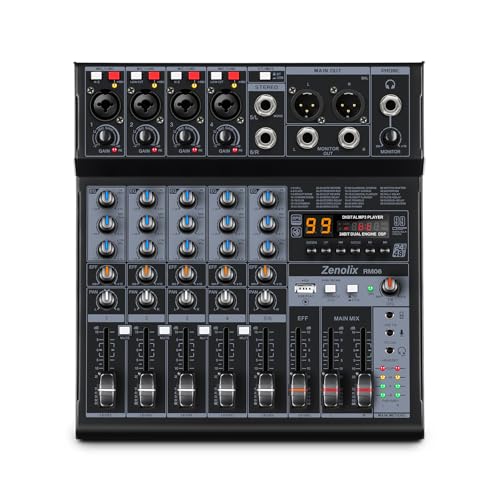
- Six-channel design with four combo inputs
- 24-bit/192 kHz USB-C interface with loopback
- Bluetooth, USB playback, and 99 reverb effects
Best For: Streaming, podcasts, rehearsals, and compact home studios
Versatile Budget Performer

- USB, flash-drive, MP3, and Bluetooth playback
- Four channels with +48V phantom power
- Steel chassis and compact 7.5-inch depth
Best For: Karaoke, small gigs, DJ sessions, and simple recording
Versatile Analog Hub – Behringer XENYX 1204USB
For buyers comparing audio mixers with usb interface capability, the Behringer XENYX 1204USB offers a larger analog layout with XENYX mic preamps, compressors, British-style three-band EQs, and USB connectivity. Its low-noise, high-headroom design suits users who want hands-on control for recording or small setups.
Best For: Musicians, small recording setups, and users who need more analog mixing control.
Pros:
- XENYX mic preamps and onboard compressors
- British-style three-band EQs for each applicable channel
- USB audio connectivity with XLR output
- Low-noise, high-headroom analog design
Cons:
- Larger and heavier than the compact mixers in this roundup
- Its feature set may be more than needed for simple streaming
The 1204USB is a practical choice when tactile analog mixing and channel-focused processing matter more than portability. Confirm your channel and routing needs before choosing it for a compact desk.
Streaming Control Center – Mackie ProFX6v3+
Among audio mixers with usb interface features, the Mackie ProFX6v3+ stands out for streaming and podcast workflows. It combines a compact analog mixer with a 2×4 USB-C interface, Bluetooth audio, loopback support, 24-bit/192 kHz recording, and built-in GigFX+ effects.
Best For: Streamers, podcasters, and small-gig performers who need flexible computer and mobile audio routing.
Pros:
- 2×4 USB-C interface with standard mix, loopback, and dry-channel modes
- 24-bit/192 kHz recording and streaming support
- Bluetooth send-and-receive audio for calls or backing tracks
- Onyx preamps, one-button compression, and editable GigFX+ presets
Cons:
- It is an analog mixer rather than a digital mixer with scene recall
- The display intentionally shows Delay at each power-up
The ProFX6v3+ is especially useful when a compact mixer must handle computer audio, Bluetooth sources, and live effects. Its routing options make it more adaptable than a basic stereo USB mixer.
Flexible Recording Mixer – Allen & Heath ZEDi-10
The Allen & Heath ZEDi-10 is a strong option for shoppers seeking audio mixers with usb interface functionality and a flexible analog channel layout. It provides four mic/line channels, two switchable hi-Z inputs, two stereo channels, three-band EQ, and a 4×4 USB audio interface.
Best For: Home recording, small ensembles, and players who need hi-Z instrument inputs.
Pros:
- 10-channel analog mixer in a compact format
- 4×4 USB audio interface operating up to 96 kHz
- Two switchable hi-Z inputs for compatible instruments
- Four mic/line channels plus two stereo channels
Cons:
- Uses USB Type-B connectivity rather than USB-C
- Its 7.5-pound weight may be less convenient for frequent transport
The ZEDi-10 balances traditional mixer control with multichannel USB recording. Choose it when input flexibility and hi-Z support are more important than the smallest possible footprint.
Simple Streaming Mixer – Behringer XENYX 802S
Behringer XENYX 802S Premium Analog 8-Input Mixer with USB Streaming Interface
Check Price On AmazonFor straightforward audio mixers with usb interface use, the Behringer XENYX 802S focuses on analog mixing, streaming, and computer or mobile connectivity. Its stereo USB interface can combine PC or gaming audio directly into the streaming output while maintaining a low-noise analog design.
Best For: Streamers, podcasters, and casual recording users who want simple stereo USB connectivity.
Pros:
- Eight-input analog mixer with hands-on equalization
- Stereo USB interface for a computer or mobile device
- Direct mixing of PC or gaming audio into the streaming output
- Includes XLR, TRS, and RCA output connections
Cons:
- The USB interface is stereo rather than a multichannel interface
- Its listed dimensions may be less convenient for very small desks
The XENYX 802S is a sensible pick for uncomplicated streaming setups that need computer or gaming audio mixed with analog sources. Consider a higher-channel or multichannel USB model if your recording workflow will expand.
Feature-Packed Pick – CT-80S 8-Channel USB Mixer
The CT-80S is a versatile choice among audio mixers with USB interface, combining eight channels with USB recording, Bluetooth playback, an MP3 player, and 48V phantom power. Its broad connection options make it suitable for home karaoke, small performances, conferences, and studio-oriented setups.
Best For: Users who want an affordable, feature-rich mixer for karaoke, live music, and general-purpose audio playback or recording.
Pros:
- Eight channels support microphones, instruments, and other audio sources.
- USB input and recording support, plus built-in Bluetooth and MP3 playback.
- Includes 48V phantom power and a large LED display.
- Thin 1.57-inch design for easier placement and transport.
Cons:
- Its many built-in features may be more than needed for simple mixing.
- The supplied specifications list a 110V American plug, limiting convenience for some international users.
The CT-80S stands out when connectivity and onboard playback matter as much as basic mixing. It is a practical all-in-one option, though buyers should confirm power compatibility before ordering.
Streaming Specialist – Behringer XENYX 502S USB Mixer
Behringer XENYX 502S Premium Analog 5-Input Mixer with USB Streaming Interface
Check Price On AmazonThe Behringer XENYX 502S is a compact option among audio mixers with USB interface, designed for streaming, podcasting, recording, and computer or mobile-device connection. Its five inputs and stereo USB interface keep the setup focused while allowing PC or gaming audio to be mixed into a streaming output.
Best For: Streamers, podcasters, and home recordists who prefer a small analog mixer with direct USB connectivity.
Pros:
- Stereo USB audio interface connects to a computer or mobile device.
- Designed for streaming, podcasting, and recording.
- XENYX microphone preamp provides the product’s specified warm, musical sound character.
- Supports direct mixing of PC or gaming sounds into the streaming output.
Cons:
- Five inputs provide less expansion than the eight-channel models in this roundup.
- Its feature set is more focused on streaming and recording than Bluetooth playback or onboard effects.
The 502S is the most purpose-built pick here for a streamlined computer-based workflow. Choose it when a compact footprint and USB streaming are more important than a larger channel count.
Live-Use Value – Pyle PMXU83BT 8-Channel Mixer
The Pyle PMXU83BT combines eight channels, USB functionality, Bluetooth streaming, DSP effects, and an audio interface in a compact DJ-oriented format. It is a flexible option among audio mixers with USB interface for live gigs, karaoke, stage use, and setups that need microphone and stereo line inputs.
Best For: DJs, performers, and karaoke users who want wireless playback, microphone inputs, and practical live-use controls.
Pros:
- Eight channels include XLR and unbalanced 1/4-inch microphone and stereo line inputs.
- Bluetooth enables wireless music streaming from a smartphone.
- Features USB-A MP3 playback, a 16-bit DSP processor, and +48V phantom power.
- Rugged steel chassis with sealed rotary controls helps resist dust and grime.
Cons:
- The supplied notes identify Bluetooth as the connectivity technology, so buyers should verify the exact USB interface workflow for their setup.
- At 4 pounds, it is heavier than the compact Behringer model.
The PMXU83BT offers a strong live-performance feature set, especially for buyers who want Bluetooth and DSP effects alongside conventional mixer inputs. Its multi-voltage power supply also makes it more adaptable for worldwide use.
Established Studio Workhorse – Behringer XENYX X1204USB
The Behringer XENYX X1204USB is a strong choice among audio mixers with USB interface for users who need 12 inputs, traditional hands-on controls, and built-in vocal processing. Its USB connection links the mixer directly to a computer for recording, editing, or podcasting.
Best For: Home studios, podcasts, vocalists, and small setups needing multiple inputs and onboard compression.
Pros:
- 12-input layout provides room for microphones and instruments.
- Four phantom-powered XENYX mic preamps support condenser microphones.
- Four one-knob compressors and British-style three-band EQs simplify sound shaping.
- Built-in USB/audio interface includes recording software, plug-ins, and a low-latency driver.
Cons:
- Its 12-channel design is larger than necessary for very small rigs.
- The unit uses corded power and is listed at 5.8 pounds.
Choose this model if you value a conventional mixer workflow and dedicated vocal-processing controls. It is particularly practical when several sources must be managed while recording to a computer.
Compact High-Resolution Hub – Zenolix RM06 6-Channel Mixer
The Zenolix RM06 is a compact option among audio mixers with USB interface, combining six-channel mixing with Bluetooth, USB playback and recording, and USB Type-C computer connectivity. Its loopback support also suits streaming and podcast workflows.
Best For: Home studios, podcasters, streamers, rehearsals, and small live events needing flexible connectivity.
Pros:
- Offers four XLR/6.35 mm combo inputs plus a stereo line input.
- Provides 24-bit/192 kHz USB audio interface operation with loopback.
- Includes Bluetooth playback, USB drive playback, and onboard recording.
- Per-channel EQ, pan, FX send, and 99 reverb effects provide broad control.
Cons:
- With six channels, it offers less input capacity than larger mixers.
- Warranty support is listed as contact-the-seller assistance.
The RM06 is a practical fit when portability and modern connections matter as much as mixing controls. Its headphone options and balanced outputs make it adaptable for personal monitoring, powered speakers, and computer-based production.
Versatile Budget Performer – Pyle PMXU43BT.5 Mixer
The Pyle PMXU43BT.5 is a four-channel choice among audio mixers with USB interface, adding Bluetooth streaming, USB and flash-drive compatibility, and a built-in MP3 player. It also includes phantom power and stereo line inputs for simple performance and recording setups.
Best For: Karaoke, live gigs, DJ sessions, casual recording, and users who want Bluetooth playback in a compact mixer.
Pros:
- Supports USB, computer, flash-drive, and Bluetooth audio sources.
- Provides XLR and unbalanced 1/4-inch inputs with +48V phantom power.
- Three-band EQ, LED peak indicators, and a 16-bit DSP processor support basic sound shaping.
- Steel chassis with sealed rotary controls is designed to resist dust and grime.
Cons:
- Four channels provide less expansion room than larger mixer designs.
- The supplied specifications list a 16-bit DSP processor rather than a higher-resolution interface.
- Warranty details are not specified.
This Pyle mixer makes sense for straightforward playback, karaoke, and small performance systems where Bluetooth and USB media support are priorities. Its compact chassis and multi-voltage power supply add flexibility for mobile or international use.
How We Picked the Best Audio Mixers with USB Interface
We compared these mixers by looking at practical features that affect everyday use: available input channels, microphone preamp capability, USB recording and playback, monitoring options, onboard effects, phantom power, physical controls, and overall suitability for home, mobile, or live applications. We also considered whether each model is better suited to beginners, content creators, musicians, DJs, or small venues.
Specifications and layouts vary considerably, so the right choice depends less on the highest feature count and more on how many sources you need to connect at once.
Quick Comparison
- Best for growing home studios: Choose a 10- or 12-input mixer with multiple microphone channels, USB connectivity, and flexible routing.
- Best for podcasts and streaming: Look for straightforward USB operation, dependable monitoring, and useful vocal or channel controls.
- Best for small live setups: Prioritize enough inputs, rugged controls, phantom power, and effects if you need reverb or other processing.
- Best for simple desktop use: A compact five- or six-input mixer can provide the necessary USB connection without taking up much space.
Key Buying Factors for Audio Mixers with USB Interface
Channel Count and Input Types
Count your microphones, instruments, stereo devices, and playback sources before buying. XLR inputs are important for microphones, while combo or line inputs provide flexibility for guitars, keyboards, phones, and other gear. Leave at least one or two spare channels for future expansion.
USB Recording and Streaming
Check whether USB supports the workflow you need. Some mixers provide a simple stereo feed to a computer, while others offer more advanced routing or multitrack functionality. Confirm compatibility with your computer and preferred recording or streaming software.
Phantom Power and Effects
48V phantom power is useful for condenser microphones, but it may be unnecessary for basic dynamic-microphone setups. Built-in reverb, delay, and other effects can be convenient for live sound, though dedicated software or external processors may offer more control.
Monitoring and Controls
Look for a headphone output, clear level meters, accessible gain controls, and independent main or monitor outputs. These details make it easier to prevent clipping and monitor voices or instruments accurately.
Who Should Buy Which Audio Mixers with USB Interface?
Beginners and casual streamers should favor compact, easy-to-operate mixers with USB, Bluetooth, and clearly labeled controls. Podcasters and voice creators may benefit from multiple microphone inputs, reliable headphone monitoring, and onboard tone-shaping controls. Musicians and home-recording users should prioritize quality preamps, enough simultaneous inputs, and USB routing that matches their recording workflow. DJs and entertainers may prefer Bluetooth, media playback, effects, and flexible stereo inputs. For bands, venues, or larger live applications, choose the highest channel count that fits your budget and leave room for additional microphones and instruments.