The best compact audio mixers make it easier to combine microphones, instruments, computers, and playback devices without taking over your desk or performance setup.
We compared 10 small-format models across input flexibility, sound quality, connectivity, effects, portability, and ease of use to help you choose the right mixer for recording, streaming, podcasting, or live audio.
Best 10 Compact Audio Mixers Picks for 2026
Best Compact Effects Mixer

- Six inputs with two microphone preamps
- Built-in digital effects and EQ
- Compact design with XLR output
Best For: Small live vocal and instrument setups
Best USB-C Mixer for Streaming

- 2x4 USB-C interface with 24-bit/192 kHz support
- Bluetooth audio and flexible USB modes
- Built-in effects, compression, EQ, and Hi-Z inputs
Best For: Streaming, podcasting, and small computer-based gigs
Best Basic Analog Mixer

- Six channels with D-PRE microphone preamps
- Three-band EQ, filters, and compressors
- Rugged chassis with XLR or TRS outputs
Best For: Simple analog mixing for lectures and small performances
Best Mini Line Mixer
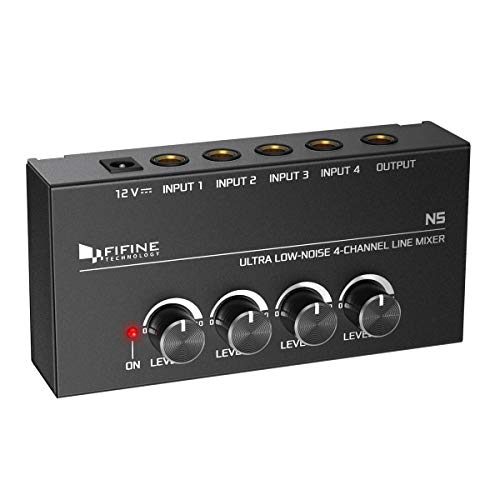
- Four-channel stereo or mono line mixing
- Independent volume controls in a tiny enclosure
- Low-noise design for keyboards and submixing
Best For: Compact line-level keyboard and small-stage setups
Simple Analog Control

- 5-channel compact analog mixer
- Low-noise, high-headroom performance
- Phantom power and RCA I/O
Best For: Small analog recording and playback setups
Premium Input Flexibility

- Six-input analog configuration
- Hi-Z instrument connections
- 3-band EQ and high-pass filters
Best For: Musicians and small live or recording setups
Digital Streaming Features

- USB recording and USB-A playback
- Bluetooth, echo, and delay effects
- Three XLR inputs with 48V phantom power
Best For: Podcasting, livestreaming, and compact creator setups
Best for Compact Podcast Setups

- Two Onyx mic preamps with phantom power
- Four line inputs in a 2.5-pound desktop mixer
- 1/4-inch and RCA main outputs
Best For: Podcasts, broadcast, and small studios
Best Feature-Packed Option

- 99 DSP effects with 3-band channel EQ
- 48V phantom power, PAD, and 80Hz filter
- USB, OTG, and Bluetooth 5.0 connectivity
Best For: Podcasting, streaming, and home recording
Best for Simple Line Sub-Mixing
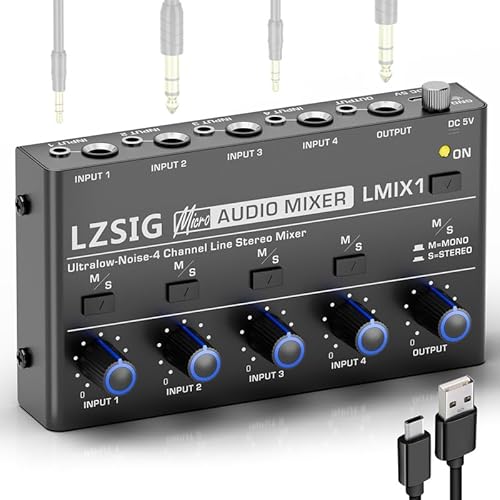
- Four inputs combine into one mono or stereo output
- Accepts 3.5mm and 6.35mm cables
- Compact, ultra-low-noise line-level design
Best For: Desktop audio routing and instrument sub-mixing
Best Compact Effects Mixer – Yamaha MG06X
The Yamaha MG06X is a practical choice among compact audio mixers when you need six inputs, two microphone preamps, stereo line channels, and built-in digital effects in a small, corded unit. Its XLR output and 48-volt specification make it suitable for straightforward live sound and vocal-focused setups.
Best For: Small performances, vocal setups, and users who want built-in effects without a larger mixer.
Pros:
- Six-input layout with two microphone preamps and four dedicated stereo line channels.
- Built-in digital effects add flexibility for live vocals and instruments.
- Compact 5.9-by-7.9-by-2.4-inch design with XLR output.
Cons:
- Does not list USB recording or computer-interface functionality.
- Only two microphone preamps are provided.
The MG06X stands out for buyers who want a compact analog mixer with effects and a focused six-channel layout. It is less suited to computer-centered workflows than models with a dedicated USB interface.
Best USB-C Mixer for Streaming – Mackie ProFX6v3+
The Mackie ProFX6v3+ combines a six-channel analog mixer with a 2×4 USB-C interface, making it one of the more versatile compact audio mixers for streaming, podcasting, and small gigs. It also adds Bluetooth audio, onboard effects, compression, and Hi-Z inputs.
Best For: Streamers, podcasters, and performers who need USB-C computer audio, Bluetooth, and flexible routing.
Pros:
- Supports 24-bit/192 kHz recording or streaming through three USB modes.
- Includes 24 GigFX+ effects with 12 editable presets and preset storage.
- Offers Bluetooth send and receive, Onyx preamps, compression, EQ, and Hi-Z inputs.
Cons:
- More feature-heavy than a basic line mixer.
- The built-in display intentionally shows Delay at every power-up.
- At 2.6 pounds, it is heavier than ultra-mini desktop mixers.
Choose the ProFX6v3+ when computer connectivity and routing matter as much as analog mixing. Its broader feature set makes it especially useful for hybrid audio setups, though simple users may not need every control.
Best Basic Analog Mixer – Yamaha MG06
The Yamaha MG06 is a straightforward six-channel option among compact audio mixers, with D-PRE preamps, three-band EQ, high-pass filters, one-knob compressors, and XLR outputs. It is designed for users who prefer a rugged analog control surface rather than USB connectivity.
Best For: Lectures, small performances, and analog recording or mixing setups that do not require USB.
Pros:
- Studio-grade discrete Class A D-PRE preamps support natural bass and smooth highs.
- Three-band EQ, high-pass filters, and one-knob compressors provide useful sound shaping.
- Rugged, impact-resistant powder-coated metal chassis with XLR or TRS output options.
Cons:
- No USB connectivity for direct computer recording.
- Provides six channels but no built-in digital effects are listed.
The MG06 is a sensible pick for hands-on analog mixing and dependable basic signal control. Select it over the MG06X when you do not need onboard effects, and over a USB model when computer integration is not a priority.
Best Mini Line Mixer – FIFINE N5
The FIFINE N5 is a very small four-channel line mixer for combining stereo or mono line-level sources. Among compact audio mixers, it favors simplicity, low-noise operation, and easy desktop placement for keyboards, guitars, bass, drum kits, or submixing.
Best For: Keyboard rigs, small-stage submixes, and combining four line-level sources into one output.
Pros:
- Four independent input volume controls support quick source balancing.
- Heavy-duty metal enclosure and compact 1.1-by-2.36-by-4.7-inch format fit tight spaces.
- Supports stereo operation or four-channel mono mixing, with low-noise performance.
Cons:
- Designed for line-level sources rather than a full microphone-preamp mixer.
- TRS/TS cables are not included.
- Requires choosing the correct stereo TRS or mono TS cabling for the intended setup.
The N5 is best viewed as a compact routing and submixing tool, not a full-featured live console. Its independent level controls and tiny footprint make it useful when space is limited and the sources are already at line level.
Simple Analog Control – Mackie Mix5
The Mackie Mix5 is a straightforward choice among compact audio mixers for small setups that prioritize clean, low-noise sound over extensive digital features. It provides one mic/line input, two stereo 1/4-inch line inputs, and dedicated RCA connections for playback or recording.
Best For: Solo performers, simple home recording systems, and users who need dependable analog mixing in a small footprint.
Pros:
- Compact 5-channel design measuring 7.7 by 5.5 by 1.7 inches.
- High-headroom, low-noise performance with studio-level audio quality.
- Phantom power supports studio condenser microphones.
- Dedicated stereo RCA inputs and outputs add convenient playback and recording connectivity.
Cons:
- Only one mic/line input is provided.
- Its 2-band EQ offers less tone-shaping control than a mixer with a 3-band EQ.
- No USB, Bluetooth, or built-in effects are listed.
The Mix5 is a focused, easy-to-use option when you want essential inputs and clean analog operation without extra complexity. Its limited microphone capacity makes it less suitable for larger ensembles or multi-mic podcast setups.
Premium Input Flexibility – Allen & Heath ZED-6
The Allen & Heath ZED-6 stands out among compact audio mixers for its sturdy construction, quality microphone preamps, and flexible six-input layout. It combines two mic inputs, two line/instrument inputs, and two stereo inputs with useful hands-on tone controls.
Best For: Musicians, small recording setups, and performers who need direct instrument connections and more detailed analog control.
Pros:
- Six-input configuration includes two mic, two line/instrument, and two stereo inputs.
- GS-Pre microphone preamps provide low noise, high headroom, and clean gain.
- Hi-Z connections support direct connection of electric, acoustic, or bass guitars without a separate DI box.
- Every mono input includes a 100Hz high-pass filter and 3-band MusiQ EQ.
Cons:
- At 2.8 pounds, it is heavier than the Mackie Mix5.
- No USB, Bluetooth, or onboard effects are listed.
- The feature set is primarily analog, so computer-based recording may require additional equipment.
The ZED-6 is a strong pick when input quality, instrument compatibility, and tactile control matter most. Its Hi-Z inputs and 3-band EQ give it more musical flexibility than many basic compact mixers, though it is not designed as an all-in-one USB streaming console.
Digital Streaming Features – BOMGE BM-05 5-Channel Mixer
The BOMGE BM-05 brings USB, Bluetooth, playback, and built-in effects to the compact audio mixers category. With three XLR inputs, stereo line connections, 48V phantom power, and a built-in sound card, it is aimed at flexible recording, streaming, podcasting, and small live applications.
Best For: Content creators, podcasters, livestreamers, and users who want music playback and computer recording features in one compact mixer.
Pros:
- Three XLR inputs with switchable 48V phantom power for condenser microphones.
- USB-B supports connection to a computer, phone, or tablet for mixing and recording with the appropriate adapter.
- Bluetooth enables wireless music streaming, while USB-A supports MP3 playback and recording.
- Includes headphone monitoring, 2-band EQ, gain controls, echo, and delay effects.
Cons:
- Bluetooth, USB, and channels 4/5 cannot be used simultaneously.
- Bluetooth operation is specified for a range of 1.5 feet.
- Phone connection requires a USB OTG adapter, and Bluetooth cannot connect an output device.
The BM-05 offers the broadest feature set of these compact mixers, especially for streaming and casual recording. Its connection limitations and reliance on adapters are worth considering, but the combination of effects, playback, monitoring, and USB recording is useful for small creator-focused setups.
Best for Compact Podcast Setups – Mackie 402VLZ4
The Mackie 402VLZ4 is one of the more straightforward compact audio mixers for podcasts, small studios, and broadcast setups. It combines two Onyx mic preamps with phantom power, four line inputs, and both 1/4-inch and RCA main outputs in a 2.5-pound desktop design.
Best For: Podcasters, broadcasters, and small studio users who want a compact, low-noise mixer with quality mic preamps and conventional analog connections.
Pros:
- Two Onyx mic preamps with phantom power and improved RF rejection
- Four line inputs supplement the two microphone inputs
- Lightweight 2.5-pound desktop design
- Offers both 1/4-inch and RCA main outputs
Cons:
- Uses an external power adapter rather than a built-in power cord socket
- Limited to four channels
The 402VLZ4 favors dependable analog mixing over extra digital features. It is a practical choice when clean microphone inputs and a simple desktop workflow matter more than Bluetooth, USB recording, or built-in effects.
Best Feature-Packed Option – 4-Channel Podcast Audio Mixer
This 4-channel console is a versatile pick among compact audio mixers for home recording, streaming, and podcasting. It adds 48V phantom power, a 3-band EQ, a -26dB PAD, an 80Hz high-pass filter, 99 DSP effects, USB connectivity, and Bluetooth 5.0.
Best For: Home creators and streamers who want microphone control, built-in effects, computer or mobile connectivity, and wireless playback in a small mixer.
Pros:
- 48V phantom power supports condenser microphones
- PAD and 80Hz high-pass filter help manage loud sources and rumble
- 99 DSP effects provide selectable reverb and delay options
- USB recording, OTG support, and Bluetooth 5.0 add flexible connectivity
Cons:
- Limited to four channels
- Bluetooth streaming range is specified at up to 15 feet
Its combination of effects, EQ, USB, and Bluetooth makes this mixer especially adaptable for content creation. Choose it when built-in processing and modern connections are more useful than a strictly traditional analog layout.
Best for Simple Line Sub-Mixing – LZSIG Mini Audio Mixer
The LZSIG Mini Audio Mixer is a tiny line-level solution for combining several playback or instrument sources. This compact audio mixer accepts 3.5mm and 6.35mm connections, supports mono or stereo operation, and routes four inputs to one output.
Best For: Musicians, gamers, and desktop users who need to combine keyboards, electronic drums, guitars, computers, CD players, or consoles without microphone preamps or recording features.
Pros:
- Combines up to four line-level sources into one stereo or mono output
- Supports both 3.5mm and 6.35mm TS/TRS cables
- Mono/stereo switching accommodates different routing setups
- Ultra-low-noise design uses an MPS power chip and low-noise op-amps
Cons:
- Power adapter is sold separately
- Designed for line mixing rather than microphone inputs or effects
- Does not offer USB, Bluetooth, or recording functions in the supplied specifications
This is best viewed as a compact routing tool rather than a full production console. Its small footprint and mixed-size input support make it useful for expanding a basic audio setup, provided you already have a compatible 5V power supply.
How We Picked the Best Compact Audio Mixers
We focused on mixers that balance useful connectivity with a genuinely compact footprint. The lineup includes simple analog models for straightforward level control, USB-equipped mixers for computer recording and streaming, and feature-rich options with Bluetooth, DSP effects, echo, or phantom power.
Our comparisons considered channel count, input and output types, microphone preamp quality, monitoring options, control layout, construction, and the intended use case. A compact mixer should not merely be small; it should provide the connections and controls you need without adding unnecessary complexity.
Quick Comparison
| Best For | What to Prioritize | Recommended Type |
|---|---|---|
| Simple home audio | Easy controls and low noise | Basic analog mixer |
| Podcasting and streaming | USB connectivity, microphone inputs, monitoring | USB mixer with effects |
| Live music | Reliable preamps, outputs, and rugged construction | Traditional analog mixer |
| Home recording | Phantom power, clean preamps, and computer integration | USB mixer with XLR inputs |
| DJ or casual playback | Bluetooth, echo, and flexible stereo inputs | Digital feature-focused mixer |
Key Buying Factors for Compact Audio Mixers
Inputs and Channel Layout
Count the sources you plan to connect at the same time, not just the devices you own. Microphones generally require XLR inputs, while keyboards, phones, media players, and other stereo sources may use line inputs. Leave at least one spare channel if your setup may grow.
USB, Bluetooth, and Recording Features
USB is valuable when you want to record to a computer, stream audio, or play computer audio through the mixer. Bluetooth can simplify wireless playback but is not a substitute for a proper wired recording connection. Check whether USB supports the routing and playback functions you need.
Phantom Power and Preamps
Condenser microphones require 48V phantom power, while dynamic microphones generally do not. If you use studio microphones, verify that phantom power is available and understand whether it applies to all microphone channels. Cleaner preamps also matter when recording quieter sources.
Effects, Monitoring, and Outputs
Built-in reverb, echo, and DSP effects can be useful for live vocals, karaoke, and streaming, but they are less important for a clean recording workflow. Look for a headphone output with a practical level control, main outputs that match your speakers, and a dedicated monitor or control-room path when needed.
Size and Operating Style
Ultra-compact models are convenient for travel and small desks, but their limited controls and connections may restrict more demanding setups. Before buying, confirm the mixer’s power requirements, connector types, and whether level meters or mute controls are included.
Who Should Buy Which Compact Audio Mixers?
Choose a Simple Analog Mixer If…
You need dependable volume and balance control for a few microphones, instruments, or playback sources. These models are often the easiest to learn and work well for small rehearsals, basic presentations, and home audio systems.
Choose a USB Mixer If…
You record podcasts, stream, produce demos, or regularly move audio between a mixer and computer. USB connectivity reduces the need for a separate interface, while onboard effects can help with live production.
Choose a Mixer with Bluetooth and DSP If…
You prioritize convenience, wireless playback, karaoke, casual DJ use, or live vocal effects. These features are useful when speed and flexibility matter more than a minimalist recording path.
Choose the Most Professional Compact Option If…
You need reliable preamps, predictable routing, durable construction, and room to connect multiple source types. A higher-quality compact mixer is often the better long-term choice for frequent live work or a growing home studio.