Choosing among today’s 3D printers means balancing print quality, setup time, speed, materials, and long-term upgrade potential. The right model depends on whether you want a simple first printer, detailed resin parts, rapid prototyping, or multicolor output.
We selected 10 standout options across beginner-friendly, high-speed, enclosed, resin, and multicolor categories to help you find a capable printer for your projects and budget.
Best 10 3d Printers Picks for 2026
Best Enclosed High-Speed 3D Printer

- Up to 500mm/s printing speed
- Enclosed design with auto bed leveling
- AMS required for multi-color printing
Best For: Fast, enclosed filament printing
Best Beginner-Friendly 3D Printer

- Up to 250mm/s printing speed
- Auto leveling and Z-offset calibration
- Direct-drive extrusion for PLA, PETG, and TPU
Best For: Beginners and everyday projects
Best Easy Multi-Color 3D Printer

- Full-auto calibration for easier setup
- AMS lite supports multi-color printing
- Quiet operation with quick-swap nozzle
Best For: Beginners and accessible multi-color printing
Best Rapid-Prototyping 3D Printer

- CoreXY system with up to 600mm/s travel speed
- Automatic leveling and quick nozzle changes
- Remote monitoring through Flash Studio
Best For: Fast prototyping and efficient workflows
Best Resin Detail

- 9K LCD with 18μm XY resolution
- Pre-leveled platform for easier setup
- USB, WiFi, and AI model generation
Best For: Detailed miniatures, figurines, and compact resin projects
Best Multi-Color Performance

- Prints up to 600 mm/s
- AMS 2 Pro enables multi-color printing
- Automatic calibration and AI failure detection
Best For: Fast, automated FDM printing with multi-color capability
Premium Multicolor Pick
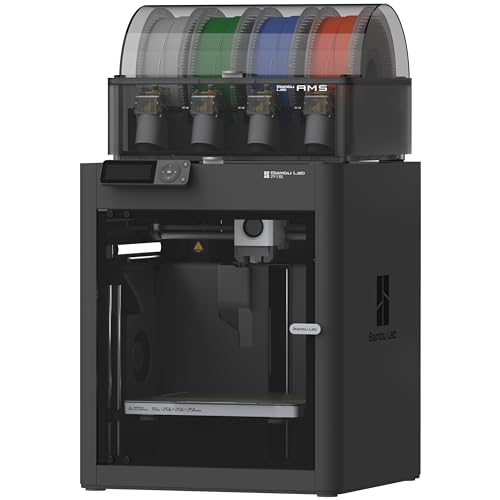
- Up to 16 colors with the required AMS connection
- 500mm/s printing and automatic bed leveling
- Enclosed design with 15-minute setup
Best For: Fast, enclosed multicolor printing with an included AMS
Flexible Speed Choice

- Up to four-color printing
- 600mm/s CoreXY speed with 1-click leveling
- Four supported nozzle sizes
Best For: Fast multicolor prototyping and adaptable everyday printing
Best Enclosed High-Speed 3D Printer – Bambu Lab P1S
The Bambu Lab P1S is a ready-to-use choice for shoppers comparing 3d printers that prioritize speed, automation, and an enclosed design. It reaches up to 500mm/s, sets up in about 15 minutes, and supports automatic bed leveling for a more streamlined workflow.
Best For: Fast, enclosed printing with compatible everyday and advanced filaments.
Pros:
- Enclosed body helps improve print performance with advanced filaments.
- Automatic bed leveling simplifies setup and supports reliable prints.
- Supports multi-color or multi-material printing with a Bambu Lab AMS.
- Works with PLA, PETG, TPU, PVA, PET ABS, and ASA, with capability for PA and PC.
Cons:
- The AMS is required for multi-color or multi-material printing.
- Carbon- and glass-fiber-reinforced polymers are not recommended.
The P1S is a strong fit when an enclosed frame, high speed, and hands-off bed leveling matter more than minimizing size or weight.
Best Beginner-Friendly 3D Printer – Creality Ender 3 V3 SE
The Creality Ender 3 V3 SE is a practical entry point for shoppers comparing 3d printers for prototypes, functional parts, and everyday projects. Its simple assembly, auto leveling, direct-drive extruder, and flexible build plate are designed to reduce common beginner frustrations.
Best For: Beginners who want straightforward setup and reliable everyday printing.
Pros:
- Prints at speeds up to 250mm/s with compatible materials and settings.
- CR Touch auto leveling and automatic Z-offset calibration simplify first-layer setup.
- Sprite direct-drive extrusion supports PLA, PETG, and TPU.
- Flexible PC spring steel plate helps with quick print removal.
Cons:
- Its material support is focused on PLA, PETG, and TPU.
- Setup still requires assembly, even though it uses only a few steps.
With its synchronized Z-axis system, quiet 32-bit board, and automated calibration, the Ender 3 V3 SE offers a balanced starting point for routine FDM projects.
Best Easy Multi-Color 3D Printer – Bambu Lab A1
The Bambu Lab A1 is a ready-to-use option for shoppers comparing 3d printers that emphasize automatic calibration, quiet operation, and accessible multi-color printing. Its 10,000mm/s² acceleration, active flow rate compensation, and simplified touchscreen support a low-maintenance printing experience.
Best For: Beginners, kids, and makers who want automated operation and optional multi-color output.
Pros:
- Full-auto calibration handles Z-offset and bed-leveling tasks.
- AMS lite enables multi-color printing when purchased with or added to the printer.
- Active flow rate compensation helps maintain consistent extrusion.
- Quiet operation, a quick-swap nozzle, and a simple touchscreen improve usability.
Cons:
- AMS lite is required for multi-color printing and is not included with the standalone printer.
- The product dimensions make it a relatively large desktop appliance.
The A1 is well suited to users who value convenience and automatic tuning, especially if color printing is a priority and the AMS lite is added.
Best Rapid-Prototyping 3D Printer – FLASHFORGE Adventurer 5M
The FLASHFORGE Adventurer 5M is a compelling choice for shoppers comparing 3d printers built around rapid production. Its CoreXY structure, 600mm/s travel speed, automatic leveling, quick nozzle changes, and remote app monitoring are designed to keep projects moving efficiently.
Best For: Rapid prototyping and users who want fast, remotely monitored printing.
Pros:
- CoreXY motion system supports up to 600mm/s travel speed and 20,000mm/s² acceleration.
- Automatic bed leveling helps produce consistent first layers without manual adjustments.
- Quick 3-second nozzle changes and a 35-second warm-up to 200°C support efficient operation.
- Flash Studio enables remote monitoring, setting adjustments, and status alerts.
Cons:
- The standard package includes a 0.4mm nozzle; other sizes are optional.
- Its build volume is limited to 220 x 220 x 220mm.
The Adventurer 5M stands out for production-oriented speed and convenience, while its compact build area is best matched with smaller prototypes and parts.
Best Resin Detail – Creality HALOT-X1 Neo
For makers comparing 3d printers for highly detailed miniatures and figurines, the Creality HALOT-X1 Neo is a compact resin option with an 18μm XY pixel size and 9K LCD. Its pre-leveled platform and beginner tutorials make it easier to get started.
Best For: Miniatures, figurines, tabletop models, and intricate desktop projects.
Pros:
- 9K resolution and 18μm XY detail support finely rendered models.
- Factory pre-leveled build platform simplifies initial setup.
- Supports USB, 2.4GHz WiFi, Creality Cloud, and multiple slicers.
- AI-powered 2D-to-3D generation can turn images into models.
Cons:
- The 153.36 × 77.76 × 160 mm build volume is relatively compact.
- Resin printing is best suited to detailed models rather than larger projects.
The HALOT-X1 Neo stands out when surface detail and beginner-friendly setup matter more than print size. Its connectivity and AI creation tools add flexibility for hobbyists exploring resin 3D printing.
Best Multi-Color Performance – Bambu Lab P2S Combo
Among 3d printers for fast, automated FDM printing, the Bambu Lab P2S Combo combines high-speed performance with the AMS 2 Pro multi-color and multi-material system. Automatic calibration, AI failure detection, and quick-swap nozzles streamline the workflow.
Best For: Users who want fast FDM printing, multi-color projects, and a more automated setup.
Pros:
- Print speeds of up to 600 mm/s with active flowrate compensation.
- AMS 2 Pro supports multi-color and multi-material printing with filament drying.
- Automatic calibration, AI failure detection, and quick-swap nozzles simplify operation.
- Adaptive airflow supports both detailed overhangs and engineering-grade materials.
Cons:
- The printer and combo have a substantial 46.3-pound listed weight.
- Multi-color printing requires the Combo version with AMS 2 Pro.
The P2S Combo is a strong fit for buyers who value speed, convenience, and color-changing capability. Its integrated software ecosystem and automated features make it approachable while retaining support for more demanding materials.
Best Everyday Value – ELEGOO Neptune 3 Pro
For shoppers seeking practical 3d printers for everyday projects, the ELEGOO Neptune 3 Pro offers a useful 225 × 225 × 280 mm build area, quick assembly, and 36-point auto bed leveling. Its direct-drive extruder supports several common filaments.
Best For: Daily household projects, hobby printing, and users working with PLA, TPU, PETG, or ABS.
Pros:
- 225 × 225 × 280 mm build volume suits a broad range of projects.
- 36-point auto bed leveling helps produce a reliable first layer.
- Dual-gear direct-drive extruder supports PLA, TPU, PETG, and ABS.
- Filament runout detection and power-loss resume add convenience.
Cons:
- Listed print noise is as low as 47dB, so it is not completely silent.
- Its feature set is focused on dependable everyday printing rather than multi-color output.
The Neptune 3 Pro is a sensible choice for users who want a straightforward FDM printer with helpful safeguards and broad filament compatibility. Auto leveling, stable dual Z-axis movement, and quick assembly keep the focus on consistent daily use.
Premium Multicolor Pick – Bambu Lab P1S Combo
The Bambu Lab P1S Combo is a strong option for shoppers comparing 3d printers that combine fast operation, automatic calibration, and enclosed printing. Its included AMS supports multicolor and multimaterial workflows, while the enclosed design is suited to a broad range of filaments.
Best For: Makers who want fast, enclosed multicolor printing with an included AMS system.
Pros:
- Supports up to 16 colors when connected to the Bambu Lab AMS.
- Print speeds reach 500mm/s with 20,000mm/s² acceleration.
- Automatic bed leveling and a stated 15-minute setup simplify operation.
- Enclosed body supports advanced filaments and improved print performance.
Cons:
- Connecting the AMS is required for multicolor or multimaterial printing.
- Carbon- and glass-fiber-reinforced polymer filaments are not recommended.
- At 47.5 pounds, it is relatively heavy to move.
The P1S Combo stands out when multicolor capability and a contained printing environment matter more than portability. It is a feature-rich choice for users who want to move quickly from setup to finished prints.
Flexible Speed Choice – FLASHFORGE AD5X
The FLASHFORGE AD5X is a practical contender among 3d printers for users who want multicolor output, rapid CoreXY movement, and convenient automation. It combines 1-click auto leveling with a direct-drive extruder and remote monitoring through the Flash Maker mobile app.
Best For: Creators and small production workflows that need fast four-color printing and adaptable nozzle options.
Pros:
- Supports up to four colors simultaneously.
- CoreXY motion reaches 600mm/s with 20,000mm/s² acceleration.
- 1-click auto leveling, automatic filament handling, and print-resume support improve convenience.
- Interchangeable 0.25mm, 0.4mm, 0.6mm, and 0.8mm nozzle options suit different jobs.
Cons:
- The larger 0.6mm and 0.8mm nozzles are optional upgrades.
- Its multicolor capacity is limited to four colors simultaneously.
- Remote control depends on the Flash Maker mobile app.
Choose the AD5X if you value speed and workflow flexibility, especially for prototypes or batches of parts. Its nozzle range also makes it easier to prioritize fine detail or shorter print times as needed.
Expandable Workhorse – Creality K2 SE
The Creality K2 SE is a compelling option among 3d printers for shoppers who want fast, stable printing with room to expand. Its rigid metal frame, automatic leveling, direct-drive extruder, and compatibility with the separately sold Creality CFS support both everyday models and functional parts.
Best For: Beginners and experienced users who want a sturdy high-speed printer with optional multicolor expansion.
Pros:
- CoreXY printing reaches 500mm/s with 20,000mm/s² acceleration.
- Die-cast aluminum construction and vibration compensation support stable, precise prints.
- Automatic leveling and a five-minute assembly make setup approachable.
- Direct-drive extruder includes a quick-swap nozzle and filament run-out sensor.
Cons:
- Multicolor printing requires the separately sold Creality CFS system.
- The supplied notes do not specify a complete print volume beyond the listed 220×215×245mm size.
- Advanced multicolor slicing and automatic filament functions depend on pairing with CFS.
The K2 SE makes sense for buyers who prefer a solid base printer today and the option to add multicolor capability later. Its automatic setup features and rigid construction give it broad appeal for both learning and functional-printing workflows.
How We Picked These 3d Printers
We compared the selected models by considering setup and leveling, print reliability, build volume, motion system, extruder design, material compatibility, safety features, software support, and expansion options. We also looked at whether each printer’s features match its intended audience. A compact beginner machine should be easy to operate, while a production-oriented model should justify its higher price with speed, automation, or broader material support.
Because the lineup includes both FDM and resin machines, print characteristics matter as much as specifications. FDM printers are generally better for functional parts and larger objects; resin printers are favored for fine detail, miniatures, and highly contoured models.
Quick Comparison
| Best For | Recommended Type | What to Prioritize |
|---|---|---|
| First-time users | Auto-leveled FDM | Simple setup, guided software, reliable calibration |
| Fast prototyping | High-speed CoreXY or Cartesian FDM | Acceleration, cooling, input shaping, dependable extrusion |
| Multicolor models | FDM with an automated material system | Material switching, purge management, software workflow |
| Miniatures and fine detail | Resin | XY resolution, wash-and-cure workflow, ventilation |
| Functional parts | Enclosed or high-temperature FDM | Build volume, direct drive, heated bed, material range |
Key Buying Factors for 3d Printers
Print Technology and Materials
FDM printers melt filament such as PLA, PETG, and sometimes ABS or other engineering materials. They are versatile and economical for everyday projects. Resin printers use liquid photopolymer and can produce sharper small details, but they require gloves, cleaning, curing, and suitable ventilation.
Ease of Setup and Reliability
Automatic bed leveling, preassembled frames, filament runout detection, and remote monitoring can reduce troubleshooting. These features are especially valuable for beginners or anyone who wants to print rather than constantly tune the machine.
Speed Versus Quality
Headline speed ratings do not guarantee faster finished parts. Look for a rigid frame, effective cooling, stable motion control, and a capable hot end. At high speeds, acceleration and software calibration often matter more than the maximum number on the specification sheet.
Build Volume and Temperature
Measure the models you expect to print before buying. A heated bed helps with adhesion, while an enclosure and higher-temperature hot end can make demanding materials easier to use. Also consider noise, footprint, and access to replacement parts.
Who Should Buy Which 3d Printers?
Beginners and families: Choose an auto-leveled FDM printer with a straightforward slicer and minimal assembly. These models offer the gentlest learning curve for toys, organizers, classroom projects, and basic prototypes.
Speed-focused makers: A modern high-speed printer is worthwhile if you print frequently or iterate on designs. Prioritize reliable automation and motion stability over maximum advertised speed alone.
Multicolor enthusiasts: Select a printer bundled with or compatible with an automated material system. Expect longer print times and additional waste during color changes, but enjoy a much simpler multicolor workflow.
Miniature artists and detail-focused users: A high-resolution resin printer is the better fit for tiny facial features, jewelry, and display models. Plan for washing, curing, consumables, and safe handling.
Engineers and advanced hobbyists: Look for a larger build area, direct-drive extrusion, a heated bed, enclosure options, and support for a wider range of filaments. Those features provide more room to grow as your projects become larger or more demanding.