A portable screen can make an outdoor movie night, backyard presentation, or camping setup far easier than projecting onto a wall or sheet. The best projector screens with stands combine a stable frame, smooth viewing surface, compact storage, and setup that does not require specialized tools.
We selected 10 models in popular 80-, 100-, 120-, and 150-inch sizes, including front- and rear-projection designs, wrinkle-resistant surfaces, carry bags, and options suited to indoor and outdoor use. Use the guide below to match screen size, stability, portability, and projection needs to your setup.
Best 10 Projector Screens with Stands Picks for 2026
Best for Flexible Outdoor Viewing
100-Inch 16:10 Portable Screen

- 4K HD 16:10 projection with a 160° viewing angle
- Tool-free setup in about five minutes
- Carry bag plus ropes, nails, and water bags included
Best For: Backyard movies, travel, presentations, and events
Best for Adjustable Tripod Setup
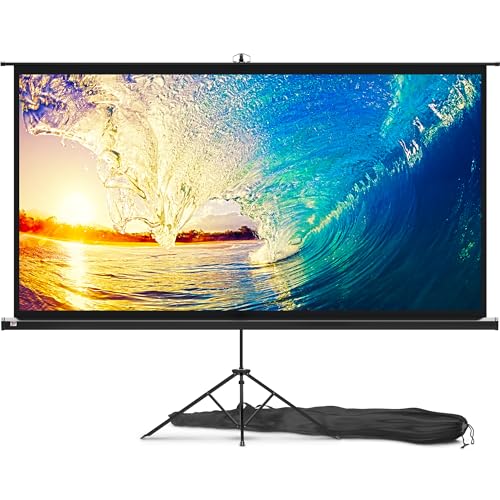
- 16:9 HD format with 1.1 gain reflection
- Stable, wide-leg tripod support
- Three-step assembly with adjustable height
Best For: Home theaters, presentations, classrooms, and offices
Best Lightweight Travel Pick

- Lightweight 5-pound aluminum-frame design
- Padded carry bag for car travel and storage
- Quick setup with a 160° viewing angle
Best For: Camping, travel, backyard cinema, and smaller viewing groups
Best for One-Piece Stability
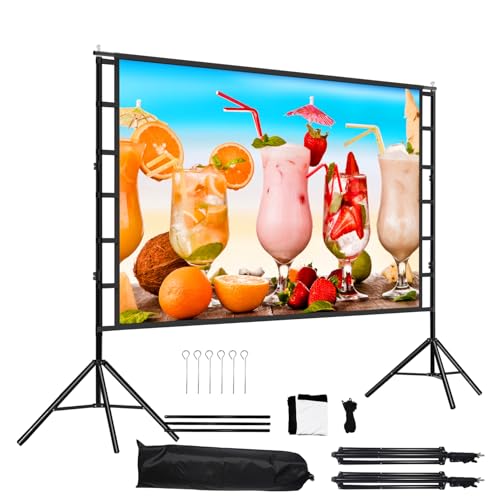
- One-piece telescopic stand with ropes and stakes
- 4K HD surface for long-throw projectors
- Lightweight 5.5-pound portable design
Best For: Backyard movies, camping, and lightweight outdoor setups
Lightweight Pick
ExcelImage 80-Inch Portable Screen
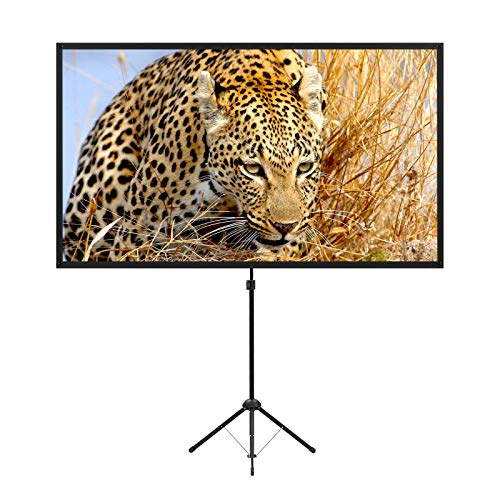
- 8.5-pound portable design
- Four-tube tension system
- 160-degree viewing angle
Best For: Quickly assembled home, classroom, and backyard movie setups
Camping Choice

- 5.62-pound aluminum design
- Tool-free assembly
- Includes rope, hook, and water bag
Best For: Portable camping, picnic, and backyard movie nights
Image-Focused Option
VISULAPEX 80-Inch Fiberglass Screen

- 1.2-gain fiberglass surface
- Adjustable 59–89-inch tripod
- 8.5-pound portable design
Best For: Portable 4K-oriented indoor and outdoor movie viewing
Best Stake-Down Design

- 120-inch 16:9 matte screen for front or rear projection
- Widened base plate accepts ground stakes
- Includes four stakes and two windproof ropes
Best For: Larger backyard screenings with stakeable ground
Best for Flexible Outdoor Viewing – 100-Inch 16:10 Portable Screen
This 100-inch projector screen with stand is a versatile choice for backyard movies, presentations, and other indoor or outdoor viewing. Its 16:10 format, 160-degree viewing angle, double-sided projection support, and included stabilizing accessories make it practical for group entertainment and events.
Best For: Families and event hosts who need a large, portable screen for backyard theaters, travel, presentations, or public displays.
Pros:
- Supports 4K HD projection with a 16:10 aspect ratio and 160-degree viewing angle.
- Sets up without tools in about five minutes and includes ropes, nails, and water bags for added stability.
- Folds into the included carry bag and fits in car trunks, including sedans.
- Natural polyester fabric supports double-sided projection and resists wrinkles and curling.
Cons:
- The listed screen dimensions are 85 by 53 inches, so the full 100-inch diagonal does not describe the visible width and height directly.
- Outdoor setup may require extra securing hardware in windy conditions.
Choose this model if flexibility matters more than the simplest possible frame. The included carry bag and ground-securing accessories make it well suited to mobile outdoor use, while its presentation-friendly format expands its usefulness beyond movie nights.
Best for Adjustable Tripod Setup – 100-Inch 16:9 Screen
This 100-inch projector screen with stand uses a stable tripod base and adjustable height to suit movies, presentations, and classroom or office use. Its 16:9 matte screen, tight straps, and fitted carry bag make it a straightforward portable option for indoor and outdoor viewing.
Best For: Buyers who want a conventional 16:9 screen with adjustable height for home theaters, schools, offices, churches, and backyard entertainment.
Pros:
- Provides a 16:9 HD viewing format with a 1.1 gain reflection and 160-degree viewing angle.
- Wide tripod legs provide a stable support base.
- Retractable, adjustable design assembles in three steps.
- Tight straps and a fitted projector screen bag simplify transport.
Cons:
- At 17.6 pounds, it is heavier than several lightweight portable screen designs.
- The supplied operation details indicate that an English instruction manual is not included.
This is a sensible pick for users who value height adjustment and a familiar tripod configuration. Its broad venue compatibility makes it especially useful when one screen needs to move between presentations, classrooms, and movie sessions.
Best Lightweight Travel Pick – 80-Inch Foldable Screen
For shoppers comparing projector screens with stands for travel, this 80-inch model emphasizes low weight and compact storage. The aluminum frame, padded carry bag, anti-crease screen, and 160-degree viewing angle make it convenient for backyard cinema, camping, classrooms, and presentations.
Best For: Travelers and smaller groups who want a lightweight, foldable screen that can move easily between indoor and outdoor locations.
Pros:
- Weighs 5 pounds and fits in the included soft padded carrying bag.
- Sets up in a few minutes by connecting the frame tubes.
- Offers a 160-degree viewing angle and supports sharp, high-resolution images.
- Natural polyester fabric receives moisture-proof treatment and is designed to resist wrinkles and curling.
Cons:
- Its 80-inch size provides less viewing area than the 100-inch alternatives.
- Windy outdoor use requires securing the scaffold to the ground.
This model is the most travel-oriented option in the group. Its lighter weight and compact bag favor portability, while the anti-crease finish and broad viewing angle help it remain practical for both movie nights and presentation duty.
Best for One-Piece Stability – 100-Inch Telescopic Screen
This 100-inch outdoor projector screen with stand uses a one-piece telescopic support frame instead of a conventional tripod. The wrinkle-resistant polyester surface, included ropes and stakes, and sub-7-pound weight make it a practical choice for backyard movies, camping, and indoor home theater setups using long-throw projectors.
Best For: Outdoor movie fans who prioritize a compact, lightweight frame with additional ground support for light wind.
Pros:
- One-piece telescopic stand is designed to remain stable in light coastal breezes when properly secured.
- Supports 4K HD projection and long-throw projectors on a wrinkle-free polyester surface.
- Weighs 5.5 pounds and includes a compact carry bag.
- Suitable for backyard, beach, camping, and indoor home theater use.
Cons:
- Ropes and ground stakes are needed for additional wind resistance outdoors.
- The supplied screen dimensions are listed as 49 by 86 inches despite the 100-inch screen-size designation.
If outdoor stability and low carry weight are your priorities, this telescopic-frame design is worth considering. It is especially suited to long-throw projector setups and users who want a larger screen without carrying a heavy stand.
Lightweight Pick – ExcelImage 80-Inch Portable Screen
If you want projector screens with stands that are easy to transport and set up, this 80-inch ExcelImage model is a practical option. Its 16:9 matte screen uses a four-tube tension system, while the adjustable tripod folds into the included carrying bag.
Best For: Home movie nights, backyard viewing, classrooms, and buyers who prioritize low carry weight and quick setup.
Pros:
- Lightweight 8.5-pound design for easier transport.
- Four spring-tensioned aluminum tubes help maintain a flat surface.
- 160-degree viewing angle supports group viewing.
- Manufacturer-backed two-year warranty.
Cons:
- Manual setup and adjustment are required.
- The 80-inch size may be limiting for larger audiences.
Choose this model when portability is a priority. Its compact format, adjustable tripod, and stated setup time of about two minutes make it well suited to flexible indoor or outdoor use.
Camping Choice – AODIOU 80-Inch Outdoor Screen
For projector screens with stands intended for outdoor use, the AODIOU 80-inch model emphasizes easy transport and flexible placement. The aluminum frame folds into a padded bag, and the included rope, hook, and water bag are designed to help keep the screen stable in a breeze.
Best For: Camping, picnics, backyard movie nights, and small groups needing a compact outdoor setup.
Pros:
- Lightweight 5.62-pound construction is easy to carry.
- Tool-free assembly and disassembly simplify setup.
- Washable polyester screen is described as wrinkle-free.
- Included anchoring accessories support outdoor placement.
Cons:
- The supplied screen dimensions are listed as 70 by 40 inches despite the 80-inch product designation.
- Its glossy finish may not suit buyers specifically seeking a matte surface.
This is a particularly portable choice for casual outdoor viewing. Check the listed screen dimensions against your available space before ordering, especially if the diagonal size is important to your setup.
Image-Focused Option – VISULAPEX 80-Inch Fiberglass Screen
This VISULAPEX model is one of the projector screens with stands aimed at buyers who want a portable 4K-ready viewing surface. Its 1.2-gain fiberglass screen has a black-coated back, and the adjustable tripod supports a 70-by-39-inch viewing area in a 16:9 format.
Best For: Indoor or outdoor movie nights where a tensioned fiberglass surface, wide viewing angle, and adjustable stand are useful.
Pros:
- 1.2-gain fiberglass surface is designed to reproduce vibrant colors.
- Four spring-tensioned aluminum tubes help limit edge curling.
- Tripod height adjusts from 59 to 89 inches floor-to-bottom.
- Includes a carrying bag and a stated two-year warranty.
Cons:
- At 8.5 pounds, it is heavier than the AODIOU option listed here.
- Indoor placement requires more than 70 inches of width and 89 inches of height.
- Manual assembly is still required.
Consider this screen if image presentation and structural stability matter more than the lowest possible carry weight. Verify the required width and height first, since the adjustable stand can require substantial indoor clearance.
Best Portable 100-Inch Pick – Lightweight TOWOND Tripod Screen
If you want projector screens with stands for flexible indoor and outdoor use, this 100-inch TOWOND model emphasizes portability and straightforward setup. Its detachable tripod, foldable screen, carry bag, and included outdoor securing accessories make it practical for backyard movies, camping, presentations, and home viewing.
Best For: Buyers seeking a lightweight 100-inch screen for frequently changing locations.
Pros:
- Lightweight 7.5-pound design with a carry bag.
- Supports front and rear projection with a 160-degree viewing angle.
- Includes sandbag, ground nails, and windproof ropes for outdoor stability.
- Washable, foldable polyester milk-silk screen is designed to resist wrinkles.
Cons:
- The tripod needs careful leg positioning and secured locking points.
- Outdoor use requires the included stabilizing accessories, especially in wind.
This is a well-rounded choice when portability matters more than maximum screen size. The 100-inch format is substantial for movie nights while remaining relatively easy to carry and set up.
Best Stake-Down Design – STWUI 120-Inch Outdoor Screen
Among projector screens with stands, this STWUI 120-inch model stands out for its stake-down base and wind-resistance setup. The widened metal base, ground stakes, ropes, and modular frame are aimed at making outdoor viewing more secure without relying solely on heavy sandbags.
Best For: Backyard viewers who prioritize a larger screen and a stake-supported outdoor setup.
Pros:
- Large 120-inch, 16:9 screen with a 160-degree viewing angle.
- Widened base plate includes holes for inserting ground stakes.
- All-iron bracket is described as rust-resistant and resistant to bending.
- Tool-free assembly is designed to take about eight minutes.
Cons:
- The stake-down system is most useful where the ground can accept stakes.
- At 120 inches, it requires more setup and space than a smaller portable screen.
This is a strong fit for regular backyard screenings where stability is a priority. Its compact carrying bag and detachable frame still make it practical to transport in a car.
Best for Large-Scale Viewing – TOWOND 150-Inch Projection Screen
This 150-inch TOWOND model is one of the largest projector screens with stands in this roundup, making it suited to expansive backyard cinema and event-style viewing. Its foldable stand, elastic-cord assembly, carry bag, and front/rear projection support add flexibility, but the substantial size calls for adequate room.
Best For: Large gatherings, backyard cinema, sports viewing, and presentations with plenty of setup space.
Pros:
- Very large 150-inch display with a 160-degree viewing angle.
- Supports front and rear projection and is designed for 4K HD content.
- Tool-free foldable stand can be assembled in about five minutes.
- Includes ground nails, ropes, brackets, and storage bags.
Cons:
- At 11.5 pounds, it is heavier than the smaller options here.
- Indoor use requires a room wider than 140 inches, according to the supplied guidance.
- The listed screen dimensions require substantial floor and setup space.
Choose this model when screen scale is the main priority. It can create a more immersive viewing area for groups, but measure the intended room or yard before buying.
How We Picked the Best Projector Screens with Stands
We compared the selected screens by size, aspect ratio, stand design, setup requirements, portability, projection-surface features, and intended use. Priority went to models that clearly support common movie and presentation formats, pack into a carry bag, and offer practical stability for indoor or outdoor placement.
Because specifications and included accessories can vary, confirm the current listing for dimensions, frame hardware, tie-downs, stakes, carry cases, and whether front or rear projection is supported before buying.
Quick Comparison
| Screen size | Best suited to | Main advantage |
|---|---|---|
| 80 inches | Small yards, camping, and easy transport | Lower weight and faster setup |
| 100 inches | Most backyard movie nights | Good balance of image size and portability |
| 120 inches | Larger groups and open spaces | More immersive viewing |
| 150 inches | Large audiences and spacious venues | Maximum image area, with greater setup demands |
Key Buying Factors for Projector Screens with Stands
Size and Viewing Distance
A larger screen is not automatically better. Match the screen to your projector’s throw distance and brightness, as well as the available space. An 80- or 100-inch model is generally easier to illuminate and position, while 120- or 150-inch screens need more room and may reveal weaknesses in a lower-powered projector.
Aspect Ratio and Projection Surface
Most listed models use 16:9, the standard format for modern movies and streaming video. A 16:10 screen can be useful for laptops and presentations but may leave unused space with widescreen content. Look for a smooth, opaque, wrinkle-resistant surface and check whether the screen supports front projection, rear projection, or both.
Stand Stability and Weather Conditions
Outdoor screens need more than a tall frame. Stakes, guy lines, weighted feet, or a stake-down base can help prevent movement from wind. Never leave a lightweight screen unattended in changing weather, and take it down before strong wind or rain. For indoor use, prioritize a stable footprint that will not wobble on hard floors.
Setup, Storage, and Transport
Telescopic or one-piece frames can reduce assembly time, while multi-part frames may pack smaller but require more steps. Check the packed dimensions and included carry bag if you plan to transport the screen by car, carry it to a campsite, or store it in a closet.
Who Should Buy Which Projector Screens with Stands?
- For camping and frequent travel: Choose an 80-inch lightweight model with a compact bag and simple setup.
- For most backyard movie nights: A 100-inch 16:9 screen offers a practical mix of viewing impact, brightness requirements, and portability.
- For presentations: Consider a 16:10 screen if your laptop or presentation content uses that format; otherwise, 16:9 remains the more versatile choice.
- For windy outdoor locations: Choose a design with stakes, tie-downs, or a broader base, and use additional weights when appropriate.
- For large groups: A 120- or 150-inch screen can improve visibility, provided your projector has sufficient brightness and the location allows a secure setup.