Choosing among the best graphics cards with 16GB VRAM means balancing performance, features, cooling, power requirements, and price—not simply picking the fastest model.
This roundup compares 10 current Radeon and GeForce options across mainstream, high-end, and enthusiast builds, helping you match the card to your resolution, games, and workload.
Best 10 Graphics Cards with 16gb Vram Picks for 2026
High-Performance AMD Pick
Radeon RX 9070 XT Gaming OC 16G

- 16GB GDDR6 with PCIe 5.0
- 3060 MHz listed GPU clock
- WINDFORCE cooling and RGB lighting
Best For: High-performance AMD gaming and creative systems
Quiet Compact Choice

- 16GB GDDR7 and DLSS 4
- 2632 MHz OC-mode clock
- 2.5-slot dual-fan design with 0dB mode
Best For: Compact gaming PCs with quiet-operation priorities
Space-Conscious AMD Value
ASRock RX 9060 XT Challenger 16GB OC

- 16GB GDDR6 on a 128-bit bus
- Up to 3290 MHz boost clock
- Two-slot, 249 mm dual-fan design
Best For: Compact 1440p gaming PCs
Enthusiast NVIDIA Powerhouse

- 16GB GDDR7 with Blackwell architecture
- 2730 MHz OC-mode boost clock
- Three-fan, 3.6-slot cooling design
Best For: High-end gaming and demanding desktop workloads
Balanced 4K Performer
ASRock Radeon RX 9070 Challenger 16GB

- 16GB GDDR6 on a 256-bit bus
- Up to 2520MHz boost clock
- Triple fans with 0dB silent mode
Best For: 1440p and 4K gaming builds
High-Clocked Midrange Option
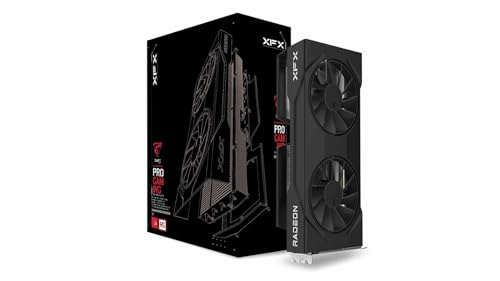
- 16GB GDDR6 memory
- Boost clock up to 3320MHz
- Dual-fan SWFT cooling
Best For: Desktop gaming PCs needing 16GB VRAM
Premium Quiet-Cooling Pick
ASUS Prime Radeon RX 9070 XT 16GB

- 16GB GDDR6 with up to 3030MHz boost
- 0dB mode and dual BIOS profiles
- Triple-fan axial-tech cooling
Best For: Enthusiast gaming and tuned desktop builds
Quiet 4K Upgrade
ASRock RX 9060 XT Steel Legend 16GB

- 16GB GDDR6 and 3275 MHz boost clock
- Triple-fan 0dB cooling for quieter light-load use
- HDMI 2.1b, DisplayPort 2.1a, and metal backplate
Best For: Quiet gaming and content-creation builds
Value Triple-Fan Pick

- 16GB GDDR6 memory for desktop gaming
- Boost clock up to 3320 MHz
- Triple-fan Swift cooling solution
Best For: Desktop gamers wanting a high-clock RX 9060 XT
High-End 4K Choice
ASRock RX 9070 XT Steel Legend 16GB

- 16GB GDDR6 on a 256-bit, 20 Gbps memory bus
- 64 compute units with ray tracing and AI acceleration
- Large 2.9-slot card requiring two 8-pin connectors
Best For: Enthusiast 4K desktops with an 800W PSU
High-Performance AMD Pick – Radeon RX 9070 XT Gaming OC 16G
The GIGABYTE Radeon RX 9070 XT Gaming OC 16G is a strong option for shoppers comparing graphics cards with 16gb vram and prioritizing a high boost clock, robust cooling, and a premium-size desktop build. Its 16GB of GDDR6 memory and 7680 x 4320 maximum resolution support modern gaming and creative workloads.
Best For: Gamers and creators seeking a high-performance AMD card with substantial cooling hardware.
Pros:
- Radeon RX 9070 XT GPU with a listed 3060 MHz clock speed
- WINDFORCE cooling system with Hawk Fan and server-grade thermal conductive gel
- 16GB GDDR6 memory and PCIe 5.0 interface
- RGB lighting and a three-year manufacturer warranty
Cons:
- Large 11.34-inch length may require careful case-clearance checks
- At 1.78 kg, it is relatively heavy for a graphics card
This card emphasizes cooling and sustained performance, but its larger dimensions and weight make case compatibility worth confirming before purchase.
Quiet Compact Choice – ASUS Dual RTX 5060 Ti 16GB OC
The ASUS Dual GeForce RTX 5060 Ti 16GB OC is a practical choice among graphics cards with 16gb vram for compact desktop builds. It combines 16GB of newer GDDR7 memory with NVIDIA Blackwell architecture, DLSS 4, a 2.5-slot design, and quiet-focused features.
Best For: Small-chassis gamers who want modern NVIDIA features and flexible noise settings.
Pros:
- 16GB GDDR7 memory with NVIDIA Blackwell architecture and DLSS 4
- 2632 MHz OC-mode clock speed
- 2.5-slot design with dual Axial-tech fans
- 0dB technology and Dual BIOS provide quiet and performance profiles
Cons:
- Its 2.5-slot thickness still requires available expansion-space clearance
- Uses DisplayPort 2.1b and HDMI 2.1b outputs, so older display setups may need compatibility checks
With a relatively compact 9-inch length and a 0.66 kg listed weight, this ASUS card is easier to fit than many larger models while retaining enthusiast-oriented controls.
Space-Conscious AMD Value – ASRock RX 9060 XT Challenger 16GB OC
The ASRock Radeon RX 9060 XT Challenger 16GB OC gives shoppers considering graphics cards with 16gb vram a compact RDNA 4 option aimed at 1440p gaming and AI-enhanced performance. It pairs 16GB of GDDR6 memory with a dual-fan cooler and a listed boost clock of up to 3290 MHz.
Best For: 1440p-focused builders needing a shorter, two-slot AMD graphics card.
Pros:
- 16GB GDDR6 memory running at 20 Gbps on a 128-bit bus
- Up to 3290 MHz boost clock and 2700 MHz game clock
- Two-slot, 249 mm design for easier case compatibility
- 0dB silent operation, DisplayPort 2.1a, and HDMI 2.1b
Cons:
- Requires a single 8-pin connector and a recommended 550W power supply
- 128-bit memory bus is narrower than some higher-tier alternatives
- Two-year manufacturer warranty is shorter than some competing models listed here
The compact dimensions and moderate power guidance make this a practical fit for many mainstream systems, provided the power supply and chassis clearances are verified.
Enthusiast NVIDIA Powerhouse – ASUS TUF RTX 5080 16GB OC
The ASUS TUF Gaming GeForce RTX 5080 16GB OC is the high-end option in this selection of graphics cards with 16gb vram. Its NVIDIA Blackwell architecture, DLSS 4 support, GDDR7 memory, and three-fan cooling system are designed for demanding desktop gaming and professional workloads.
Best For: Enthusiast builders with large cases, high-wattage power supplies, and demanding performance goals.
Pros:
- GeForce RTX 5080 with 16GB GDDR7 memory
- 2730 MHz OC-mode boost clock and DLSS 4 support
- Three Axial-tech fans and a 3.6-slot fin-array cooler
- Protective PCB coating, military-grade components, and three-year warranty
Cons:
- Large 348 mm length and 3.6-slot thickness require substantial case space
- Requires a minimum 850W PSU with a 16-pin 12V-2×6 connector
- At about 4.3 pounds, it may need the included GPU bracket for support
This card offers the most demanding installation requirements in the group, but it is well suited to a carefully planned enthusiast system with adequate clearance, power, and airflow.
Balanced 4K Performer – ASRock Radeon RX 9070 Challenger 16GB
The ASRock Radeon RX 9070 Challenger is a practical choice among graphics cards with 16gb vram, pairing AMD’s RDNA 4 architecture with 16GB of GDDR6 memory on a 256-bit bus. Its factory overclock and triple-fan cooler make it suited to demanding 1440p and 4K gaming, provided your case and power supply can accommodate it.
Best For: Gamers wanting a 16GB card for high-resolution gaming, ray tracing, and demanding textures.
Pros:
- 16GB GDDR6 with a 256-bit memory bus and 20Gbps memory speed.
- Factory boost clock up to 2520MHz with RDNA 4, third-generation ray tracing, and second-generation AI accelerators.
- Triple-fan cooling with 0dB silent operation and DisplayPort and HDMI outputs.
Cons:
- The 2.5-slot, 290 x 123 x 51mm design requires careful chassis clearance checks.
- Uses two 8-pin power connectors and has a recommended 700W PSU.
With its substantial memory capacity and high bandwidth, this Challenger model is a well-rounded option for modern 1440p and 4K builds. Confirm your case dimensions and power connections before ordering.
High-Clocked Midrange Option – XFX Swift RX 9060 XT 16GB
The XFX Swift AMD Radeon RX 9060 XT is a straightforward pick among graphics cards with 16gb vram. It combines 16GB of GDDR6 memory with a dual-fan cooling solution and a boost clock of up to 3320MHz for desktop gaming systems.
Best For: Desktop PC users seeking 16GB of graphics memory and a high advertised boost clock.
Pros:
- 16GB GDDR6 memory for games and graphics workloads that benefit from added VRAM.
- Boost clock up to 3320MHz.
- Dual-fan XFX SWFT cooling solution.
Cons:
- The supplied specifications do not list physical dimensions or power-supply requirements.
- Cooling uses two fans rather than a triple-fan design.
This model keeps the feature set focused on memory capacity, clock speed, and dual-fan cooling. Before purchase, verify case clearance, power requirements, and the available HDMI and DisplayPort connections for your system.
Premium Quiet-Cooling Pick – ASUS Prime Radeon RX 9070 XT 16GB
The ASUS Prime Radeon RX 9070 XT is a performance-focused option among graphics cards with 16gb vram, offering 16GB of GDDR6 memory, PCIe 5.0 connectivity, and a factory overclock. Its 2.5-slot cooler adds features such as 0dB operation, dual BIOS profiles, and dual-ball fan bearings.
Best For: Gamers and enthusiasts who want a 16GB RX 9070 XT with configurable cooling and display options.
Pros:
- OC mode boost clock up to 3030MHz and game clock up to 2480MHz.
- Three fans, axial-tech cooling, a phase-change GPU thermal pad, and dual-ball bearings.
- 0dB technology, dual BIOS profiles, PCIe 5.0, and three DisplayPort 2.1a outputs plus HDMI 2.1b.
Cons:
- The 2.5-slot design may require clearance planning in compact cases.
- The supplied notes do not specify a recommended power-supply wattage.
ASUS gives this RX 9070 XT a strong feature set for high-performance desktop builds, especially where quiet operation and tuning controls matter. Check your case clearance and power connections, then use GPU Tweak III or the dual BIOS switch to match the card to your preferred operating profile.
Quiet 4K Upgrade – ASRock RX 9060 XT Steel Legend 16GB
The ASRock Radeon RX 9060 XT Steel Legend is a strong option for shoppers comparing graphics cards with 16GB VRAM. Its RDNA 4 architecture, 3275 MHz boost clock, triple-fan cooling, and modern display outputs suit gaming and content-creation systems, provided your PC has room for the card and supports its power and interface requirements.
Best For: Gamers and creators wanting 16GB VRAM, high-refresh display support, and quiet cooling under light workloads.
Pros:
- 16GB GDDR6 memory with AMD RDNA 4 architecture, 3rd-generation ray tracing, and 2nd-generation AI acceleration.
- 3275 MHz boost clock and triple-fan 0dB cooling design.
- Metal backplate, reinforced construction, and HDMI 2.1b plus DisplayPort 2.1a.
- Supports displays up to 8K/120Hz or 4K/240Hz according to the supplied specifications.
Cons:
- Not compatible with every built-in computer or system.
- The card measures 11.73 inches long, so case clearance should be checked.
- RGB synchronization is primarily aimed at compatible ASRock motherboard setups.
Choose this model if silent low-load operation and a reinforced metal design matter alongside 16GB capacity. Confirm system compatibility and available space before buying.
Value Triple-Fan Pick – XFX RX 9060 XT Swift 16GB
The XFX Swift Radeon RX 9060 XT is a straightforward choice among graphics cards with 16GB VRAM for compatible desktop PCs. It combines 16GB GDDR6 memory with a boost clock up to 3320 MHz and a triple-fan cooling solution, making it worth considering for gaming-focused builds that have adequate case clearance.
Best For: Desktop PC gamers seeking a factory-overclocked RX 9060 XT with triple-fan cooling and 16GB memory.
Pros:
- 16GB GDDR6 memory on an AMD Radeon RX 9060 XT GPU.
- Boost clock up to 3320 MHz.
- XFX Swift triple-fan cooling solution.
- Uses DisplayPort and HDMI outputs and a PCI-Express x16 interface.
Cons:
- Listed display maximum is 4K UHD rather than 8K.
- Compatibility is specified for desktop PCs, so integrated or nonstandard systems may not be suitable.
- The supplied specifications do not include card dimensions or power-supply guidance.
This XFX card keeps the feature set focused on core gaming hardware: 16GB GDDR6, a high listed boost clock, and triple-fan cooling. Check your desktop’s available space and compatibility details before ordering.
High-End 4K Choice – ASRock RX 9070 XT Steel Legend 16GB
The ASRock Radeon RX 9070 XT Steel Legend is the performance-oriented option in this graphics cards with 16GB VRAM roundup. It pairs 16GB GDDR6 on a 256-bit bus with 64 compute units, a factory boost clock up to 2970 MHz, and RDNA 4 features aimed at demanding 4K gaming, ray tracing, AI-enhanced workloads, and content creation.
Best For: Enthusiasts building a powerful 4K desktop system with room for a large card and an 800W recommended power supply.
Pros:
- 16GB GDDR6 running at 20 Gbps on a 256-bit memory bus.
- 64 compute units with 3rd-generation ray tracing and 2nd-generation AI accelerators.
- Factory boost clock up to 2970 MHz and triple-fan cooling.
- PCIe 5.0, DisplayPort 2.1a, HDMI 2.1b, and reinforced metal construction.
Cons:
- Large 2.9-slot design measuring 298 x 131 x 58 mm.
- Requires two 8-pin PCIe power connectors and a recommended 800W power supply.
- Its size and power requirements may rule it out for compact or lower-power systems.
This is the strongest fit for buyers prioritizing 4K performance and memory bandwidth over compact installation. Verify the case, connectors, and power supply before purchase.
How We Picked These Graphics Cards with 16gb Vram
We focused on current 16GB models from AMD and NVIDIA, then considered their GPU tier, memory type and bandwidth, expected 1440p or 4K capability, cooling design, physical size, connectivity, and feature support. The selection includes dual-, triple-, and premium-cooled cards so buyers can compare value-oriented options with higher-performance models.
Because board-partner versions of the same GPU can differ substantially, we also looked at factory overclocks, fan-stop modes, backplates, radiator clearance, and likely power and case requirements. Pricing changes frequently, so treat the comparison as a performance-and-fit guide rather than a permanent ranking.
Quick Comparison
| GPU class | Best suited for | What to prioritize |
|---|---|---|
| RX 9060 XT 16GB | High-refresh 1080p and 1440p | Value, efficient cooling, and case compatibility |
| RTX 5060 Ti 16GB | 1440p gaming and creator workloads | Upscaling, ray tracing, and application support |
| RX 9070 16GB | Strong 1440p and entry-level 4K | Bandwidth, cooler quality, and power delivery |
| RX 9070 XT or RTX 5080 16GB | High-refresh 1440p and 4K | Performance, power supply capacity, and chassis space |
Key Buying Factors for Graphics Cards with 16gb Vram
Performance at Your Resolution
Sixteen gigabytes of VRAM helps with high-resolution textures, large game worlds, and demanding creative projects, but memory capacity alone does not determine frame rates. Match the GPU tier to your monitor: midrange cards are generally more sensible for 1440p, while the RX 9070 XT and RTX 5080 classes are better suited to demanding 4K settings.
Ray Tracing, Upscaling, and Software
Check whether your preferred games and applications benefit from NVIDIA features such as DLSS and CUDA or AMD features such as FSR and Radeon-specific technologies. Upscaling can improve performance, while ray tracing can significantly change the performance gap between otherwise similar cards.
Cooling, Size, and Power
Compare the card’s length, thickness, slot count, connector arrangement, and recommended power supply with your existing PC. Triple-fan models can run cooler and quieter but may block additional slots or fail to fit compact cases. Confirm airflow before buying, especially for high-power cards.
Memory and Display Connectivity
GDDR6 and GDDR7 differ in speed and platform design, but the complete GPU matters more than the memory label. Also verify the available HDMI and DisplayPort outputs, maximum display support, and whether your monitor can use the desired refresh rate at its native resolution.
Who Should Buy Which Graphics Cards with 16gb Vram?
Choose an RX 9060 XT 16GB or RTX 5060 Ti 16GB for a balanced 1440p system, particularly when price, efficiency, or compact dimensions matter. Move to an RX 9070 16GB for stronger raster performance and more headroom at higher settings.
The RX 9070 XT models make sense for enthusiasts seeking high-refresh 1440p or capable 4K gaming without moving to the most expensive tier. Choose the RTX 5080 when maximum performance, advanced ray tracing, and NVIDIA’s software ecosystem justify the additional budget. Before ordering, confirm current pricing, retailer warranty terms, power-supply requirements, and clearance inside your case.