Finding the best USB hub with 20Gbps ports means looking beyond the port count. Power delivery, host compatibility, layout, and sustained performance all affect how well a hub handles drives, displays, accessories, and charging.
We selected 10 versatile powered and portable USB hubs to help you match your setup with the right combination of high-speed connectivity, expansion, and everyday usability.
Best 10 USB Hub with 20gbps Ports Picks for 2026
Best High-Capacity Pick

- 17 total ports with USB-A, USB-C, SD, and TF
- 96W external power adapter included
- Three dedicated 24W QC charging ports
Best For: Desktop users needing extensive peripheral expansion
Best Professional Choice

- Eight USB-A and two USB-C ports
- 65W power adapter included
- Overcurrent protection and Wake On USB
Best For: IT and office workstations
Best for Individual Port Control

- Eight USB-A and eight USB-C ports
- Individual on/off switches for every port
- 96W power adapter with 10Gbps data
Best For: Multi-device desks needing easy port management
Best Compact USB-C Option

- Four USB-C ports rated up to 10Gbps
- Compact, portable design
- Up to 100W pass-through charging
Best For: USB-C laptops and mobile workstations
Best for Easy Setup
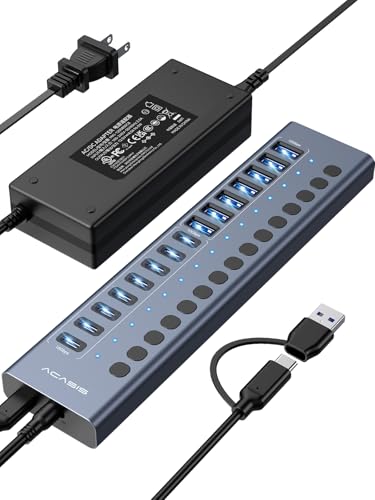
- 16 ports with eight USB-A and eight USB-C connections
- 96W powered design for multiple peripherals
- Individual switches and aluminum housing
Best For: Large desktop setups with many USB devices
Best Powered Charging Hub

- 15-in-1 layout with USB-C and USB-A ports
- Up to 10Gbps data transfer on USB 3.2 ports
- 100W PD input with included 65W power adapter
Best For: USB-C users who need charging and peripherals
Best Compact Option

- Two USB-A and two USB-C ports in a compact body
- Up to 10Gbps shared bandwidth
- Plug-and-play zinc-alloy design
Best For: Portable everyday laptop connectivity
Best Powered 9-Port Option

- Nine mixed USB-A and USB-C ports
- 65W adapter with two 45W PD charging ports
- Angled aluminum desktop design
Best For: Power users who need many ports and dedicated charging
Best All-USB-C Layout

- Four USB-C and three USB-A data ports
- 10Gbps data transfer on every port
- Individual switches with LED indicators
Best For: USB-C laptops needing consistent data performance
Best Mixed-Host Value

- Dual USB-A/USB-C host cable
- Three 10Gbps USB 3.2 ports
- Individual switches and 24W power supply
Best For: Mixed USB-A and USB-C computer setups
Best High-Capacity Pick – 17-Port Powered USB Hub
If you need a usb hub with 20gbps ports, this powered VANGREE model is worth comparing for its large port count, though its listed data ports top out at 10Gbps rather than 20Gbps. It combines 10 USB-A data ports, two USB-C data ports, three dedicated QC charging ports, and SD/TF card slots.
Best For: Desktop users who need many USB connections, card readers, and separate charging ports.
Pros:
- Offers 17 total ports, including USB-A, USB-C, SD, and TF connections.
- Includes a 96W UL-certified external power adapter.
- Provides three dedicated 24W QC 3.0 charging ports.
- Reads SD and TF cards simultaneously.
Cons:
- Data transfer is listed at up to 10Gbps, not 20Gbps.
- The three QC charging ports do not support data transmission.
- Its large port count and external power supply are better suited to stationary setups.
This is a practical choice when connection capacity matters more than maximum USB speed. Its powered design and card slots make it especially useful for a busy workstation with multiple peripherals and storage devices.
Best Professional Choice – StarTech 10-Port USB-C Hub
For shoppers comparing a usb hub with 20gbps ports, the StarTech 10-port model offers a more modest 10Gbps maximum but adds a self-powered, business-oriented design. It connects through USB-C and provides eight USB-A ports plus two USB-C ports.
Best For: IT workspaces and desktop setups that need reliable powered USB expansion and device-management features.
Pros:
- Provides 10 USB 3.2 Gen 2 ports with up to 10Gbps transfer speeds.
- Includes a 65W power adapter to support connected peripherals.
- Two BC 1.2 ports provide up to 12W charging.
- Offers overcurrent protection, Wake On USB, and mounting compatibility.
Cons:
- It does not provide 20Gbps USB ports.
- It has fewer total ports than several high-capacity powered hubs.
- Mounting accessories are sold separately.
The StarTech stands out for controlled office and IT environments rather than maximum port quantity. Its locking USB-C connection, included power supply, and protection features make it a sensible option for a more permanent workstation.
Best for Individual Port Control – 16-Port Powered USB Hub
This VANGREE hub is a useful alternative to a usb hub with 20gbps ports when you need broad USB expansion and convenient device control. Its 16 USB 3.2 ports—eight USB-A and eight USB-C—are rated for up to 10Gbps and each has an independent switch.
Best For: Users managing many USB peripherals who want to turn individual ports on or off without unplugging devices.
Pros:
- Offers an even mix of eight USB-A and eight USB-C ports.
- Includes a 96W UL-certified power adapter.
- Independent switches allow separate control of all 16 ports.
- Supports Windows, macOS, Linux, and ChromeOS without additional drivers.
Cons:
- Its listed data rate is 10Gbps, not 20Gbps.
- USB-C ports do not support DisplayPort or display extension.
- The one-year warranty is shorter than some competing options.
The individual switches are the main reason to choose this model. It is well suited to a desk with frequently changed storage, input, or printing devices, provided you do not need USB-C video output.
Best Compact USB-C Option – Belkin 4-Port USB-C Hub
If portability matters more than port count, the Belkin is a compact option to consider alongside a usb hub with 20gbps ports. Its four USB-C 3.2 Gen 2 ports each support up to 10Gbps, and pass-through charging supports up to 100W.
Best For: Laptop, MacBook, iPad, and other USB-C users who need a small hub for fast storage or accessory connections.
Pros:
- All four USB-C ports support up to 10Gbps data transfer.
- Compact design measures about 2.95 by 1.65 by 0.55 inches.
- Supports pass-through charging up to 100W.
- Supports audio accessories and works with Mac, Windows, and Chrome devices.
Cons:
- The ports are rated at 10Gbps rather than 20Gbps.
- It provides only four ports.
- It does not add USB-A ports or card readers.
This is the most travel-friendly choice in the group and keeps the setup simple for USB-C-only accessories. Choose it for speed, charging support, and portability—not for maximum device capacity.
Best for Easy Setup – ACASIS 16-Port USB 3.2 Hub
If you need a USB hub with 20Gbps ports, note that this ACASIS model is rated for up to 10Gbps rather than 20Gbps. Its standout feature is capacity: 16 total ports split evenly between USB-A and USB-C, with a 96W power adapter for stable operation with multiple connected devices.
Best For: Desktop workstations, creators, and users connecting many USB-A and USB-C peripherals at once.
Pros:
- Offers 16 ports: eight USB-A 3.2 and eight USB-C 3.2.
- Includes a 96W power adapter and supports up to 10Gbps data transfer.
- Individual on/off switches make port management convenient.
- Aluminum housing helps with heat dissipation and durability.
Cons:
- It does not support video output.
- Its maximum data rate is 10Gbps, not 20Gbps.
- The large 16-port design is less portable than a compact hub.
Choose this ACASIS hub when port count matters more than achieving the keyword’s 20Gbps speed. Powered operation, mixed connector types, and independent switches make it especially practical for a fixed desk setup.
Best Powered Charging Hub – Gիտfos C1 15-in-1 USB 3.2 Hub
For shoppers comparing a USB hub with 20Gbps ports, the Gitfos C1 provides up to 10Gbps on its USB 3.2 data ports while adding extensive charging options. It combines USB-C and USB-A connectivity with a 100W USB-C PD input and a supplied 65W DC power adapter.
Best For: USB-C laptops, tablets, and workspaces that need both peripheral connectivity and charging support.
Pros:
- Provides 15 total functions, including USB-C and USB-A data and charging ports.
- USB 3.2 data ports support up to 10Gbps transfer speeds.
- Includes a 100W USB-C PD port and 65W power adapter.
- Aluminum construction, angled design, and non-slip feet suit desk use.
Cons:
- It does not support video output through any port.
- The hub requires the included power adapter to operate.
- Its maximum data speed is 10Gbps, not 20Gbps.
This is a versatile powered option for USB-C systems, particularly when charging is as important as data access. Check your device and charging requirements carefully, since the two additional USB-C charging ports have specified output limits.
Best Compact Option – ORICO 4-Port USB 3.2 Hub
If portability is more important than a USB hub with 20Gbps ports, this compact ORICO splitter offers up to 10Gbps shared across four USB 3.2 interfaces. Its two USB-A and two USB-C ports provide a convenient mix for everyday accessories, storage devices, and smartphones.
Best For: Travelers, laptop users, and anyone needing a small mixed USB-A/USB-C expansion hub.
Pros:
- Combines two USB-A and two USB-C 3.2 ports.
- Supports up to 10Gbps total bandwidth across the four interfaces.
- Compact zinc-alloy design measures 2.24 by 2.24 by 0.81 inches.
- Plug-and-play setup requires no driver installation.
Cons:
- Bandwidth is shared across all four ports.
- It is rated for 10Gbps rather than 20Gbps.
- It is a data expansion hub, not a powered charging hub.
The ORICO is a sensible low-clutter choice for routine connectivity and travel. Its four-port layout is straightforward, but users transferring data from several devices simultaneously should remember that the available bandwidth is shared.
Best Powered 9-Port Option – 65W USB Hub with 10Gbps Ports
If you need a usb hub with 20gbps ports, note that this model tops out at 10Gbps rather than 20Gbps. It offers a broad mix of connectivity, including one USB-C 3.2 port, two USB-A 3.2 ports, four USB-A 3.0 ports, and two USB-C PD charging ports.
Best For: Desktop workstations needing many USB connections, dedicated device charging, and powered stability.
Pros:
- Nine-port layout with both USB-C and USB-A data ports.
- Powered design includes a 65W adapter for stable operation with multiple devices.
- Two USB-C PD ports support up to 45W charging for compatible devices.
- Angled aluminum housing and included USB-C cable suit desktop setups.
Cons:
- Data ports support up to 10Gbps, not 20Gbps.
- PD charging ports do not transmit data.
- Does not support video output and is not recommended for charging computers.
This is a versatile powered hub for users prioritizing port quantity and charging flexibility. Its limitations around video output, simultaneous SSD use, and 20Gbps speeds make it better suited to general desktop expansion than demanding high-bandwidth storage workflows.
Best All-USB-C Layout – 7-Port 10Gbps USB-C Hub
For shoppers searching for a usb hub with 20gbps ports, this model is another 10Gbps option, with that speed available across all seven ports. Its four USB-C and three USB-A data ports provide a consistent setup for modern peripherals and storage devices.
Best For: USB-C laptop users who want uniform 10Gbps data performance and individual port control.
Pros:
- All seven ports support data transfer up to 10Gbps.
- Four USB-C and three USB-A ports accommodate mixed devices.
- Individual electronic switches and blue LEDs simplify power management.
- 36W adapter, aluminum housing, and detachable 3.3-foot cable support organized setups.
Cons:
- Does not provide 20Gbps transfer speeds.
- USB-C ports do not support PD charging or video output.
- USB-C ports provide standard 1.5A charging only.
Choose this hub when consistent high-speed data across every port matters more than display connectivity or fast device charging. The switches are particularly useful for selectively powering peripherals without unplugging them.
Best Mixed-Host Value – 7-Port USB-A and USB-C Hub
If your setup includes both USB-A and USB-C computers, this is a practical alternative to a usb hub with 20gbps ports, though its maximum rated speed is 10Gbps. It combines one USB-A 3.2 port, two USB-C 3.2 ports, and four USB-A 3.0 ports, plus a dual USB-A/USB-C host cable.
Best For: Users switching between USB-A and USB-C laptops, desktops, Mac computers, and peripherals.
Pros:
- Dual USB-A/USB-C host cable supports a wide range of computers.
- Seven-port mix includes three USB 3.2 ports and four USB 3.0 ports.
- Individual switches let you disable ports without unplugging devices.
- 24W UL-certified power supply and surge protection support powered operation.
Cons:
- Maximum data speed is 10Gbps, not 20Gbps.
- Only the USB 3.2 ports reach 10Gbps; USB 3.0 ports are rated at 5Gbps.
- The included power adapter is less powerful than the 65W adapter in the nine-port model.
This hub stands out for compatibility and everyday convenience. Its dual-purpose host cable and individually controlled ports make it a good fit for mixed-device desks, while the 10Gbps ceiling means it is not intended for true USB 20Gbps workloads.
How We Picked the Best USB Hub with 20gbps Ports
We focused on hubs designed for demanding modern setups, prioritizing USB 3.2 connectivity, powered operation where appropriate, practical port variety, and dependable compatibility with laptops, desktops, tablets, and other USB-C devices. Because many listings describe 10Gbps products while buyers search for a USB Hub with 20gbps Ports, check the manufacturer’s specifications carefully: USB 3.2 Gen 2×2 is the standard associated with 20Gbps operation, while USB 3.2 Gen 2 commonly tops out at 10Gbps.
We also considered whether each model suits a compact travel kit, a workstation, a media-creation setup, or a high-device-count environment. Power adapters, USB-C host connections, individual switches, construction, and charging support helped distinguish the options.
Quick Comparison
| Best For | What to Prioritize | Typical Advantage |
|---|---|---|
| Many peripherals | Powered 9- to 17-port design | Connects more drives and accessories simultaneously |
| Fast external storage | Verified 20Gbps USB 3.2 Gen 2×2 support | Higher peak transfer rates with compatible devices |
| Laptop expansion | USB-C hub with PD and mixed ports | Adds connectivity while charging the host |
| Travel | Compact, bus-powered four-port model | Simple plug-and-play expansion |
| Desk organization | Individual switches and a long cable | Easier control of attached equipment |
Key Buying Factors for a USB Hub with 20gbps Ports
Confirm the Actual USB Standard
Do not rely on “USB 3.2” alone. Look for USB 3.2 Gen 2×2 or an explicit 20Gbps rating if maximum speed is the goal. Your computer, cable, and external drive must all support the same standard, and real-world speeds are usually lower than the advertised ceiling.
Check Power and Charging
A powered hub is preferable for multiple hard drives, webcams, lighting devices, and other power-hungry accessories. If you want laptop charging, verify the hub’s USB Power Delivery input and its actual pass-through wattage. A 100W input does not necessarily mean the connected computer receives the full 100W.
Match the Port Layout
Count USB-A and USB-C data ports separately. Some USB-C ports are charging-only or offer different speeds. Also check spacing, cable length, front-access ports, and whether bulky plugs will block neighboring connections.
Consider Compatibility and Heat
Confirm support for your operating system and host connector. High-speed hubs can generate noticeable heat during sustained transfers, so an aluminum enclosure, ventilation, and a stable power adapter are useful for desktop installations.
Who Should Buy Which USB Hub with 20gbps Ports?
Choose a large powered 15- to 17-port hub if you routinely connect several storage devices, cameras, controllers, or office peripherals. A 7- to 10-port powered model is a better middle ground for a workstation without excessive desk clutter. For a laptop or iPad, prioritize a USB-C hub with reliable PD pass-through and the exact display or storage ports you need. A compact four-port model works best for travel and occasional accessories.
If transfer speed is your main reason for upgrading, choose only a model that explicitly confirms 20Gbps USB 3.2 Gen 2×2 support; otherwise, a well-built 10Gbps hub can still be the more practical and widely compatible choice.