A USB hub with individual power switches makes it easier to control peripherals without repeatedly unplugging cables. It can also reduce desktop clutter and help keep rarely used accessories powered down.
We compared 10 powered USB hubs across port count, switch layout, charging features, power capacity, and practical desk usability. The best choice depends on how many devices you connect and whether you need data ports, charging, or both.
Best 10 USB Hub with Individual Power Switches Picks for 2026
Best Compact Pick

- Four USB 3.0 ports
- Individual switches with LEDs
- Slim design and 2-foot cable
Best For: Compact desktop or laptop setups needing simple per-port control
Best Seven-Port Option

- Seven USB 3.0 ports
- 5V/2A power adapter included
- Switches and LEDs on every port
Best For: Multi-device workstations needing powered USB expansion
Best High-Capacity Pick
SABRENT 10-Port Powered USB Hub

- Ten USB 3.0 ports
- 60W power adapter included
- Individual switches and blue LEDs
Best For: Large desktop setups with numerous USB peripherals
Best Charging-Ready Pick
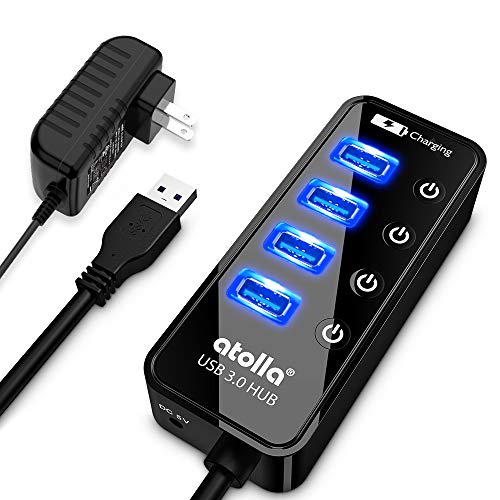
- Four switchable USB 3.0 ports
- Dedicated charging port up to 2.4A
- 5V/3A adapter and long cable
Best For: Users combining USB data expansion with basic mobile-device charging
Compact Control
SABRENT 4-Port Powered USB 3.0 Hub

- Four USB 3.0 ports with individual LED power switches
- Includes a 5V/2.5A power adapter
- Slim, lightweight design for desks or travel
Best For: Small setups needing simple per-port power control
Best for Everyday Use
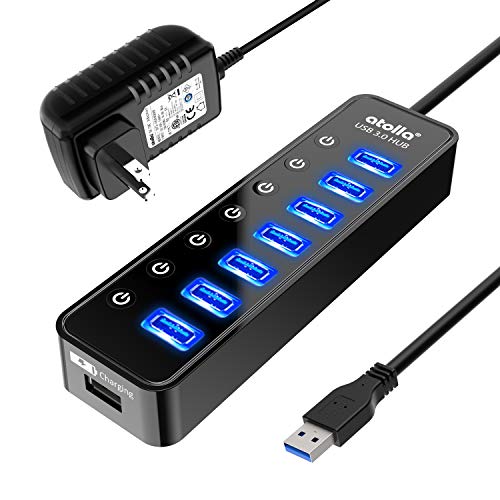
- Seven USB 3.0 data ports plus a charging port
- Individual switches control each data port
- Includes a 5V/4A power adapter
Best For: Multi-device workstations needing more ports and charging
Durable Powerhouse

- Seven data ports and four smart charging ports
- Aluminum enclosure with individual LED switches
- Includes protection features and a 24-month warranty
Best For: Heavy-duty setups needing high capacity and durable construction
Best Compact Aluminum Pick

- Four USB 3.0 data ports reach up to 5Gbps
- Individual switches include LED status indicators
- Aluminum body with dedicated 2.4A charging port
Best For: Compact home and office setups
Best for Maximum Expansion

- Ten 5Gbps data ports plus one charging port
- Individual LED-lit switches for every port
- 36W adapter and three-year warranty included
Best For: Large, peripheral-heavy workstations
Best for Flexible Cable Placement

- Ten USB 3.0 data ports support up to 5Gbps
- Individual switches provide visible per-port control
- Long USB and power cables aid workspace placement
Best For: Expanded desktop setups needing cable flexibility
Best Compact Pick – SABRENT 4-Port USB 3.0 Hub
If you need a compact usb hub with individual power switches, the SABRENT HB-UM43 adds four USB 3.0 ports while keeping connected peripherals easy to control. Its 2-foot cable helps with flexible placement, and setup is plug-and-play.
Best For: Laptop and desktop users who want four individually switchable USB data ports in a slim design.
Pros:
- Four USB 3.0 ports with transfer speeds up to 5Gbps
- Individual switches and LED indicators for each port
- Plug-and-play, hot-swappable design with broad USB compatibility
Cons:
- Not intended for charging devices
- Four ports may be limiting for larger setups
This is a straightforward choice when portability and per-port control matter more than maximum capacity or charging capability.
Best Seven-Port Option – RSHTECH Powered USB 3.0 Hub
The RSHTECH RSH-518 is a practical usb hub with individual power switches for users who need more connections and steadier power. It provides seven USB 3.0 ports, a 5V/2A adapter, and LED indicators for monitoring each port.
Best For: Home offices, workstations, and entertainment setups with several USB peripherals connected at once.
Pros:
- Seven USB 3.0 ports with speeds up to 5Gbps
- Included power adapter supports self-powered operation
- Individual on/off switches, LED indicators, and a detachable 3.3-foot cable
Cons:
- Larger than a basic four-port hub
- Requires an external power adapter for powered operation
Its mix of capacity, external power, and individual controls makes it a well-rounded option for a busy USB workstation.
Best High-Capacity Pick – SABRENT 10-Port Powered USB Hub
For the largest setup in this roundup, the SABRENT HB-BU10 delivers ten USB 3.0 ports with individual switches and blue LEDs. The included 60W, 12V/5A adapter is designed to provide powered expansion for multiple peripherals.
Best For: Users managing many USB devices, including drives, card readers, phones, and other peripherals.
Pros:
- Ten USB 3.0 ports with data speeds up to 5Gbps
- Individual power switches and blue LED indicators
- Includes a 60W power adapter and supports USB 2.0 and 1.1 devices
Cons:
- Bulkier than four- and seven-port alternatives
- Designed for powered desktop use rather than minimal portability
This is the strongest fit when port count is the priority and you want direct control over a large collection of connected devices.
Best Charging-Ready Pick – atolla 4-Port USB 3.0 Hub
The atolla powered hub combines four individually switched USB 3.0 data ports with a dedicated charging port. For shoppers seeking a usb hub with individual power switches that can also charge compatible mobile devices, it adds useful flexibility while maintaining plug-and-play operation.
Best For: Users who need switchable USB data ports plus a dedicated port rated up to 2.4A for charging phones or tablets.
Pros:
- Four USB 3.0 data ports with speeds up to 5Gbps
- Individual illuminated on/off switches
- Dedicated charging port, 5V/3A adapter, and 25.59-inch cable included
Cons:
- Charging performance is specified at up to 2.4A, not USB-C fast charging
- Plastic case may feel less substantial than metal alternatives
Choose this model if per-port control and basic device charging are both important in a compact powered hub.
Compact Control – SABRENT 4-Port Powered USB 3.0 Hub
If you need a compact USB hub with individual power switches, the SABRENT HB-UMP3 adds four USB 3.0 ports while keeping each connected device independently controllable. Its included 2.5A power adapter supports powered operation, and the hub works with USB 3.0, USB 2.0, and USB 1.1 devices.
Best For: Desktops and laptops that need a small, straightforward hub for selectively powering up to four USB devices.
Pros:
- Individual LED-lit power switches simplify device control.
- USB 3.0 supports transfer speeds up to 5Gbps.
- Compact, lightweight design is convenient for travel and smaller desks.
- Includes a 5V/2.5A power adapter and supports plug-and-play setup.
Cons:
- Offers only four total USB ports.
- Its plastic enclosure may be less rugged than an aluminum design.
The SABRENT is a practical pick when portability and simple per-port control matter more than maximum capacity. It provides the essential powered-hub features in a slim four-port format.
Best for Everyday Use – Atolla 7-Port USB 3.0 Hub
For a larger USB hub with individual power switches, the Atolla expands one USB connection into seven USB 3.0 data ports plus a dedicated smart charging port. Its 5V/4A power adapter supports connected peripherals, while each data port can be switched independently.
Best For: Workstations using several peripherals such as keyboards, mice, printers, hard drives, smartphones, and tablets.
Pros:
- Provides seven USB 3.0 data ports for broad peripheral connectivity.
- Dedicated charging port can provide up to 2.4A charging power.
- Individual on/off switches reduce the need to unplug idle devices.
- Supports plug-and-play operation, hot swapping, and multiple Windows, Mac, and Linux versions.
Cons:
- The larger design takes more desk space than a compact four-port hub.
- The charging port is separate from the seven data ports.
The Atolla offers a strong balance of capacity and control for a busy desk. Choose it if seven data connections and a separate charging port are more useful than a smaller footprint.
Durable Powerhouse – Leinsis 7-Port USB 3.0 Hub
The Leinsis is a USB hub with individual power switches designed for heavier-duty setups. It combines seven USB 3.0 data ports with four smart charging ports, an aluminum enclosure, a 12V/2A power adapter, and protection against overcurrent, overvoltage, short circuits, and overheating.
Best For: Users who want a durable, high-capacity hub for multiple peripherals and simultaneous device charging.
Pros:
- Offers seven data ports and four smart charging ports.
- Aluminum construction provides a durable, travel-friendly enclosure.
- Individual LED switches allow convenient port control and power saving.
- Includes longer USB and power cables, a USB-C adapter, and a 24-month warranty.
Cons:
- Its 11-port layout is larger than simpler hub designs.
- Charging ports are intended for charging rather than data transfer.
- The supplied power adapter is more substantial than those included with smaller hubs.
Leinsis stands out when durability, port count, and charging capacity are priorities. Its aluminum build and protective circuitry make it a compelling option for demanding home or office setups, provided you have room for the larger unit.
Best Compact Aluminum Pick – atolla 5-Port USB 3.0 Hub
If you need a USB hub with individual power switches without taking over your desk, the atolla 5-port model is a practical choice. It provides four USB 3.0 data ports with transfer speeds up to 5Gbps, plus a dedicated smart-charging port rated up to 2.4A.
Best For: Home and office users who want a compact, durable hub with per-port control and a dedicated charging connection.
Pros:
- Individual switches and LED indicators let you disable unused ports without unplugging devices.
- Four USB 3.0 ports support data transfers up to 5Gbps and work with older USB devices.
- Aluminum construction, plug-and-play operation, and broad Windows, Mac, and Linux compatibility.
- Includes a 5V/3A power adapter, 100cm USB cable, and an 18-month warranty.
Cons:
- Offers five total ports, fewer than the two 11-port alternatives in this roundup.
- The dedicated charging port is intended for charging rather than general data transfer.
Choose this atolla hub when a smaller footprint and aluminum housing matter more than maximum port count. The individual switches make it easy to manage connected accessories and reduce unnecessary power use.
Best for Maximum Expansion – JESWO 11-Port USB 3.0 Hub
The JESWO 11-port hub is designed for busy workstations that need many connections in one place. As a USB hub with individual power switches, it combines ten 5Gbps USB 3.0 data ports with a dedicated smart-charging port and a 36W power adapter.
Best For: Multitasking users connecting numerous peripherals such as keyboards, mice, cameras, card readers, flash drives, and other USB accessories.
Pros:
- Ten USB 3.0 data ports provide substantial expansion for crowded desktops.
- Individual on/off switches and LEDs make each connection easy to control and monitor.
- Includes a 12V/3A, 36W adapter with overheat safeguards for stable powered operation.
- Works with Windows, Mac, and Linux and includes a three-year warranty.
Cons:
- Full functionality requires the included power adapter to be connected.
- Its plastic enclosure may feel less premium than an aluminum-bodied hub.
- The large port count may be unnecessary for users with only a few peripherals.
For a heavily connected desk, the JESWO stands out for capacity and granular power management. It is especially practical when several data accessories need to remain connected while unused ports can be switched off individually.
Best for Flexible Cable Placement – Wenter 11-Port USB 3.0 Hub
The Wenter 11-port model is a versatile USB hub with individual power switches for users who need both high port capacity and flexible placement. It offers ten USB 3.0 data ports with up to 5Gbps transfers, plus a dedicated charging port rated up to 2.4A.
Best For: Desktop users who need to connect many peripherals and want longer cables for easier positioning around a PC or workspace.
Pros:
- Ten USB 3.0 data ports accommodate devices including printers, drives, keyboards, mice, and flash drives.
- Per-port switches and LED indicators simplify power control without unplugging equipment.
- The included 12V/3A adapter supports powered operation, while the charging port delivers up to 2.4A.
- Includes a 100cm USB cable, a longer power cable option listed at 120cm or 150cm, and a 24-month warranty.
Cons:
- Requires the power adapter for powered hub functionality and charging.
- The supplied specifications contain inconsistent power-cable length information.
- The enclosure is plastic rather than aluminum.
The Wenter is a strong fit when ten data ports are useful and cable reach affects where the hub can sit. Its broad USB compatibility and per-port controls make it convenient for a mixed collection of everyday peripherals.
How We Picked the Best USB Hub with Individual Power Switches
We focused on powered USB 3.0 hubs with individually switchable ports, then compared the features that matter most in daily use: total port count, data-transfer capability, charging support, included power supply, switch and LED placement, build quality, and compatibility. Models with dedicated smart-charging ports were considered separately from hubs where every port is primarily intended for data.
Individual switches are useful for webcams, external drives, card readers, lights, keyboards, and other accessories that do not need to remain active constantly. A powered design is especially important when several bus-powered devices are connected at once.
Quick Comparison
- For a compact setup: Four-port models take up less space and suit a keyboard, mouse, storage device, and occasional accessory.
- For several peripherals: Seven- and eight-port hubs offer more flexibility without the footprint of the largest desktop units.
- For maximum expansion: Ten- and eleven-port options are better for workstations, studios, testing benches, and cable-heavy setups.
- For charging: Look for a clearly labeled smart-charging port and check its output separately from the hub’s data ports.
- For visibility: Individual LEDs make it easy to see which ports are active, although bright indicators may be distracting in a bedroom or dark office.
Key Buying Factors for a USB Hub with Individual Power Switches
Port Type and Bandwidth
USB 3.0 ports are generally preferable for external storage and other faster peripherals, but real-world performance is shared across the hub’s upstream connection. If you regularly move large files, connect the hub directly to a suitable USB 3.0 port on your computer and avoid expecting every device to reach peak speed simultaneously.
Power and Charging
Compare the included adapter’s voltage and amperage, not just the number of ports. More available power helps the hub handle multiple accessories reliably. A smart-charging port may charge phones or other devices, but it may not provide computer data connectivity, so confirm the port labels before buying.
Size, Controls, and Construction
Check whether the switches are easy to reach and whether the cable length suits your desk. Aluminum housings can feel sturdier and help with heat dissipation, while larger hubs may need more room behind a monitor or under a shelf. Individual LEDs are helpful for troubleshooting but should be positioned where they remain visible without creating glare.
Who Should Buy Which USB Hub with Individual Power Switches?
Choose a four-port hub if you need simple control for a small desk setup. A seven- or eight-port model is the practical middle ground for users with several peripherals, external storage, or occasional charging needs. Select a ten- or eleven-port hub if you want to leave many devices connected permanently and prefer switching them off individually rather than reaching behind the computer.
Before purchasing, verify your computer’s connector, operating-system compatibility, desk space, and the manufacturer’s stated power limits. No USB hub replaces a dedicated high-wattage charger, and individually switched ports control power availability rather than guaranteeing faster charging or independent full-speed bandwidth.