A good powered docking station turns a laptop into a more capable desktop workspace, adding monitors, storage, accessories, networking, and charging through one connection.
We selected 10 options spanning compact USB-C docks, high-output workstation models, and triple-display solutions so you can match features and power delivery to your laptop and daily setup.
Best 10 Powered Docking Stations Picks for 2026
Powerhouse Pick
Anker Prime 14-in-1 Dual-Monitor Dock

- 160W total output with high-power USB-C charging
- Dual HDMI display support and 10Gbps data
- Includes Ethernet, audio, and 24-month warranty
Best For: Power users creating a dual-monitor Windows or ChromeOS workstation
Triple-Display Choice

- Supports up to three extended HDMI displays
- 100W Power Delivery and six USB 3.0 ports
- Works with Windows, macOS, and ChromeOS systems
Best For: Hybrid workstations requiring three monitors and wired networking
Expansion Value

- Includes a 120W adapter and 30W device-charging port
- Supports up to three displays on compatible Windows laptops
- Adds fast USB, SD/TF, Ethernet, and audio connectivity
Best For: Windows users needing maximum expansion and multi-display support
Business-Class Pick

- Up to 100W Power Delivery for Dell and non-Dell PCs
- Native support for up to four high-resolution displays
- Three-year limited hardware warranty and office-focused design
Best For: Managed office deployments and multi-display productivity desks
Best High-Power Pick
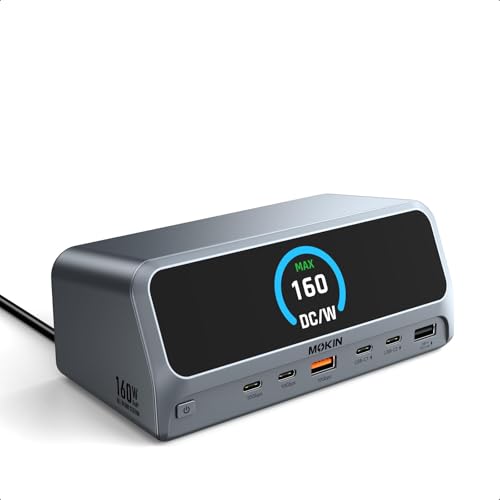
- Built-in 160W power supply
- Dual 4K HDMI with Windows extend mode
- LCD status display and privacy button
Best For: Windows users building a high-power dual-monitor workstation
Best for Desk-to-Travel Flexibility

- Detachable 6-in-1 travel hub
- Supports up to three external displays
- Includes 140W adapter and 100W laptop charging
Best For: Home-office users who also work on the go
Best Dell-Centered Choice

- Dell-branded USB-C docking solution
- Dual DisplayPort outputs
- Designed for compatible Dell laptops
Best For: Dell laptop users setting up a conventional office workstation
Best Overall
Anker 13-in-1 Triple-Display Dock

- 135W adapter with up to 85W laptop charging
- 13 ports with dual HDMI and DisplayPort
- Up to three 1080p displays on Windows and ChromeOS
Best For: Windows or ChromeOS triple-display workstations
Best Heavy-Duty Pick
Selore&S-Global 13-in-1 150W Dock

- 150W total DC power delivery
- Triple-monitor support with dual HDMI and DisplayPort
- Single 4K display support up to 144Hz
Best For: High-power Windows workstations and high-refresh displays
Best for Port Variety
TobenONE 18-in-1 Triple-4K Dock
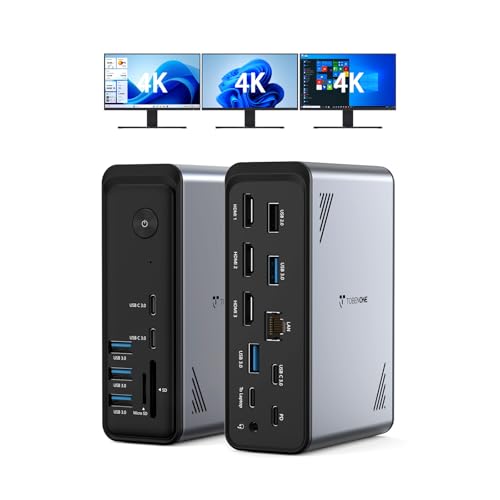
- 18 ports, including nine USB ports and three HDMI outputs
- Dual or triple 4K@60Hz display support
- 100W laptop charging with compatible power setup
Best For: Windows and ChromeOS users with many peripherals
Powerhouse Pick – Anker Prime 14-in-1 Dual-Monitor Dock
The Anker Prime is one of the more capable powered docking stations for users who need extensive connectivity, fast data transfers, and dual-display support. Its 160W total output and broad USB-C, USB-A, HDMI, Ethernet, and audio connectivity make it suited to a busy desktop setup.
Best For: Windows, ChromeOS, and compatible USB-C laptop users building a dual-monitor workstation.
Pros:
- 14-in-1 design with up to 10Gbps data transfer speeds.
- 160W total output, with up to 100W available through each of three USB-C ports.
- Dual HDMI display support, plus Ethernet and audio connectivity.
- Includes a 100W, 10Gbps upstream USB-C cable and a 24-month warranty.
Cons:
- macOS mirrors the same image across both external monitors.
- Not compatible with Linux.
- Does not support a 5120×1440 monitor.
This is a strong choice when charging capacity and port variety matter as much as display expansion. Check your laptop’s DP Alt Mode and Power Delivery support before buying, especially if you use macOS.
Triple-Display Choice – Plugable 12-in-1 USB-C Dock
The Plugable USB-C dock is a practical option among powered docking stations for hybrid offices and multi-monitor workspaces. It supports up to three HDMI displays, wired Gigabit Ethernet, six USB 3.0 peripherals, and 100W Power Delivery across compatible Windows, macOS, and ChromeOS systems.
Best For: Hybrid teams and professionals who need three extended displays and broad laptop compatibility.
Pros:
- Supports up to three HDMI monitors, including one 4K display and two 1080p displays.
- DisplayLink helps bypass native single-display limits on supported Apple Silicon MacBooks.
- Provides six USB 3.0 ports, Gigabit Ethernet, audio, and 100W Power Delivery.
- Backed by North American technical support and a compatibility guarantee.
Cons:
- macOS requires driver installation.
- Not compatible with Linux.
- HDCP is not supported.
For a managed office or home workstation that depends on three screens, this dock offers a useful mix of display and peripheral expansion. Confirm that your laptop has a full-featured USB-C, USB4, or Thunderbolt port and account for the macOS driver requirement.
Expansion Value – HODO 18-in-1 Docking Station
The HODO 18-in-1 is a feature-rich powered docking station for users who want multiple displays, card readers, fast USB ports, and a dedicated power adapter. Its included 120W adapter supports laptop and phone charging, while Windows users can connect up to three displays or a single 8K screen.
Best For: Windows laptop users who need extensive expansion, card-reader access, and multi-display output.
Pros:
- 18-in-1 design with two HDMI ports and one DisplayPort 1.4 output.
- Includes a 120W power adapter and a 30W USB-C port for phone or tablet charging.
- Offers 10Gbps USB ports, 3Gbps SD/TF card access, Gigabit Ethernet, and audio.
- Screen on/off button adds convenient control for privacy and power savings.
Cons:
- Triple- and dual-display support is specified for Windows laptops.
- macOS and iPadOS mirror connected displays because of SST restrictions.
- The 120W adapter must be connected before using the display functions.
This dock stands out for sheer connectivity and included power hardware. It is especially compelling for Windows users with several screens and removable storage needs, but users on macOS or iPadOS should expect mirrored displays.
Business-Class Pick – Dell Pro WD25 Dock
The Dell Pro WD25 is a business-focused choice among powered docking stations, delivering up to 100W to compatible laptops and support for up to four high-resolution displays. It also adds modern manageability, flexible cable routing, USB connectivity, Ethernet, and a three-year limited hardware warranty.
Best For: Office and IT-managed workstations using Dell or other compatible Windows, Linux, or ChromeOS systems.
Pros:
- Delivers up to 100W of power to compatible Dell and non-Dell PCs.
- Supports up to four high-resolution displays.
- Ambidextrous USB-C cable routing and a reinforced USB-C connector improve desk usability.
- Includes Ethernet, USB-A, USB-C, Power Delivery, and a three-year limited warranty.
Cons:
- Display outputs and compatibility should be checked against the host system and operating system.
- Its business-management features may be more than a basic home setup requires.
- The listed operating-system support is version-specific.
The WD25 makes the most sense for organizations that value dependable deployment, manageability, and long-term support. It is also a good fit for a multi-display office desk, provided the laptop and operating system meet Dell’s listed compatibility requirements.
Best High-Power Pick – MOKiN LumiNext DD01
The MOKiN LumiNext DD01 is one of the more capable powered docking stations for users who want built-in power, dual-monitor connectivity, and a broad selection of ports. Its LCD status display and privacy button add useful visibility and control to a busy desktop setup.
Best For: Windows users who need dual 4K monitors, substantial charging capacity, and frequent access to multiple peripherals.
Pros:
- Built-in 160W power supply avoids a separate external power brick.
- Supports dual HDMI displays at up to 4K@60Hz, with extended mode on Windows.
- Includes an LCD status display and physical privacy button.
- Offers 10Gbps USB data ports and Gigabit Ethernet.
Cons:
- macOS supports mirrored rather than extended dual-monitor output.
- Requires a full-function USB-C or Thunderbolt laptop port.
With 100W laptop Power Delivery, quad-device charging, fast USB ports, and built-in networking, this is a strong desktop-centered choice. The main limitation is display behavior on macOS, so check your operating system before buying.
Best for Desk-to-Travel Flexibility – Anker Nano 13-in-1 Dock
Anker’s Nano dock stands out among powered docking stations because its detachable 6-in-1 USB-C hub can serve both a permanent desk setup and mobile work needs. It also combines three-display support, card readers, Ethernet, audio, and fast data transfer in one system.
Best For: Users who want one dock for a home office and a portable USB-C hub for travel.
Pros:
- Detachable 6-in-1 hub adds convenient portability.
- Supports up to three external displays, including HDMI and DisplayPort connections.
- Provides up to 100W laptop charging with a supplied 140W power adapter.
- Includes USB ports, SD/TF readers, Gigabit Ethernet, and 3.5mm audio.
Cons:
- macOS supports mirrored mode only for multiple external displays.
- The dock and its ports activate only when connected to a laptop.
- Requires a full-function USB-C or Thunderbolt connection.
This is a versatile option for people who alternate between a fixed workstation and travel. Its broad connectivity and detachable hub are practical advantages, while Windows users get the most flexibility from the multi-monitor support.
Best Dell-Centered Choice – Dell WD19S 180W Dock
Dell WD19S 180W Docking Station (130W Power Delivery) USB-C, HDMI, Dual DisplayPort, Black
Check Price On AmazonThe Dell WD19S is a straightforward option among powered docking stations for users who want a Dell-branded USB-C dock for a compatible laptop. Its 180W dock power rating and dual DisplayPort outputs make it suited to a conventional office workstation.
Best For: Dell laptop owners seeking a branded USB-C docking station for a fixed office setup.
Pros:
- Designed around Dell’s business-oriented docking ecosystem.
- Offers dual DisplayPort connectivity for external displays.
- Provides USB-C connectivity and a 180W power rating.
Cons:
- The supplied details identify compatibility primarily with USB-C-enabled Dell devices.
- Port information is less extensive than the 13-in-1 alternatives in this roundup.
- The listed specifications contain conflicting wattage details, so verify the exact configuration before purchase.
The WD19S makes the most sense when brand compatibility and a familiar office dock matter more than maximum port variety. Confirm laptop support and power specifications carefully, particularly if you need broad cross-brand compatibility.
Best Overall – Anker 13-in-1 Triple-Display Dock
If you want powered docking stations for a compact desktop-style setup, the Anker 13-in-1 combines broad connectivity with an included 135W power adapter. It supports up to three 1080p displays on compatible Windows and ChromeOS systems, while also providing fast USB, networking, card-reading, and audio ports.
Best For: Windows or ChromeOS users who want a compact, fully powered dock for triple-display multitasking.
Pros:
- Includes a 135W adapter and delivers up to 85W to the host laptop.
- Offers 13 ports, including dual HDMI, DisplayPort, 10Gbps USB-C, Ethernet, SD, and microSD.
- Supports up to three 1080p displays or one 4K@60Hz display on compatible systems.
Cons:
- macOS limits connected displays to mirrored output rather than extended desktop mode.
- The laptop must support full-function USB-C with DisplayPort Alt Mode and Power Delivery.
Its included power supply and well-rounded port selection make this a practical all-in-one choice. Mac users should choose it primarily for charging and connectivity, not extended multi-monitor support.
Best Heavy-Duty Pick – Selore&S-Global 13-in-1 150W Dock
Among powered docking stations, this 13-in-1 Selore&S-Global model stands out for its 150W DC power design and high-refresh single-display support. It combines dual HDMI, DisplayPort, fast USB-C, Ethernet, card readers, and audio for a flexible Windows workstation.
Best For: Windows users who need substantial power delivery, triple-monitor connectivity, or a high-refresh single 4K display.
Pros:
- Provides 150W total DC power delivery, including up to 100W for the laptop and 30W for USB-C accessories.
- Supports triple displays through dual HDMI and DisplayPort on compatible Windows and Linux systems.
- Can drive a single 4K display at up to 144Hz through DisplayPort 1.4.
Cons:
- Multi-display use requires lower resolutions than the single-display 4K@144Hz mode.
- macOS supports screen mirroring rather than an extended desktop.
- Power is dynamically allocated when the laptop and accessories charge simultaneously.
This dock is a strong fit for demanding Windows setups, especially when high-refresh single-monitor output and generous power are priorities. Its display modes require careful planning if you intend to use several monitors at once.
Best for Port Variety – TobenONE 18-in-1 Triple-4K Dock
For users comparing powered docking stations by port count, the TobenONE 18-in-1 offers one of the most expansive setups here. It provides nine USB ports, three HDMI outputs, card readers, Ethernet, audio, and 100W power delivery for compatible Windows and ChromeOS laptops.
Best For: Windows and ChromeOS users who need many peripheral connections and dual- or triple-4K@60Hz display support.
Pros:
- Provides 18 ports, including nine USB ports, three HDMI outputs, Ethernet, SD, microSD, and audio.
- Supports dual or triple 4K@60Hz displays on compatible systems.
- Delivers 100W PD charging for a laptop-focused workstation.
Cons:
- Does not include a power supply; an additional supply rated above 65W is required for stable operation.
- Designed primarily for Windows and ChromeOS rather than Mac extended-display setups.
- Requires a full-featured USB-C, USB4, or Thunderbolt connection for the stated expansion features.
The TobenONE is appealing when maximum connectivity matters more than a minimal footprint. Factor in the separate power-supply requirement, then verify your laptop and monitor configuration before buying.
How We Picked These Powered Docking Stations
We focused on docks that combine power delivery with practical expansion rather than simple passive hubs. The selection considers charging output, display support, port variety, compatibility, and the kind of desk setup each model is designed to serve. We also included products with different power-adapter ratings, from compact everyday docks to higher-capacity options intended for demanding laptops and multiple displays.
Because operating-system support, video standards, and laptop charging requirements vary, advertised port counts are only part of the decision. A dock should be judged by how well its ports work simultaneously and whether it supports your computer’s display technology.
Quick Comparison
| Best For | Look For | Typical Advantage |
|---|---|---|
| Home-office productivity | 100W-class USB-C power delivery and dual-display support | Simple one-cable setup |
| Creative or technical work | High charging output, fast USB ports, and multiple video outputs | Handles more peripherals and monitors |
| Three-monitor desks | Triple HDMI or mixed HDMI/DisplayPort support | Expands screen real estate |
| Business laptop fleets | Brand compatibility, stable drivers, and enterprise support | Easier deployment and troubleshooting |
| Travel or flexible workspaces | Compact construction and detachable or integrated hubs | Less desk and bag clutter |
Key Buying Factors for Powered Docking Stations
Power Delivery and the Included Adapter
Check both the dock’s advertised power delivery and the wattage of its included power adapter. A 100W USB-C output may be suitable for many office laptops, while gaming, mobile-workstation, and performance-focused systems may benefit from a higher-capacity adapter. The dock’s own electronics consume some power, so maximum output is not always the same as charging power reaching the laptop.
Display Compatibility
Count the displays you plan to connect and verify the required resolution and refresh rate. HDMI and DisplayPort combinations are common, but multi-monitor operation may depend on DisplayLink software, DisplayPort Alt Mode, Thunderbolt support, or the laptop’s native graphics limits. Mac and Windows behavior can differ, particularly when driving more than one external display.
Ports, Networking, and Speed
Prioritize ports you will actually use: USB-A for older accessories, USB-C for newer storage and peripherals, Ethernet for stable networking, audio for headsets, and card readers for photography or media work. If you transfer large files, check whether the high-speed ports are shared or limited to specific connectors.
Compatibility and Desk Integration
Confirm that your laptop supports charging and video over its USB-C port. Some docks work best with specific Dell, Lenovo, or HP systems, while universal models may require drivers or firmware updates. Also consider cable length, ventilation, footprint, and whether the dock can remain connected to your monitor and accessories permanently.
Who Should Buy Which Powered Docking Stations?
Choose a compact 13-in-1-class dock if you need a tidy home-office setup with several everyday accessories. A dual-monitor model is the sensible choice for spreadsheets, communication, and multitasking without the complexity of a three-screen workstation.
For demanding workstations, prioritize higher-wattage adapters, 100W-or-better laptop charging, fast USB connectivity, and multiple display outputs. Triple-display docks suit analysts, developers, traders, and creators who benefit from several persistent windows, but verify your laptop’s graphics and operating-system support first.
Finally, choose a manufacturer-specific business dock when fleet management, predictable compatibility, and support matter more than the highest port count. Before buying, make a short checklist of your laptop model, charger requirement, monitor inputs, desired resolution, and must-have peripherals; that will narrow the field faster than comparing port totals alone.