Choosing among today’s video switchers is easier when you focus on your cameras, output resolution, audio workflow, and streaming setup—not just the number of HDMI ports.
This roundup compares 10 options ranging from compact HDMI mixers to feature-rich production consoles, helping you match the right switcher to your budget and workflow.
Best 10 Video Switchers Picks for 2026
Best Compact HDMI Pick

- Four HDMI inputs with multiview
- Built-in streaming and recording
- Integrated audio mixer and keying
Best For: Compact multicamera livestreams
Best Eight-Input Option

- Eight HDMI inputs
- Built-in preview monitor and AUX output
- 18-channel digital audio mixer
Best For: HDMI-heavy live events and broadcasts
Best PTZ Production Hub
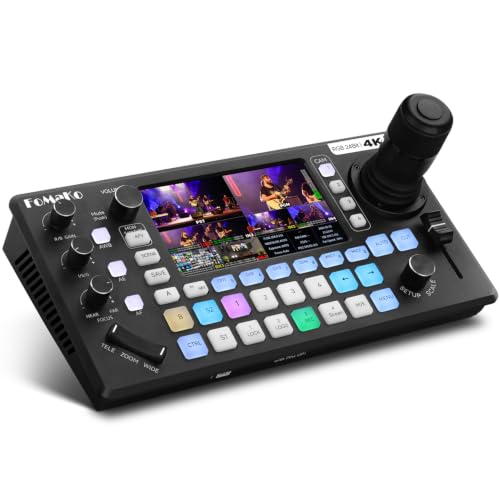
- Four 4K HDMI inputs
- Integrated PTZ joystick and AI tracking
- XLR mixing, recording, and multistreaming
Best For: Solo-operated PTZ productions
Best Audio-Integrated Choice

- Six HDMI and USB video inputs
- Custom scenes, overlays, and chroma keying
- Direct streaming plus ISO recording
Best For: Audio-focused live production and content creation
Feature-Rich Pick

- Four HDMI inputs and two HDMI outputs
- Three-platform streaming with recording and playback
- Audio tools, keying, PIP, and graphics overlays
Best For: Feature-heavy multi-camera productions and live events
Podcast Production Pick

- Three HDMI and one USB video input
- Studio-grade combo inputs for microphones and instruments
- Scenes, overlays, streaming, and ISO recording
Best For: Video podcasts and audio-focused studio productions
Compact Budget Pick

- Four HDMI inputs with 1080p real-time switching
- USB 3.0 output works as a webcam input
- Compact body with preview display and remote control
Best For: Solo streamers and small four-camera productions
Best All-in-One Streaming Hub

- Four HDMI inputs plus USB camera support
- SD recording and USB streaming can run together
- Direct Ethernet streaming to up to three platforms
Best For: Churches, schools, and live-event teams needing an integrated production hub
Best Portable Multiview Switcher

- Built-in four-inch multiview display
- Four HDMI inputs with zero-latency switching
- PTZ, keying, PIP, DSK, and logo tools
Best For: Portable multi-camera productions, classes, and events
Best Simple USB Streaming Switcher

- Four HDMI inputs with 2K support
- USB 3.0 output works as a computer webcam
- Includes transitions, PIP layouts, and LAN control
Best For: Solo streamers using OBS, vMix, or social-media software
Best Compact HDMI Pick – ATEM Mini Pro
The Blackmagic Design ATEM Mini Pro is one of the most practical video switchers for compact multicamera streaming. Its four HDMI inputs, built-in multiview, audio mixer, recording support, and integrated streaming make it suitable for productions that need capable controls without a large setup.
Best For: Education, business presentations, esports, and multicamera livestreams using up to four HDMI sources.
Pros:
- Four HDMI inputs with a built-in multiview output.
- Supports multiple transitions, upstream keys, and a downstream keyer.
- Includes a six-input, two-channel audio mixer.
- Provides built-in streaming, recording, and USB webcam output.
Cons:
- Limited to four HDMI video inputs.
- Its listed HDMI workflow may be less suitable for productions needing broader source connectivity.
Choose the ATEM Mini Pro when a compact HDMI switcher with integrated streaming and recording is more important than a high input count. It offers a strong feature set for small teams and solo operators.
Best Eight-Input Option – Roland V-8HD
The Roland V-8HD is a flexible choice among video switchers for productions that need to connect up to eight HDMI sources. It combines a built-in preview monitor, advanced effects and keying, AUX routing, automated switching, and an 18-channel digital audio mixer in a compact design.
Best For: Live events, presentations, and broadcasts requiring eight HDMI inputs and flexible video routing.
Pros:
- Mixes up to eight HDMI sources in an ultra-compact design.
- Includes a built-in multiview preview monitor and AUX output.
- Offers five-layer effects and keying capabilities.
- Provides an 18-channel digital audio mixer with effects and sync delay.
Cons:
- Heavier and larger than the compact four-input switcher options listed here.
- Its workflow is focused on HDMI sources rather than a wider range of input types.
The V-8HD makes the most sense when eight HDMI inputs, routing flexibility, and detailed audio control justify its larger footprint. Preset memories and macros can also help repeatable productions run more efficiently.
Best PTZ Production Hub – KC800 4K Switcher
The KC800 combines a 4K HDMI switcher with PTZ camera control, making it a distinctive option for video switchers aimed at solo-operated productions. Its four HDMI inputs, integrated 4D joystick, AI tracking, LCD screen, audio mixing, recording, and multistreaming features support a broad range of live workflows.
Best For: Churches, weddings, corporate events, and other multicamera productions using PTZ cameras and direct recording.
Pros:
- Supports four 4K HDMI inputs and three HDMI outputs.
- Controls up to four PTZ cameras with a 4D joystick, presets, and AI tracking.
- Includes XLR inputs with 48V phantom power and a six-channel audio mixer.
- Records to USB storage or SD cards and can stream to multiple platforms.
Cons:
- The feature-rich design may require more setup and learning than a basic switcher.
- PTZ control benefits primarily users with compatible VISCA or VISCA-over-IP cameras.
- Its listed streaming output is centered on 1080p at 60 fps despite 4K HDMI support.
The KC800 is a strong all-in-one choice when camera control, audio, switching, recording, and streaming need to live in one device. It is particularly appealing for operators who want to reduce the amount of separate production hardware.
Best Audio-Integrated Choice – RØDECaster Video
The RØDE RØDECaster Video stands out among video switchers by combining six video inputs with a studio-oriented audio interface. It supports HDMI and USB sources, customizable scenes, overlays, chroma keying, direct streaming, external recording, and isolated recording for post-production.
Best For: Creators and live producers who want video switching, advanced audio capture, scenes, and recording in one unit.
Pros:
- Switches up to six sources, including four HDMI and two USB inputs.
- Supports seven customizable multi-source scenes with transitions and overlays.
- Includes two Neutrik combo inputs with Revolution Preamps.
- Offers direct streaming, external recording, and ISO recording for post-editing.
Cons:
- Its six-input capacity is lower than the Roland’s eight HDMI inputs.
- Users needing more than two XLR-style combo inputs may need additional audio hardware.
The RØDECaster Video is a compelling fit for productions where polished audio and video must be managed together. Its scenes, auto-switching, Inspect Mode, and ISO recording add useful flexibility for live shows and later editing.
Feature-Rich Pick – Osee GoStream Deck HDMI Pro
For creators comparing video switchers, the Osee GoStream Deck is a versatile choice for multi-camera productions that need recording, streaming, audio control, and graphics in one unit. Its four HDMI inputs, dual HDMI outputs, USB-C connectivity, and Ethernet streaming support make it suitable for more involved live setups.
Best For: Conferences, worship services, weddings, podcasts, education, and other productions needing integrated switching, streaming, and overlays.
Pros:
- Four HDMI inputs plus two HDMI outputs support multi-camera and MultiView monitoring.
- Streams to three platforms simultaneously through Ethernet and supports landscape or portrait formats.
- Includes audio effects, SD card or USB SSD recording, playback, chroma key, PIP, and graphics overlays.
- Physical PVW/PGM controls, a T-Bar, macros, and PC control software offer flexible operation.
Cons:
- Its broad feature set may be more than a simple one-person streaming setup requires.
- Some advanced functions rely on connected storage, networking, or additional control software.
The GoStream Deck stands out when you want broadcast-style control without depending entirely on a computer. Choose it for feature depth and connectivity rather than the smallest possible footprint.
Podcast Production Pick – RØDECaster Video S
The RØDECaster Video S is one of the more studio-oriented video switchers for creators who want video production and audio capture handled together. It switches among three HDMI sources and one USB source, while adding customizable scenes, media playback, overlays, and direct streaming.
Best For: Video podcasts, interviews, and studio productions that prioritize high-quality microphone input alongside multi-camera switching.
Pros:
- Supports up to four video sources: three HDMI inputs and one USB input.
- Two Neutrik combo inputs with Revolution Preamps support XLR microphones, instruments, and other audio sources.
- Provides five customizable multi-source scenes, graphic overlays, chroma keying, transitions, and media playback.
- Can stream through Wi-Fi or Ethernet, output to software over USB, and record to external USB storage with ISO recording.
Cons:
- Video input capacity is limited to three HDMI sources plus one USB source.
- Its studio-focused feature set may be unnecessary for basic camera switching.
Choose the RØDECaster Video S if audio quality is central to your production as much as video switching. Inspect Mode and intelligent auto-switching add useful control for hands-free or carefully monitored workflows.
Compact Budget Pick – FEELWORLD LIVEPRO L1 V1
The FEELWORLD LIVEPRO L1 V1 is a compact option for shoppers who need straightforward video switchers for four-camera 1080p live production. Its USB 3.0 output appears as a webcam to streaming software, making it practical for solo operators working with cameras, presentations, clips, or gameplay.
Best For: Single-person live streaming, small productions, and users who want four HDMI inputs without a large control surface.
Pros:
- Offers four HDMI inputs and real-time switching for 1080p sources.
- USB 3.0 output works like a built-in webcam with streaming software.
- Compact design includes a 2-inch display, six-picture preview, transitions, and audio level display.
- LAN connectivity enables remote operation through the XPOSE software without installing extra software.
Cons:
- Provides one HDMI output and a simpler feature set than more advanced production switchers.
- The supplied notes identify a USB 3.0 output but do not describe direct platform streaming or onboard recording.
The LIVEPRO L1 V1 makes sense when ease of setup and portability matter more than extensive audio, graphics, or streaming features. It is a practical entry point for switching several HDMI sources into a computer-based stream.
Best All-in-One Streaming Hub – Osee GoStream Deck Pro
The Osee GoStream Deck Pro is one of the more self-contained video switchers for teams that want both production control and streaming features in one unit. It accepts four HDMI sources plus a USB camera, records MP4 video to an SD card, and can stream directly over Ethernet to up to three platforms.
Best For: Churches, schools, and live-event teams that need local recording, direct multi-platform streaming, and tactile controls.
Pros:
- Supports four HDMI inputs plus an additional USB camera input.
- Records to an SD card while streaming through USB, allowing a local backup.
- Built-in encoder supports direct Ethernet streaming to up to three platforms.
- Eight physical macro buttons provide quick access to switching, overlays, and transitions.
Cons:
- Its feature set may be more than needed for simple single-camera streaming.
- Direct streaming depends on a wired network connection.
Choose this model when your workflow benefits from recording, network streaming, and hands-on macro control in the same compact switcher. IP remote control and firmware updates add useful flexibility for managed production setups.
Best Portable Multiview Switcher – Mixer Plus Compact Switcher
The Mixer Plus is a practical choice among video switchers when monitoring is a priority. Its four-inch built-in screen displays a multiview of connected sources, while four HDMI inputs, customizable transitions, scene presets, and broadcast-style keying tools support multi-camera productions.
Best For: Portable multi-camera streaming, online classes, events, and productions using OBS or Zoom.
Pros:
- Built-in four-inch display provides real-time multiview monitoring.
- Four HDMI inputs support cameras, computers, gaming consoles, and streaming devices.
- Includes 30 transition effects and four user-defined scene presets.
- Offers PTZ control, chroma key, luma key, PIP, DSK, and logo overlay functions.
Cons:
- The listed 8-by-8-by-3-inch dimensions are less compact than an ultra-mini switcher.
- Its advanced controls may require more setup than a basic HDMI switcher.
The built-in screen is the standout feature for operators who need to preview sources without adding a separate monitor. Its configurable AUX output and multiview options also make it suitable for more involved production layouts.
Best Simple USB Streaming Switcher – RGBlink Mini
The RGBlink Mini is a straightforward option among video switchers for creators who want to combine up to four HDMI sources and send the result to a computer as a USB webcam. It supports 2K input and output, built-in transitions, picture-in-picture layouts, and remote control through its LAN connection.
Best For: Solo streamers and small multi-camera setups using OBS, vMix, or social-media streaming software.
Pros:
- Four HDMI inputs support multi-camera production.
- USB 3.0 output is recognized by computers as a webcam.
- Includes 14 transition effects and nine picture-in-picture layouts.
- LAN control works from a phone or computer without additional software.
Cons:
- The standard Mini does not provide onboard recording; the notes direct buyers to Mini-Pro or higher models for that feature.
- Its USB streaming workflow requires a computer and compatible streaming software.
For computer-based streaming, the RGBlink Mini keeps the connection process simple while still offering useful layout and transition controls. It is a good fit when you need flexible HDMI switching but do not require built-in recording or direct platform streaming.
How We Picked These Video Switchers
We selected these Video Switchers for practical differences in connectivity, switching control, streaming support, monitoring, audio handling, and portability. The list includes compact models for creators and classrooms, traditional multi-camera mixers for events, and advanced units with integrated audio interfaces, PTZ control, or production-focused features.
Because specifications can vary by firmware, input source, and output format, confirm the manufacturer’s current documentation before buying. Pay particular attention to supported resolutions, frame rates, computer compatibility, and whether streaming requires a separate encoder.
Quick Comparison
| Best For | What to Prioritize | Typical Choice From This List |
|---|---|---|
| Beginner live streaming | Simple HDMI switching and direct streaming | ATEM Mini Pro or a compact GoStream Deck model |
| Professional events | More inputs, reliable monitoring, and flexible outputs | Roland V-8HD or an SDI-capable mixer |
| Video podcasts | Integrated audio, scenes, and creator-friendly controls | RØDECaster Video or Video S |
| PTZ camera production | Joystick control, tracking, and camera compatibility | KC800 4K switcher |
| Budget multi-camera setups | Basic HDMI switching and low cost | FEELWORLD, Mixer Plus, or Mini Video Mixer models |
Key Buying Factors for Video Switchers
Inputs and Signal Compatibility
Count the cameras and other sources you plan to connect today, then leave room for expansion. HDMI is common for mirrorless cameras, camcorders, laptops, and game consoles. SDI is better suited to longer cable runs and professional installations, but it requires compatible equipment or converters.
Resolution, Frame Rate, and Scaling
Check whether every input must use the same format. Some switchers handle mixed sources more gracefully than others, while certain models may pass through 4K but switch internally at a lower resolution. Match the unit to your cameras, display, recording device, and streaming platform.
Streaming and Recording Workflow
A switcher with USB webcam output or built-in encoding can simplify direct streaming. Otherwise, you may need a computer, capture device, or dedicated encoder. Also check for multiview output, recording options, scene memory, transitions, and keying if your production needs graphics or picture-in-picture.
Audio and Control
Integrated audio mixing is valuable for podcasts, classes, and live events. Look for the connections you actually use, including XLR, 3.5mm, embedded HDMI audio, or line inputs. Physical buttons are useful during live production, while joystick PTZ control and touchscreen monitoring can reduce the need for additional hardware.
Who Should Buy Which Video Switchers?
Choose a compact HDMI switcher if you want a straightforward setup for two to four cameras, online classes, gaming, or occasional streams. These models are generally easier to carry and operate, but may offer fewer professional outputs and less flexible audio control.
Choose a creator-focused production console if you produce podcasts, interviews, or regular social video. Integrated audio interfaces, shortcut controls, and scene-based workflows can replace several separate devices.
Choose a larger or SDI-capable switcher for conferences, performances, houses of worship, and other installations where cable distance, input capacity, and dependable monitoring matter most. For PTZ-heavy productions, prioritize dedicated camera control and tracking support rather than buying solely on port count.