Choosing the best capture card for retro consoles is less about headline resolution and more about matching the device to your console’s output. Older systems commonly use composite RCA, component YPbPr, or S-Video, while modern adapters and upscalers may provide HDMI.
This roundup compares 10 options for digitizing classic gameplay, recording VHS-era footage, or streaming retro consoles with practical attention to compatibility, latency, frame rates, and connection types.
Best 10 Capture Card for Retro Consoles Picks for 2026
Versatile Analog Archivist
1080p VHS and Retro Console Capture Card

- Composite AV and YPbPr inputs
- Up to 1080p at 60Hz capture
- Windows, Mac, Linux, and Android support
Best For: Mixed analog gaming and video archives
Streaming Audio Hub
1080p60 HDMI Game Capture Card

- 4K30 input and 1080p60 capture
- 1080p60 HDMI loop-out
- Microphone input and headphone output
Best For: HDMI streaming with live commentary
Analog Archive Specialist
VHS, RCA, and YPbPr USB Capture

- Composite and component signal support
- Up to 1080p at 60Hz acquisition
- Input switch with mode indicators
Best For: VHS and analog console preservation
Portable HDMI Streamer

- 4K60 HDMI input with 1080p60 capture
- USB-A and USB-C connectivity
- Compact 30g aluminum-alloy design
Best For: Portable HDMI streaming on Windows, Linux, or Android
Best Analog Digitizer

- RCA and S-Video input support
- Captures up to 720p with audio
- Works with Windows and Mac
Best For: VHS, camcorder, and RCA-equipped retro systems
Best for HDMI Gameplay

- 1080p at 60fps capture
- 4K pass-through with HDMI loop-out
- Mic-in and broad OS compatibility
Best For: HDMI consoles and low-latency gameplay streaming
Most Versatile Inputs
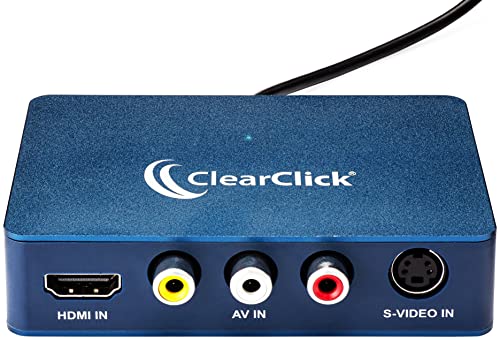
- HDMI, RCA, and S-Video inputs
- USB-C with USB-A adapter included
- Software and instructions included
Best For: Mixed HDMI, analog, VCR, and retro-console setups
Best HDMI Pick

- 1080p capture with 4K input support
- HDMI loop-out for low-latency play
- Plug-and-play with mic input
Best For: HDMI retro consoles and streaming setups
Best Analog-to-HDMI Option
VHS and Retro Console Capture Card
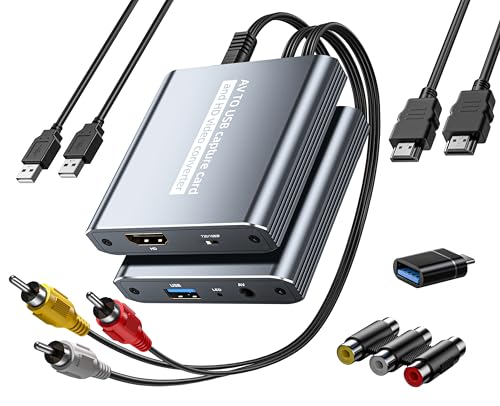
- Captures RCA/AV sources to a computer
- HDMI loop-out for live TV monitoring
- Includes cables and USB-C adapter
Best For: PS2, Wii, VCRs, and other analog sources
Best S-Video Choice

- Supports CVBS and S-Video inputs
- 1080p real-time PAL/NTSC capture
- Works with Windows, Mac, Linux, and Android
Best For: S-Video and composite retro consoles
Versatile Analog Archivist – 1080p VHS and Retro Console Capture Card
If you need a capture card for retro consoles as well as older video equipment, this Wonlyus model is built for broad analog compatibility. Its composite AV and component YPbPr inputs support systems such as the PS2, Wii, and N64, while USB connectivity sends video to a computer or compatible Android device.
Best For: Digitizing VHS tapes, recording component or composite retro gameplay, and archiving DVD or camcorder footage.
Pros:
- Supports both composite AV and YPbPr component inputs.
- Captures up to 1920×1080 at 60Hz.
- Works with Windows, Mac, Linux, and Android, plus OBS and other listed software.
- Physical input switch makes changing sources straightforward.
Cons:
- Uses USB 2.0 rather than USB 3.0.
- Designed for analog inputs, so it is not a direct HDMI capture solution.
This is a practical all-in-one option when your retro setup includes different analog connection types. The dual-input design and included cables make it especially useful for mixed collections of consoles, tapes, and DVD players.
Streaming Audio Hub – 1080p60 HDMI Game Capture Card
This HDMI model is a strong choice if your capture card for retro consoles will also handle modern streaming equipment. It accepts up to 4K30 input, captures at 1080p60, and adds microphone and headphone ports for commentary and monitoring during gameplay.
Best For: HDMI-equipped consoles, live game streaming, and creators who want simple voice-input and headphone connections.
Pros:
- Supports up to 4K30 input with 1080p60 capture.
- Includes 1080p60 HDMI loop-out for screen display.
- Provides 3.5mm microphone input and headphone output.
- Works with Windows, Linux, and Mac OS without an external power supply.
Cons:
- Requires a USB 3.0 computer port and advises against hubs or extension cables.
- Maximum stated output is 1080p at 60Hz.
- Uses HDMI, so older composite-only consoles need appropriate signal conversion.
With loop-out and dedicated audio ports, this generic capture card is aimed at a more complete streaming setup rather than basic digitization. It is most convenient when your console already provides HDMI and you want commentary without adding another audio device.
Analog Archive Specialist – VHS, RCA, and YPbPr USB Capture
The Anber-Tech converter is a focused capture card for retro consoles and analog media. It accepts composite AV and YPbPr component signals, then transfers the footage over USB 2.0 for recording, previewing, or archiving on a compatible computer.
Best For: VHS conversion, older DVD players, retro consoles with AV or component outputs, and analog camera footage.
Pros:
- Handles both CVBS composite and YPbPr component sources.
- Supports maximum acquisition up to 1920×1080 at 60Hz.
- Compatible with Windows, Mac, Linux, and Android systems.
- Input indicator lights and a switch help select the connected source.
Cons:
- USB 2.0 transmission may be less suitable for newer high-bandwidth workflows.
- Does not provide HDMI input according to the supplied specifications.
- Software compatibility is listed for mainstream third-party programs, not a dedicated application.
This model makes sense for users whose priority is preserving analog material rather than capturing HDMI devices. Its switchable input modes and included connection cables simplify working through a varied collection of legacy equipment.
Portable HDMI Streamer – 4K Input, 1080p60 USB Capture
For HDMI-based setups, the ELUTENG is a compact capture card for retro consoles that can also connect to laptops, tablets, and smartphones. It accepts up to 4K at 60Hz and outputs up to 1080p at 60Hz over USB 3.0 or USB-C for recording and streaming.
Best For: Portable HDMI gameplay capture on Windows, Linux, or Android devices, especially when both USB-A and USB-C connectivity are useful.
Pros:
- Accepts HDMI input up to 4K60 and captures up to 1080p60.
- Includes USB-A and USB-C connectivity through its adapter.
- Compact 30g aluminum-alloy design with a braided cable.
- Supports OBS, Twitch, YouTube, and PotPlayer on listed systems.
Cons:
- Not compatible with MacOS or iOS according to the supplied notes.
- Driver installation is required using the device’s built-in removable disk.
- Requires a USB 3.0 port.
This is a travel-friendly option for HDMI consoles and mobile streaming setups. Its main trade-off is platform coverage: Windows, Linux, and Android users get the intended compatibility, while Apple users should look elsewhere.
Best Analog Digitizer – RCA-to-USB Capture Card
If you need a capture card for retro consoles or older video equipment with composite outputs, this RCA-to-USB model is designed for straightforward digitizing. It accepts RCA or S-Video sources and sends video and audio to a Windows or Mac computer at up to 720p.
Best For: Converting VHS tapes, camcorder recordings, and compatible retro gaming systems with RCA or S-Video connections.
Pros:
- Supports RCA composite and S-Video inputs.
- Captures video and audio without requiring an external sound card.
- Plug-and-play setup with no external power needed.
- Supports NTSC and PAL, with image adjustment controls.
Cons:
- Maximum listed USB output is 720p.
- Requires separate acquisition software, such as OBS Studio, PotPlayer, or QuickTime Player.
- Uses legacy RCA and S-Video connections rather than HDMI.
This is a practical, compact choice for analog sources. Confirm that your console or player has RCA or S-Video output before buying, and plan to use compatible capture software on your computer.
Best for HDMI Gameplay – 1080p 60FPS Capture Card
For modernized retro-console setups using HDMI, this capture card for retro consoles combines 1080p 60fps capture with HDMI loop-out. The pass-through connection lets you play on an external display while recording or streaming through a computer.
Best For: HDMI-equipped consoles, including PS4, PS5, Xbox, Switch, and other HD video sources requiring low-latency pass-through.
Pros:
- Captures HDMI video at up to 1080p and 60fps.
- Provides real-time HDMI loop-out for playing on a separate display.
- Supports Windows, macOS, Linux, and iPadOS 17 or later.
- Includes a microphone input for commentary with a 3.5mm TRS headset.
Cons:
- Designed for HDMI sources, so RCA-only consoles need another converter.
- Microphone input accepts a 3.5mm TRS standard microphone headset.
- Capture and streaming still require compatible third-party software such as OBS.
Its loop-out and 1080p60 capture make it well suited to gameplay recording and streaming. Check your console’s output and your computer’s USB 3.0 compatibility for the intended setup.
Most Versatile Inputs – ClearClick Video2USB Capture
If your collection mixes HDMI and analog hardware, the ClearClick Video2USB is a flexible capture card for retro consoles and older media devices. It accepts HDMI, AV/RCA, and S-Video sources, connects over USB-C, and includes software and instructions for recording or live streaming.
Best For: Households capturing a mix of HDMI consoles, composite gaming systems, VCRs, camcorders, and other analog sources.
Pros:
- Supports HDMI, AV/RCA, and S-Video inputs.
- Captures HDMI sources up to 1080p and supports sources up to 4K 30fps.
- Analog video is automatically upscaled to HD resolution.
- USB-C plug-and-play design includes a full-size USB-A adapter and software.
Cons:
- Does not support copyrighted or content-protected HDMI sources.
- Analog upscaling is not the same as native HD output.
- Listed warranty is one year, shorter than some competing options.
This is the strongest fit when you want one device for varied inputs rather than a specialized HDMI-only or RCA-only solution. Its included software and USB adapters also simplify setup across newer and older computers.
Best HDMI Pick – 1080p 60FPS Capture Card
If you need a capture card for retro consoles that use HDMI, this VIXLW model offers a straightforward setup for systems such as the PS3, PS4, Xbox 360, Xbox One, and Wii U. It captures up to 1080p and includes HDMI pass-through for playing on a connected display while recording.
Best For: HDMI-equipped retro consoles and gamers who want low-latency pass-through with computer streaming.
Pros:
- Captures video at up to 1080p and supports 4K input up to 60Hz.
- HDMI loop-out supports playing with no stated gameplay delay.
- Plug-and-play operation works with Windows and Mac, plus software such as OBS, PotPlayer, and VLC.
- Includes a microphone input for commentary using a 3.5mm TRS headset.
Cons:
- It does not support 4K at 120Hz or 144Hz.
- Output is limited to up to 2K at 30Hz, while capture is up to 1080p.
- The listed warranty is 60 days.
This is the most versatile option here for HDMI-based retro hardware and modern consoles. It is less suitable for older systems that output RCA or S-Video without an additional converter.
Best Analog-to-HDMI Option – VHS and Retro Console Capture Card
For a capture card for retro consoles with RCA or other analog connections, this Fulfalic unit is designed for PS2, Wii, VCRs, DVD players, and camcorders. It can capture analog video to a computer while sending a live preview to an HDMI television or monitor.
Best For: Retro consoles and legacy video equipment using RCA/AV connections, especially when HDMI monitoring is useful.
Pros:
- Supports RCA/AV capture and HDMI loop-out for simultaneous viewing and recording.
- Works with PS2, Wii, VHS/VCR equipment, DVD players, and Hi8 camcorders.
- Offers switchable 720p/1080p HDMI output for TVs, projectors, and monitors.
- Includes an HDMI cable, AV cables, USB-C adapter, and other connection accessories.
Cons:
- Requires capture software such as OBS, PotPlayer, or QuickTime Player.
- The notes specify 1080p at 30fps for analog-to-digital capture.
- Audio setup in OBS may require restarting the software before sound output works.
This is the strongest choice for mixed retro collections because it combines analog inputs, HDMI output, and digitization features. Its 30fps capture specification makes it better suited to classic footage and gameplay than high-frame-rate recording.
Best S-Video Choice – CVBS and S-Video USB Capture
This HBFQMDJLX adapter is a practical capture card for retro consoles with CVBS or S-Video output. It connects older game systems, VCRs, DVD players, and cameras to a computer over USB for recording or streaming through compatible software.
Best For: Retro hardware with composite or S-Video outputs and users who want broad computer and operating-system compatibility.
Pros:
- Provides both CVBS/RCA and S-Video inputs for wider legacy-device support.
- Supports real-time PAL/NTSC acquisition and 1080p video capture.
- Compatible with Windows, Mac, Linux, and Android without requiring drivers.
- Works with OBS, PotPlayer, QuickTime, and XSplit.
Cons:
- Uses USB 2.0 rather than USB 3.0.
- It connects directly to a computer and does not list HDMI loop-out.
- The integrated cable is 1 meter long, which may limit placement flexibility.
Choose this model when S-Video support matters or when you need compatibility beyond Windows and Mac. It is a focused analog capture solution rather than an HDMI pass-through device.
How We Picked the Best Capture Card for Retro Consoles
We focused on the connections commonly used by retro hardware: composite AV, component YPbPr, S-Video, and HDMI. We also considered advertised capture resolution, frame-rate support, USB connectivity, pass-through features, audio handling, and compatibility with recording or streaming software.
Because product listings can use “4K” to describe pass-through rather than actual capture, we separated input or pass-through claims from the resolution the device records over USB. The best choice depends on your console, television setup, computer ports, and whether you prioritize simple archiving, low-latency gameplay, or live streaming.
Quick Comparison
| Best For | Connection To Look For | Useful Feature |
|---|---|---|
| Original composite consoles | RCA or CVBS | Analog audio capture |
| Component-equipped consoles | YPbPr | 1080p support and correct audio breakout |
| Older camcorders and VCRs | RCA or S-Video | Broad analog input compatibility |
| HDMI adapters and upscalers | HDMI | Low latency and USB 3.0 |
| Streaming setups | HDMI with pass-through | Separate display output |
Key Buying Factors for a Capture Card for Retro Consoles
Input Compatibility
Check the console’s actual output before buying. Composite systems need yellow, red, and white RCA connections; component systems use red, green, and blue video plugs plus separate audio; some cameras and VCRs work better through S-Video. HDMI capture cards will not accept analog signals without a converter or upscaler.
Capture Versus Pass-Through Resolution
A device advertised as 4K may only offer 4K pass-through while capturing at 1080p. For most retro games, 1080p capture is sufficient, but confirm whether the listing specifies 30 or 60 frames per second. Fast gameplay benefits from 60fps capture when the source and converter support it.
Latency and Connection Type
USB 3.0 is generally preferable for higher-bandwidth video and responsive streaming. HDMI pass-through lets you play on a television while the computer records, reducing the effect of preview delay. For simple VHS transfers, latency is usually less important than stable audio and video synchronization.
Software and Operating-System Support
Look for compatibility with common UVC software such as OBS, as well as your computer’s operating system. Some basic USB capture devices are plug-and-play, while bundled applications may be limited or outdated.
Who Should Buy Which Capture Card for Retro Consoles?
Choose an RCA, CVBS, or S-Video model if you are transferring VHS tapes, DVD footage, camcorder recordings, or consoles with standard-definition analog outputs. Choose a component-capable converter for systems that provide YPbPr and for users seeking a cleaner signal than composite can provide.
An HDMI capture card is the better fit for consoles connected through an HDMI upscaler, modern converter, or switch. Streamers should prioritize USB 3.0, 1080p60 support, reliable audio, and HDMI pass-through. Buyers who mainly want to archive tapes should prioritize broad analog compatibility, straightforward software support, and stable long-duration recording over 4K marketing claims.