The right sim racing pedals can improve braking consistency, control, and confidence more than a basic wheel upgrade. This roundup compares 10 options across entry-level, midrange, and advanced setups.
From console-compatible pedal sets to high-capacity load-cell and hydraulic designs, these picks cover different budgets, mounting needs, and driving styles.
Best 10 Sim Racing Pedals Picks for 2026
Best Overall
Logitech G RS Sim Racing Pedals

- 75 kg load-cell brake
- Hall Effect throttle and clutch sensors
- Adjustable, stable steel frame
Best For: Versatile PC and console racing setups
Best Adjustable Brake Feel

- Up to 90 kg measured brake force
- Three included elastomer hardness options
- RJ12 and standalone PC USB connection
Best For: Fanatec setups with tunable braking
Best Customization

- 100 kg load-cell brake
- 25 standard brake-feel configurations
- Adjustable angle, spacing, and height
Best For: Serious racers tuning a two-pedal setup
Best Hydraulic Feedback
SIMSONN Plus X Hydraulic Pedals
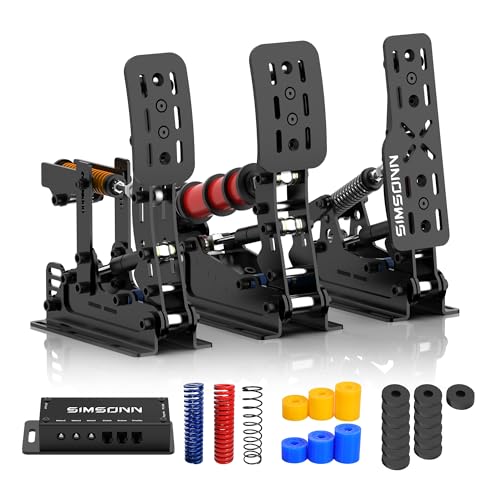
- Hydraulic brake with progressive feedback
- Three-pedal brake, throttle, and clutch set
- Software and haptic-module support
Best For: Dedicated PC rigs seeking immersive pedal tuning
Premium Modular Control

- 100kg load cell brake for pressure-based braking
- Swappable springs and elastomers customize pedal feel
- Modular spacing and PC/console compatibility
Best For: Dedicated sim racers wanting extensive adjustment and consistent braking
Upgradeable All-Metal Value
Thrustmaster Raceline Pedals III

- Three-pedal all-metal construction
- Adjustable resistance with multiple springs
- Optional load-cell upgrade and multi-platform support
Best For: Racers seeking durable pedals with room to upgrade
High-Pressure PC Performance
Simjack UT-P3-H3 200kg Load Cell Pedals
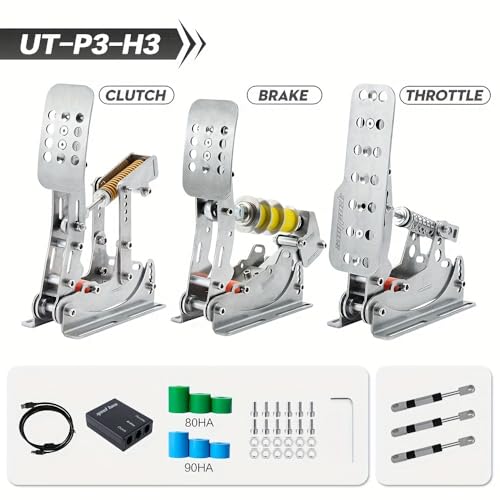
- 200kg load cell brake for force-focused driving
- Configurable curves, dead zones, and saved profiles
- Windows PC-only USB design with steel construction
Best For: PC sim racers wanting powerful braking and detailed tuning
Best Adjustable Value

- All-metal two-pedal construction
- Hall effect sensing and adjustable layout
- USB-A, Type-C, and RJ45 connectivity
Best For: PC racers and PXN wheel-base owners
Best Feature-Rich Load Cell Set

- Three-pedal load-cell configuration
- Adjustable hydraulic rod and elastomers
- Software curves, dead zones, and profiles
Best For: Enthusiasts seeking detailed brake tuning
Best Heavy-Duty PC Setup
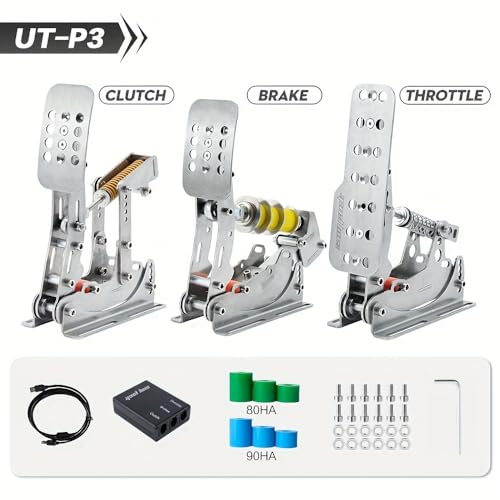
- Three-pedal PC configuration
- 200 kg load-cell brake specification
- Adjustable damping and USB plug-and-play setup
Best For: Windows PC cockpit and wheel-stand users
Best Overall – Logitech G RS Sim Racing Pedals
The Logitech G RS pedals are a versatile choice for sim racing pedals, combining a 75 kg load-cell brake with Hall Effect throttle and clutch sensors. Adjustable pedal placement and a stability-focused steel frame make them practical for both casual and serious racers.
Best For: Racers seeking a durable, adjustable pedal set with broad PC and console compatibility.
Pros:
- 75 kg load-cell brake supports consistent braking and trail braking.
- Contactless Hall Effect sensors provide precise throttle and clutch response.
- Adjustable pedal positions and a modular design support ergonomic customization.
- Anti-tip frame, rubber feet, carpet grippers, and a brace help limit movement.
Cons:
- Racing Adapter is sold separately for G-Series wheel compatibility.
- Optional RS Clutch Pedal Module is sold separately.
With strong stability, flexible mounting options, and cross-platform connection choices, these are well-rounded sim racing pedals for a variety of setups.
Best Adjustable Brake Feel – Fanatec CSL Elite Pedals V2
The Fanatec CSL Elite Pedals V2 stand out among sim racing pedals for their adjustable load-cell brake system. Included elastomers and a metal spring let you tune the pedal feel, while contactless sensors support durable throttle and clutch operation.
Best For: Fanatec users who want configurable brake resistance and a three-pedal layout.
Pros:
- Load-cell brake measures up to 90 kg of foot force at the pedal plate.
- Included 65, 75, and 85 Shore elastomers enable tool-free brake adjustment.
- Hall sensors on the throttle and clutch offer precise, contactless operation.
- Can connect by RJ12 to compatible Fanatec bases or by USB on PC.
Cons:
- Console compatibility depends on using a compatible licensed Fanatec base or wheel.
- Standalone USB use is for PC only.
This set is particularly appealing if brake tuning matters to you, though its console support is tied closely to the surrounding Fanatec ecosystem.
Best Customization – MOZA SRP2 Load Cell Pedals
The MOZA SRP2 pedals are performance-focused sim racing pedals built around a 100 kg load cell and adjustable geometry. Their aerospace-grade aluminum and steel construction, sensor fusion, and configurable spring and elastomer setup give racers substantial control over pedal feel.
Best For: Serious sim racers who prioritize braking precision, durability, and extensive physical adjustment.
Pros:
- 100 kg load cell delivers responsive brake-force measurement.
- Standard setup offers 25 brake-feel configurations through elastomers and springs.
- Pedal angle, spacing, and height can be adjusted for fit and control.
- CNC-machined aluminum and high-strength steel provide a robust construction.
Cons:
- The optional Performance Kit is required for the expanded 1,000-plus setup range.
- This is a two-pedal throttle-and-brake set rather than a three-pedal configuration.
For racers who want to fine-tune both brake behavior and ergonomics, the SRP2 offers a strong balance of precision, adjustability, and build quality.
Best Hydraulic Feedback – SIMSONN Plus X Hydraulic Pedals
The SIMSONN Plus X pedals bring hydraulic feedback and configurable damping to sim racing pedals for PC users. Their three-pedal layout includes a brake, throttle, and clutch, while software support and vibration-module ports add room for deeper tuning.
Best For: PC racers who want hydraulic brake behavior, adjustable pedal curves, and haptic expansion options.
Pros:
- Hydraulic brake system is designed to provide progressive pressure feedback.
- 60HA, 70HA, and 80HA elastomers with spacers allow varied brake-feel combinations.
- SIMSONN Manager supports output curves, dead zones, brake curves, and saved profiles.
- Three vibration-module ports support compatible SIMSONN haptic accessories.
Cons:
- Compatible with Windows PC only.
- Sold without a baseplate.
- Haptic motors and related accessories are not included.
These are a compelling option for a dedicated PC rig, especially when hydraulic feel, software adjustment, and future haptic upgrades are priorities.
Premium Modular Control – Logitech G PRO Racing Pedals
The Logitech G PRO Racing Pedals are premium sim racing pedals built around a 100kg load cell brake. They emphasize consistent pressure-based braking, adjustable pedal feel, and modular positioning for drivers who want to fine-tune their setup.
Best For: Serious sim racers seeking customizable, console-and-PC-compatible pedals with a strong load cell brake.
Pros:
- 100kg load cell brake supports consistent pressure-based braking and muscle memory.
- Swappable gas and clutch springs plus brake elastomers allow pedal-feel adjustments.
- Modular design supports horizontal spacing changes and individual pedal removal.
- Hall effect sensors provide contactless operation intended for long-term accuracy.
Cons:
- The premium feature set may be more than casual racers need.
- The listed dimensions are relatively substantial for compact setups.
Choose these pedals if braking consistency and extensive physical customization are priorities. Their broad compatibility and modular construction make them a versatile centerpiece for a dedicated racing rig.
Upgradeable All-Metal Value – Thrustmaster Raceline Pedals III
The Thrustmaster Raceline Pedals III are modular sim racing pedals with three pedals, frictionless H.E.A.R.T. sensors, and adjustable resistance. Their metal construction and non-slip pads suit both cockpit mounting and standalone use.
Best For: Multi-platform racers who want durable three-pedal hardware with adjustable feel and a future load-cell upgrade path.
Pros:
- H.E.A.R.T. sensors provide consistent, drift-free input without mechanical contact.
- Three pressure-adjustment notches and included springs help tailor pedal resistance.
- All-metal construction is designed for repeated hard braking and heel-toe driving.
- Non-slip pads help keep the set stable on carpet, hardwood, or tile.
Cons:
- The load-cell brake is an optional upgrade rather than included hardware.
- Its 4kg weight and larger listed footprint may not suit highly portable setups.
This is a practical starting point for sim racing pedals, especially if you want a sturdy three-pedal layout now and the option to add load-cell braking later. Its PC, PlayStation, and Xbox compatibility broadens its usefulness.
High-Pressure PC Performance – Simjack UT-P3-H3 200kg Load Cell Pedals
The Simjack UT-P3-H3 targets PC sim racers who want high-force sim racing pedals with a 200kg load cell brake and configurable output. Its USB connection, independent ADC processing, and control software provide detailed tuning options.
Best For: PC-only drivers building a force-focused simulator and willing to configure pedal curves and profiles.
Pros:
- 200kg load cell brake is designed for high-pressure, precise force measurement.
- Three-channel sampling supports simultaneous throttle, brake, and clutch input.
- Control software allows dead-zone, linearity, and brake-curve adjustments with saved profiles.
- Steel construction includes a thickened 6mm brake load-bearing section.
Cons:
- Compatibility is limited to Windows PCs and excludes PlayStation, Xbox, and Mac.
- The high-force design may require a suitably sturdy cockpit or wheel stand.
- Software configuration may be more involved than basic plug-and-play pedals.
For PC users prioritizing braking force and software adjustability, the UT-P3-H3 offers a feature-heavy option. Confirm your cockpit strength and platform compatibility before choosing this specialized pedal set.
Best Adjustable Value – PXN PD HM 2-Pedal Set
The PXN PD HM is a practical entry point for sim racing pedals when you want a durable two-pedal setup without adding a clutch. Its all-metal construction, Hall effect sensors, adjustable layout, and optional brake-resistance kit provide useful tuning flexibility for PC and compatible PXN wheel-base users.
Best For: PC racers and PXN wheel-base owners who want adjustable throttle and brake pedals.
Pros:
- All-metal construction delivers a sturdy, motorsport-inspired feel.
- Hall effect sensors provide non-contact input sensing with smooth response.
- Pedal angle, height, and spacing can be adjusted.
- USB-A, Type-C, and RJ45 connectivity supports PC and multiple PXN bases.
Cons:
- Only two pedals are included, so there is no clutch pedal.
- The enhanced brake-resistance setup requires manual installation of the included accessory.
- Compatibility is centered on Windows PC and PXN equipment.
This is a sensible choice for buyers prioritizing adjustability and broad PXN connectivity over a three-pedal layout or a full load-cell system.
Best Feature-Rich Load Cell Set – SIMSONN PRO X Ultra P3-H3
The SIMSONN PRO X Ultra P3-H3 is built for sim racers seeking a configurable three-pedal system with load-cell measurement and hydraulic-style brake adjustment. Its adjustable elastomers, software profiles, high-resolution processing, and extensive physical tuning make it a strong option for detailed pedal setup work on Windows.
Best For: Enthusiasts who want adjustable brake feel, a clutch pedal, and software-based calibration options.
Pros:
- Includes throttle, brake, and clutch pedals.
- Adjustable hydraulic resistance rod and multiple elastomer combinations let you tune brake feel.
- Load-cell components and 16-bit HID support enable precise pedal input.
- SIMSONN Manager supports curves, dead zones, brake settings, and saved profiles.
Cons:
- The package does not include a baseplate.
- The extensive adjustment options may require more setup time.
- The supplied notes specify Windows support, so platform compatibility should be checked before buying.
Choose this set when brake tuning and configuration depth matter more than plug-and-play simplicity; plan for a suitable mounting solution because no baseplate is included.
Best Heavy-Duty PC Setup – Simjack UT-P3 Pedals
The Simjack UT-P3 targets PC sim racers who want a substantial three-pedal arrangement with a high-capacity load-cell brake and hydraulic-style damping. It connects directly by USB without driver installation and combines adjustable brake materials with control software for input shaping.
Best For: Windows PC users building a sturdy cockpit or wheel-stand setup with adjustable brake pressure.
Pros:
- Three-pedal layout includes throttle, brake, and clutch.
- Load-cell brake is specified for up to 200 kg of pressure.
- 60, 80, and 90 hardness damping options support brake-feel adjustment.
- USB plug-and-play operation and Simjack Control software simplify setup.
Cons:
- It is PC-only and does not support PS4, PS5, Xbox, or Mac according to the supplied notes.
- The substantial steel construction weighs 8.9 kg.
- A cockpit or wheel stand with suitable mounting space is recommended.
This model suits buyers who value a robust, configurable pedal assembly and direct USB operation, provided they race on Windows and have compatible mounting hardware.
How We Picked These Sim Racing Pedals
We selected pedals that represent the main choices buyers face: potentiometer, load-cell, and hydraulic designs; two- and three-pedal layouts; console and PC compatibility; and a range of adjustment and mounting options. We also considered braking capacity, construction, software or ecosystem requirements, upgrade potential, and suitability for beginners through serious sim racers.
Specifications such as a 75 kg, 100 kg, or 200 kg load-cell rating describe sensor capacity, not necessarily the force every driver must apply. Real-world feel also depends on elastomers, springs, hydraulic resistance, calibration, mounting rigidity, and software settings.
Quick Comparison
| Type | Best For | Main Advantage | Watch For |
|---|---|---|---|
| Potentiometer | Beginners and casual racing | Lower cost and simple setup | Less realistic brake control |
| Load cell | Consistent braking | Measures pressure rather than travel | Needs a rigid mounting solution |
| Hydraulic or hybrid | Advanced immersion | More progressive, race-style resistance | Higher cost and greater adjustment complexity |
| Two-pedal set | GT, formula, and compact rigs | Saves space and simplifies installation | No clutch for manual cars |
| Three-pedal set | Manual and varied driving | Includes clutch control | Requires more room and mounting points |
Key Buying Factors for Sim Racing Pedals
Brake Technology and Adjustability
A load-cell brake is usually the biggest performance step over entry-level pedals because it lets you build muscle memory around pressure. Look for adjustable elastomers, springs, preload, brake travel, and calibration range. Hydraulic systems can add a convincing progressive feel, but they are not automatically faster or easier to tune.
Compatibility and Connections
Check whether the pedals connect directly by USB or require a compatible wheelbase. PC support is common, while PlayStation and Xbox compatibility may depend on the wheel ecosystem, adapter, or console-approved connection method. Confirm compatibility with your exact platform before ordering.
Mounting and Rig Requirements
High-force pedals can slide, flex, or lift a lightweight stand. A rigid cockpit or reinforced pedal plate is especially important for 100 kg and higher-rated load-cell systems. Verify bolt patterns, included hardware, pedal-plate angle, and available space.
Software, Haptics, and Maintenance
Driver software can provide calibration, dead-zone adjustment, and firmware updates. Haptic-reactor support may add useful ABS, traction, or wheel-slip feedback, but it can require separate motors, software, and wiring. Hydraulic models may also need more care than conventional load-cell pedals.
Who Should Buy Which Sim Racing Pedals?
Choose a modular or lower-cost set if you are building your first rig, use a flexible stand, or want straightforward installation. Choose load-cell pedals if consistent braking and lap-time improvement are your priorities. Choose hydraulic or haptic-ready pedals if you already have a rigid cockpit and want deeper tuning and immersion. Choose a three-pedal set for manual cars and rally use; a two-pedal set is often enough for GT or formula-style driving. Finally, match the pedals to your console and wheel ecosystem before prioritizing maximum brake-force ratings.