The right equalizer can turn a muddy, unbalanced system into a cleaner and more enjoyable listening setup. These 10 parametric audio equalizers cover compact car-audio controls, high-output line drivers, crossover-equipped processors, and home stereo preamps.
Use the guide below to compare signal routing, adjustment range, connectivity, and installation needs before choosing the model that fits your system.
Best 10 Parametric Audio Equalizers Picks for 2026
Compact Car Tuning
CT-7EQ 7-Band Parametric Equalizer
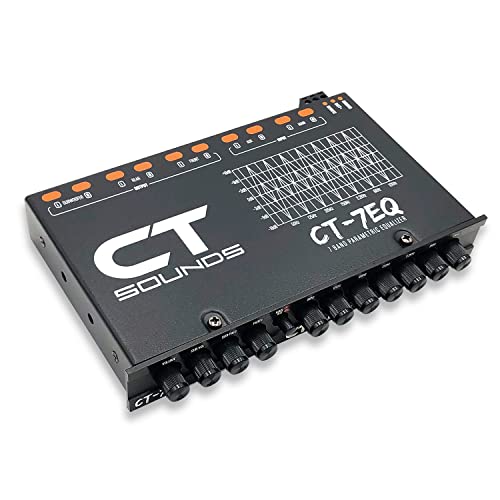
- Seven bands span 20Hz–20kHz
- Separate bass, mid, and treble adjustment
- Includes sub-bass controls and mounting hardware
Best For: Compact car-audio installations
Rackmount Precision
REQ231 V2 Dual 31-Band Graphic EQ

- Dual 31-band, 1/3-octave control
- Selectable ±6dB or ±12dB range
- Balanced pro inputs, outputs, and rack-mount build
Best For: Live sound and installed audio racks
Subwoofer-Focused Control

- Four bands offer ±12dB adjustment
- Up to 9V RMS master output
- Independent subwoofer level and frequency controls
Best For: Bass-focused car-audio tuning
Half-DIN Crossover Tuning
ATEQ709 4-Band EQ with Crossover

- Four-band preamp EQ in a half-DIN format
- Built-in front/rear active crossover
- 9V line-driver output and source selection
Best For: Integrated car-audio signal management
Best Home Stereo Pick
Douk Audio T7 7-Band Balanced EQ

- Seven bands with ±6dB adjustment
- XLR and RCA input/output connectivity
- High SNR and low distortion
Best For: Home stereo users wanting simple EQ control and flexible connections
Best Car Audio Control Hub
Stetsom EQX764 7-Band Equalizer

- Four inputs and six outputs
- Dedicated subwoofer level and frequency controls
- Up to 10 VRMS line-driver output
Best For: Multi-amplifier car audio systems with front, rear, and subwoofer zones
Best Flexible Car Tuning Value

- Variable-gain seven-band equalizer
- High-level speaker input
- Six-channel front, rear, and subwoofer outputs
Best For: Car audio installations needing flexible inputs and subwoofer control
Compact High-Voltage Pick
Timpano TPT-EQ7 7-Band Equalizer

- Seven bands with ±12dB adjustment
- Up to 10V RCA output and six channels
- Built-in high-level input converter
Best For: Compact factory-radio upgrades with added amplifiers
Hands-On Tuning Choice
7-Band Car Audio Graphic Equalizer

- Seven bands from 63Hz to 12kHz
- 30–120Hz dedicated subwoofer control
- Front, rear, and subwoofer outputs
Best For: Drivers who prefer physical tuning controls
Precision Parametric Control
SoundXtreme ST-EQ755 Equalizer

- Seven bands from 50Hz to 16kHz
- Up to 8V RMS active preamp output
- Independent input sensitivity controls
Best For: Multi-amplifier systems needing detailed signal matching
Compact Car Tuning – CT-7EQ 7-Band Parametric Equalizer
The CT Sounds CT-7EQ is a practical choice for car-audio systems that need focused frequency shaping in a compact half-DIN chassis. As parametric audio equalizers go, its seven bands divide the 20Hz–20kHz range into useful segments, while separate bass, mid, and treble controls help refine the overall balance.
Best For: Car-audio installations needing compact, seven-band tone control and sub-bass adjustment.
Pros:
- Seven bands cover frequencies from 20Hz to 20kHz.
- Provides ±10dB bass, mid, and treble adjustment.
- Includes 43Hz and 60Hz sub-bass controls.
- Installation brackets and hardware are included.
Cons:
- Offers fewer bands than professional 31-band graphic equalizers.
- Designed specifically for car-audio applications rather than general rack use.
With a 25Hz–50kHz frequency response, +16dB output level, and a compact 1/2-DIN format, the CT-7EQ suits straightforward in-vehicle system tuning where installation space matters.
Rackmount Precision – REQ231 V2 Dual 31-Band Graphic EQ
The Rockville REQ231 V2 is built for detailed system correction in live-sound and installed-audio setups. Although it is a graphic rather than parametric model, its dual 31-band, 1/3-octave layout provides extensive control across 20Hz–20kHz and complements buyers comparing professional parametric audio equalizers.
Best For: Rack-mounted live-sound and installed systems requiring two-channel, fine-grained frequency control.
Pros:
- Dual 31-band control covers the full 20Hz–20kHz range.
- Selectable ±6dB or ±12dB boost/cut supports flexible tuning.
- Low-cut and high-cut filters help manage rumble and extreme frequencies.
- Balanced XLR and 1/4-inch TRS connectivity is suited to pro systems.
Cons:
- Its 7-pound rack-mount design is less suitable for compact setups.
- It is a graphic EQ, not a parametric equalizer.
True bypass, output metering, a dedicated subwoofer output, and selectable filter controls make the REQ231 V2 a feature-rich option for users who prioritize broad, precise system management over portability.
Subwoofer-Focused Control – GR-EQP11 Digital Bass Machine
The Gravity GR-EQP11 combines four-band parametric equalization with dedicated subwoofer controls for in-car tuning. It is a useful candidate among parametric audio equalizers when you want to adjust low, midrange, and high frequencies while independently managing bass level and subwoofer frequency.
Best For: Car-audio enthusiasts who want parametric tone shaping with independent subwoofer control.
Pros:
- Four parametric bands provide ±12dB boost or cut.
- Master volume delivers up to 9V RMS output.
- Dedicated subwoofer level and frequency controls simplify bass integration.
- 30V bipolar switching power circuitry supports the equalizer functions.
Cons:
- Four bands provide less frequency coverage than seven- or 31-band designs.
- The supplied notes do not specify included installation hardware.
The GR-EQP11 is best viewed as a bass-oriented preamp equalizer: it offers meaningful ±12dB adjustments and strong output capability, but its standout feature is the ability to tailor subwoofer output separately from the main speakers.
Half-DIN Crossover Tuning – ATEQ709 4-Band EQ with Crossover
The Autotek ATEQ709 combines four-band preamp equalization with an active front/rear crossover in a half-DIN car-audio chassis. For shoppers evaluating parametric audio equalizers, its appeal is the combination of tone shaping, source selection, line-driving output, and crossover functions in one compact component.
Best For: Car-audio systems needing compact EQ, front/rear crossover control, and source-level management.
Pros:
- Combines a four-band preamp EQ with a built-in two-way crossover.
- Line-driver circuit provides a 9-volt preamp-level signal through the RCAs.
- Audio input selector switches between a head unit and another source.
- Separate input controls help match radio and media-device volume levels.
Cons:
- Four bands offer less detailed shaping than higher-band-count equalizers.
- The supplied notes do not list specific EQ boost/cut ranges.
With front/rear active crossover functionality, selectable 12dB high-pass crossover operation, and master SPL-level control, the ATEQ709 fits installations where signal routing and system integration matter as much as basic equalization.
Best Home Stereo Pick – Douk Audio T7 7-Band Balanced EQ
For listeners comparing parametric audio equalizers for a home stereo, the Douk Audio T7 offers straightforward seven-band tone shaping across key bass, midrange, and treble frequencies. Its XLR and RCA connectivity makes it a practical fit for systems that use either connection type.
Best For: Home stereo users who want simple, flexible EQ control with balanced and unbalanced connections.
Pros:
- Seven adjustable bands from 64Hz to 8kHz with a -6dB to +6dB range.
- Provides both XLR and RCA inputs and outputs simultaneously.
- Reports an SNR above 104dB, distortion as low as 0.003%, and 20Hz-20kHz response.
- Compact aluminum alloy housing helps provide shielding against interference.
Cons:
- No volume control knob; it outputs at the rated level.
- Its seven fixed bands may offer less precise control than a fully adjustable parametric design.
The T7 is a focused choice for a clean, compact home setup where connection flexibility matters. Its fixed-band layout is easy to use, but buyers seeking adjustable center frequencies should consider a different type of equalizer.
Best Car Audio Control Hub – Stetsom EQX764 7-Band Equalizer
The Stetsom EQX764 is a strong option for car audio enthusiasts evaluating parametric audio equalizers with multi-amplifier support. It combines seven-band adjustment with four inputs, six outputs, dedicated subwoofer controls, and line-driver output up to 10 VRMS.
Best For: Multi-amplifier car systems that need front, rear, and subwoofer routing with centralized level control.
Pros:
- Seven bands cover 50Hz, 125Hz, 315Hz, 750Hz, 2.2kHz, 6kHz, and 16kHz with 12dB adjustment ranges.
- Four inputs and six outputs support multiple sources and amplifiers.
- Dedicated subwoofer level and frequency controls simplify low-end tuning.
- Outputs can reach 10 VRMS and function as a line driver.
Cons:
- Designed for car audio installations rather than typical home stereo systems.
- The extensive routing and control layout may be more than a simple system needs.
With dedicated front, rear, and subwoofer controls, the EQX764 is particularly suited to systems built around several amplifiers. Its value is greatest when you will use its expanded input, output, and routing capabilities.
Best Flexible Car Tuning Value – Mulcort 7-Band Car EQ
For car owners seeking parametric audio equalizers with practical installation features, this Mulcort model combines seven-band gain adjustment with high-level speaker input and six-channel front, rear, and subwoofer outputs. Separate source and subwoofer controls add flexibility during system tuning.
Best For: Car audio setups needing high-level input, multiple outputs, and hands-on control over bass distribution.
Pros:
- Seven-band graphic EQ provides variable gain adjustment.
- High-level speaker input supports more installation options.
- Six-channel front, rear, and subwoofer outputs help feed amplifiers clearly.
- Includes subwoofer level and frequency controls, fader adjustment, and CD/Aux switching.
Cons:
- The supplied notes do not specify the individual EQ frequencies or adjustment range.
- It is a car-focused component and may not suit home audio systems.
- The multiple controls may require more setup time than a basic EQ.
This model is a practical fit when input flexibility and output routing are priorities. Its high-level input and dedicated subwoofer controls make it useful for integrating with varied car audio systems, though the unspecified frequency details may matter to shoppers seeking precise published tuning ranges.
Compact High-Voltage Pick – Timpano TPT-EQ7 7-Band Equalizer
For drivers seeking parametric audio equalizers with flexible installation options, the Timpano TPT-EQ7 combines seven adjustable bands, subwoofer control, crossover functionality, and six-channel RCA output in a slim 1/2-DIN-style chassis. Its built-in high-level input converter also supports factory-radio upgrades.
Best For: Compact factory-radio systems that need amplifier integration and straightforward tonal adjustment.
Pros:
- Seven adjustable frequencies from 50Hz to 16kHz with ±12dB control
- Up to 10V RCA output and six-channel signal routing
- Built-in speaker-wire-to-RCA converter for factory radios
- Slim design fits tight dash or console spaces
Cons:
- Analog controls may be less precise than digital tuning interfaces
- Its feature set is focused on car audio rather than broader audio applications
The TPT-EQ7 is a practical choice when installation space is limited and you want a strong preamp signal, dedicated bass adjustment, and an easy way to connect amplifiers to a factory source.
Hands-On Tuning Choice – 7-Band Car Audio Graphic Equalizer
This seven-band model suits buyers who want parametric audio equalizers with tactile controls and dedicated bass management. It provides CD and Aux input selection, front/rear/subwoofer outputs, adjustable fader, and separate subwoofer frequency control in a sturdy metal chassis.
Best For: Drivers who prefer physical rotary controls and flexible source, fader, and subwoofer adjustments.
Pros:
- Seven bands spanning 63Hz to 12kHz with ±12dB adjustment
- Dedicated subwoofer frequency control from 30Hz to 120Hz
- Front, rear, and subwoofer outputs provide six-channel routing
- CD/Aux switching and gain control add source flexibility
Cons:
- Larger 7.3 x 4.3 x 1.2-inch footprint may limit installation locations
- Operates on 12V power and is intended specifically for vehicle systems
Choose this equalizer if accessible knobs matter more than a particularly compact chassis. Its broad bass-frequency adjustment and dedicated output layout make it suitable for hands-on tuning of a multi-amplifier car system.
Precision Parametric Control – SoundXtreme ST-EQ755 Equalizer
The SoundXtreme ST-EQ755 is a focused option among parametric audio equalizers, offering seven familiar frequency bands, independent input sensitivity controls, and dedicated front, rear, and subwoofer RCA outputs. Its active gain preamp and selectable subwoofer crossover add useful control for multi-amplifier installations.
Best For: Expanded car audio systems using separate front, rear, and subwoofer amplifiers.
Pros:
- Seven bands from 50Hz to 16kHz with ±12dB adjustment
- Up to 8V RMS output with built-in active gain preamp
- Independent left and right input sensitivity controls
- Selectable 60Hz or 90Hz subwoofer frequency switch
Cons:
- At 1.63 pounds, it is heavier than some compact equalizers
- Its 1/2-DIN format may still require custom dash or console installation
With independent sensitivity matching and three dedicated stereo outputs, the ST-EQ755 is especially well suited to users refining gain structure across multiple amplifiers. The AUX/DVD selector and illuminated controls add practical convenience without changing its installation-focused design.
How We Picked the Best Parametric Audio Equalizers
We evaluated these models by focusing on the features that affect real-world setup and sound control: equalization range, number of bands, output voltage, crossover functions, input and output options, subwoofer control, physical format, and intended use. We also separated car-focused units from home-audio equipment because their connections, power requirements, and installation methods differ.
A high line-output rating can help reduce the need for excessive amplifier gain, while multiple RCA outputs make it easier to control front, rear, and subwoofer channels independently. However, specifications should be matched to the rest of your system rather than treated as a standalone measure of quality.
Quick Comparison
| Best For | Look For | Why It Matters |
|---|---|---|
| Basic car-system tuning | Compact size and simple band controls | Easy installation and quick adjustments |
| Multi-channel car audio | Front, rear, and subwoofer outputs | More precise system-wide level control |
| Subwoofer-heavy systems | Sub level, bass controls, and crossover | Better low-frequency integration |
| Home stereo systems | RCA or balanced XLR connectivity | Compatibility with preamps, amplifiers, and powered speakers |
| Noise-sensitive installations | Higher-voltage outputs and solid signal routing | Can provide cleaner gain structure when properly installed |
Key Buying Factors for Parametric Audio Equalizers
Band Count and Adjustment Style
More bands offer finer control, but they also require more careful tuning. A seven-band unit is often a practical middle ground for correcting broad peaks and dips. Graphic equalizers use fixed frequency centers, while parametric designs typically provide more targeted control over frequency, gain, and sometimes bandwidth.
Outputs, Inputs, and System Compatibility
Check whether the equalizer accepts the source signal you use, including RCA, high-level, AUX, or balanced XLR connections. For a multi-amp car system, front, rear, and subwoofer outputs are especially useful. Confirm the number of channels, connector types, and whether the unit can handle your source and amplifier voltage expectations.
Crossover and Subwoofer Controls
Built-in high-pass, low-pass, or two-way crossover controls can reduce the need for separate processing equipment. Dedicated subwoofer level control is valuable when you want to adjust bass quickly from the driver’s seat, but crossover ranges and slopes vary, so review the specifications before purchase.
Installation and Gain Structure
Most car models use a 1/2-DIN format and require switched power, ground, remote turn-on wiring, and RCA routing. Keep signal cables away from power wiring where possible. Set the equalizer and amplifier gains conservatively to avoid clipping; a high-voltage line driver does not automatically guarantee noise-free sound.
Who Should Buy Which Parametric Audio Equalizers?
Choose a compact seven-band car equalizer if you want straightforward tone shaping without adding a complex processor. A model with several RCA outputs and a crossover is better for front, rear, and subwoofer amplifier systems. Bass-focused systems should prioritize subwoofer level control and adjustable low-frequency filtering.
For a home stereo, choose a unit with the correct RCA or XLR connections and a desktop-friendly form factor rather than a vehicle-oriented 1/2-DIN design. If you are building a competition-level or highly customized system, prioritize flexible routing and precise tuning, and consider whether a dedicated digital signal processor would provide more control than a basic analog equalizer.