Choosing among the best 3D printers for miniatures means balancing fine detail, print volume, speed, cleanup, and operating cost. Resin printers generally deliver the sharpest faces, textures, and small accessories, while modern FDM machines offer cleaner workflows and more flexible material choices.
Our selection includes compact entry-level printers, high-resolution MSLA models, fast production machines, and multicolor options. Use the guide below to match the printer’s strengths with your preferred miniature scale, printing habits, and workshop setup.
Best 10 3d Printers for Miniatures Picks for 2026
Best Value Detail

- 22-micron XY resolution with an 8K mono LCD
- Supports Lychee, Chitubox, and Tango
- Compact resin printer for models and miniatures
Best For: Beginners seeking detailed resin miniatures
Premium Precision Pick

- 16K resin printing for highly detailed models
- 30 °C smart tank heating supports adhesion
- Auto-leveling, AI monitoring, and up to 150 mm/h
Best For: Detail-focused users wanting automated resin printing
Best Multicolor FDM Option

- Up to 600 mm/s with automatic calibration
- AMS 2 Pro adds multicolor and filament drying
- Adaptive airflow supports varied filament types
Best For: Makers prioritizing speed and multicolor FDM printing
Best Compact 10K Resin Pick

- 10K LCD with 17-micron XY pixel size
- Compact 7.7-pound resin printer
- Beginner-friendly leveling and power resume
Best For: Beginners wanting detailed prints in a small footprint
Best High-Speed FDM Pick

- Automatic leveling simplifies setup
- Optional 0.25mm nozzle supports finer detail
- CoreXY design reaches up to 600mm/s
Best For: Fast, convenient FDM printing with flexible nozzle options
Best Detail-Focused Resin Pick

- 9K LCD delivers 18µm XY resolution
- AI camera monitors common print issues
- WiFi supports remote and cluster printing
Best For: Highly detailed resin miniatures with smart monitoring
Best Multi-Color FDM Pick

- Supports up to four colors
- Optional 0.25mm nozzle targets fine details
- Auto leveling and feeding simplify operation
Best For: Fast, colorful FDM miniature production
Easy-Start Detail Pick
- One-click automatic leveling
- 4K mono LCD for fine detail
- Built-in checks and overheat protection
Best For: Beginners printing detailed resin miniatures
High-Speed Pro Pick

- 14K detail with 16.8 × 24.8 μm XY resolution
- Up to 170mm/h with high-speed resin
- Automated filling and intelligent detection
Best For: Batch printing and high-detail miniature work
Balanced 10K Choice

- 10K detail with 17 × 17 μm XY pixels
- Up to 120mm/h printing speed
- Five inspections and multilingual interface
Best For: Hobbyists wanting sharp detail and simple operation
Best Value Detail – Phrozen Sonic Mini 8K
For shoppers comparing 3d printers for miniatures, the Phrozen Sonic Mini 8K offers a compact resin-printing setup focused on fine detail and straightforward compatibility. Its 22-micron XY resolution, 8K monochrome LCD, and support for popular slicers make it a practical choice for detailed models and small figures.
Best For: Beginners and hobbyists who want high-detail resin prints in a compact footprint.
Pros:
- 22-micron XY resolution and an 8K monochrome LCD are designed for intricate miniature details.
- Supports open-source software and slicers including Lychee, Chitubox, and Tango.
- Compact body with a 16.5 x 7.2 x 17 cm printing volume and a listed 22-pound load capacity.
Cons:
- Its build volume is better suited to miniatures and models than large prints.
- At 22 pounds, it is not especially lightweight for frequent relocation.
The Sonic Mini 8K is a sensible entry point when miniature detail matters more than maximum build size. Its familiar slicer support and precise Z-axis calibration add flexibility for new users.
Premium Precision Pick – ELEGOO Saturn 4 Ultra 16K
The ELEGOO Saturn 4 Ultra 16K is built for shoppers who want highly detailed resin output with more automation. Its 16K resolution, heated resin tank, automatic leveling, AI monitoring, and tilt-release system target both print quality and a smoother workflow for miniature projects.
Best For: Experienced hobbyists and detail-focused users who value automation, monitoring, and fast resin printing.
Pros:
- 16K resolution is designed to produce smooth surfaces, lifelike textures, and fine details.
- Smart tank heating maintains resin at 30 °C to support fluidity and layer adhesion.
- Automatic leveling, AI camera monitoring, residue detection, and tilt release streamline printing.
- Advertised print speeds reach up to 150 mm/h.
Cons:
- Its 35.5-pound weight and 24 x 17 x 15-inch dimensions require a dedicated workspace.
- AI detection results can vary with the environment, model, and resin type.
This Saturn model stands out when you want premium miniature detail without giving up convenience features. The heated tank and automated checks are particularly useful for users running frequent or longer prints.
Best Multicolor FDM Option – Bambu Lab P2S Combo
Unlike the resin machines in this roundup, the Bambu Lab P2S Combo is an FDM printer aimed at fast, versatile production, including multicolor projects through its AMS 2 Pro system. It combines automatic calibration, AI failure detection, filament drying, and speeds up to 600 mm/s for users who want a broader material and workflow setup.
Best For: Makers who want fast FDM printing, multicolor capability, and support for varied filament types.
Pros:
- Prints at speeds up to 600 mm/s while maintaining sharp corners and consistent layers.
- AMS 2 Pro enables multicolor and multimaterial printing and dries filament up to 65 °C.
- Automatic calibration, quick-swap nozzles, and AI failure detection support a quick setup.
- Adaptive airflow supports both overhang cooling and a chamber temperature up to 50 °C.
Cons:
- The P2S printer itself does not support multicolor printing; the Combo configuration is required.
- At 46.3 pounds and 18 x 22 x 18 inches, it needs substantial workspace.
The P2S Combo is a strong alternative if your miniature projects extend beyond resin-level detail into multicolor or larger FDM workflows. Choose it for speed and material flexibility rather than the ultra-fine surface detail typically associated with resin.
Best Compact 10K Resin Pick – ANYCUBIC Photon Mono 4
The ANYCUBIC Photon Mono 4 is a compact resin printer for shoppers seeking detailed miniature output without a large machine. Its 7-inch 10K monochrome LCD, 17-micron XY pixel size, uniform LighTurbo exposure, and beginner-friendly four-point leveling make it an accessible option for hobby projects.
Best For: Beginners and hobbyists who want a lightweight, compact resin printer with fine detail.
Pros:
- 10K resolution and 17 x 17-micron XY pixels support highly detailed models.
- LighTurbo matrix lighting is designed to reduce layer lines and rasterization.
- The 153.4 x 87 x 165 mm build volume accommodates everyday models and projects.
- Laser-engraved platform improves adhesion, while power-resume can reduce wasted material.
Cons:
- Anycubic APP service is not supported on the Photon Mono 4.
- The four-point leveling process still requires tightening four screws during initial setup.
With its small 7.7-pound body and strong resolution, the Photon Mono 4 is easy to place in a hobby workspace. It is a practical pick for detailed miniatures when app connectivity is not a priority.
Best High-Speed FDM Pick – FlashForge Adventurer 5M
For makers comparing 3d printers for miniatures, the FlashForge Adventurer 5M is a practical FDM option with automatic leveling, a direct-drive extruder, and support for fine 0.25mm nozzles. Its CoreXY design also makes it suitable when speed matters.
Best For: Makers who want a fast, low-fuss FDM printer for miniatures and broader creative projects.
Pros:
- Automatic bed leveling helps simplify first-layer setup.
- Supports optional nozzle sizes from 0.25mm to 0.8mm for different detail and speed needs.
- CoreXY motion, vibration compensation, and dual-fan cooling support high-speed printing.
- Remote monitoring and controls are available through Flash Studio.
Cons:
- The standard included nozzle is 0.4mm; the finer 0.25mm nozzle is optional.
- Its 220 x 220 x 220mm build volume may be more than needed for small miniatures but limits oversized projects.
The Adventurer 5M is a flexible choice if you prefer filament printing and want convenient automation. For the finest miniature detail, plan on using the optional fine nozzle and appropriate settings.
Best Detail-Focused Resin Pick – ELEGOO Mars 5 Ultra
Among 3d printers for miniatures, the ELEGOO Mars 5 Ultra stands out as a resin model built around fine detail. Its 9K monochrome LCD, 18µm XY resolution, and uniform COB light source are designed for precise, lifelike models.
Best For: Miniature makers prioritizing detailed resin prints, smart monitoring, and streamlined calibration.
Pros:
- 9K LCD and 18µm XY resolution support highly detailed models.
- Smart mechanical sensing can alert you to low resin, foreign objects, or temperature issues.
- Built-in AI camera detects problems such as empty build plates and model warping.
- WiFi file transfer and cluster printing enable convenient remote workflows.
Cons:
- As a resin printer, it requires a resin-based workflow rather than filament printing.
- The listed 150mm/h maximum speed may vary by print mode and setup.
The Mars 5 Ultra is the strongest fit here when miniature surface detail is the priority. Its sensors, camera, and wireless features also reduce hands-on monitoring during prints.
Best Multi-Color FDM Pick – FlashForge AD5X Multi-Color
The FlashForge AD5X adds multi-color capability to a fast CoreXY platform, making it an appealing option among 3d printers for miniatures when color variety and automated operation matter. It supports up to four colors and offers a fine nozzle option for detail-focused work.
Best For: Makers who want multi-color FDM miniatures, fast batch printing, and remote control features.
Pros:
- Supports printing with up to four colors simultaneously.
- Automatic leveling and filament feeding simplify operation.
- CoreXY motion reaches up to 600mm/s with vibration compensation and dual-channel cooling.
- Optional 0.25mm nozzle is suited to finer miniature details.
Cons:
- The 0.25mm detail nozzle is optional; the included nozzle is 0.4mm.
- Multi-color printing adds workflow complexity compared with single-color printing.
- The 220 x 220 x 220mm build volume is not intended for very large models.
The AD5X is a compelling choice for colorful filament miniatures and repeated production. Choose it over a simpler FDM printer when four-color output and automated material handling are central to your projects.
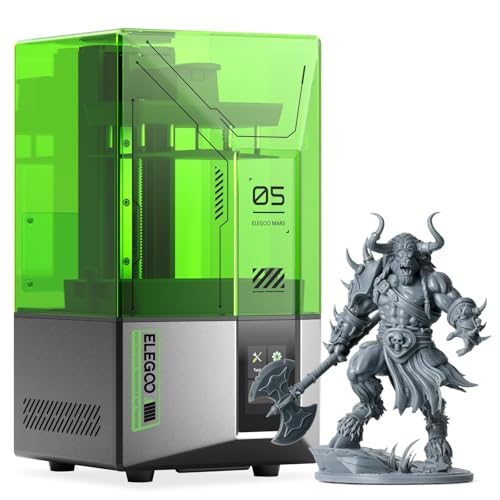
Easy-Start Detail Pick – ELEGOO Mars 5
The ELEGOO Mars 5 is a practical entry point for anyone shopping for 3d printers for miniatures. Its one-click automatic leveling, self-check routine, and 4K monochrome LCD are designed to reduce setup friction while preserving the fine textures and details miniature printing demands.
Best For: Beginners and hobbyists who want detailed resin miniatures with simpler setup and built-in safety checks.
Pros:
- One-click automatic leveling helps minimize calibration work.
- 4K mono LCD and COB lighting reproduce intricate model details.
- Residue detection, resin-shortage alerts, and self-check features can reduce avoidable printing problems.
- Overheat protection automatically stops printing if LED temperature exceeds 80°C.
Cons:
- Its 4K resolution is lower than the 10K and 14K options in this roundup.
- The supplied notes do not specify printing speed or build volume.
The Mars 5 stands out for approachable operation rather than maximum resolution or speed. If you want a less intimidating resin workflow and dependable detail for miniature projects, it is a sensible choice.
High-Speed Pro Pick – ANYCUBIC Photon Mono M7 PRO
The ANYCUBIC Photon Mono M7 PRO is aimed at shoppers who want fast, highly detailed output from 3d printers for miniatures. Its 14K monochrome LCD, advertised speeds up to 170mm/h with high-speed resin, and automated resin handling make it suited to productive hobby or batch printing.
Best For: Experienced miniature makers who prioritize high resolution, faster production, and automated resin management.
Pros:
- 14K resolution and 16.8 × 24.8 μm XY resolution support highly detailed models.
- Print speeds reach up to 170mm/h with high-speed resin and 130mm/h with standard resin.
- Temperature-controlled resin, auto-fill, and one-key resin recycling streamline operation.
- Six intelligent detection systems help identify setup, resin, and failed-print issues.
Cons:
- Its 33.3-pound weight and larger listed dimensions may require a dedicated workspace.
- Some speed claims depend on high-speed resin and specified testing conditions.
- The higher-end feature set may be more than casual users need.
The M7 PRO is the strongest fit here for users who value throughput without giving up miniature-level detail. Its automation is particularly useful when running repeated prints, though the printer demands more space and a more substantial setup.
Balanced 10K Choice – ANYCUBIC Photon Mono 4 Ultra
The ANYCUBIC Photon Mono 4 Ultra offers a balanced option among 3d printers for miniatures, combining 10K resolution with a compact listed footprint and a maximum advertised speed of 120mm/h. Its release-film design, uniform COB lighting, and inspection tools target consistent detail with easier day-to-day operation.
Best For: Hobbyists seeking sharp miniature detail, dependable release performance, and a straightforward interface.
Pros:
- 7-inch 10K screen with 17 × 17 μm XY pixel size supports detailed models.
- ACF film and an intelligent release algorithm can improve release speed and surface smoothness.
- COB lighting and at least 90% light uniformity help support consistent layers.
- Five intelligent inspections and an eight-language interface simplify operation.
Cons:
- Its 10K resolution is below the M7 PRO’s 14K specification.
- The supplied notes do not state the printer’s build volume or resin-heating capability.
The Mono 4 Ultra is a well-rounded middle ground: sharper than basic resin machines, but less feature-heavy than the M7 PRO. It is a good match for miniature hobbyists who want detail and workflow assistance without choosing the largest printer in the group.
How We Picked the Best 3d Printers for Miniatures
We focused on the features that most affect miniature results: XY resolution, layer-height capability, exposure and leveling systems, build volume, print speed, reliability, and ease of maintenance. Resin models received particular attention for their ability to reproduce facial features, armor textures, thin weapons, and other fine details. We also included several FDM printers because they provide larger build areas, easier material handling, and useful multicolor workflows for terrain, display pieces, and less intricate models.
We considered the intended user as well as headline specifications. A printer with extreme resolution is not automatically the best choice if its software, cleaning process, or operating cost makes it difficult to use consistently.
Quick Comparison
- Best fine-detail focus: High-resolution MSLA printers such as the ELEGOO Saturn 4 Ultra 16K and Phrozen Sonic Mini 8K.
- Best compact starting points: ELEGOO Mars 5, ELEGOO Mars 5 Ultra, and ANYCUBIC Photon Mono 4.
- Best fast resin options: ANYCUBIC Photon Mono M7 PRO and other modern mono-LCD models with automated calibration features.
- Best for terrain and multicolor work: Bambu Lab P2S Combo and FLASHFORGE AD5X.
- Best general-purpose FDM choice: FLASHFORGE Adventurer 5M for fast, low-mess printing.
Key Buying Factors for 3d Printers for Miniatures
Resolution and Miniature Scale
For 28mm and 32mm figures, resin resolution usually matters more than raw print speed. Look for a fine XY resolution and dependable layer exposure. Higher-resolution screens can preserve small details, but model orientation, supports, resin quality, and post-processing remain equally important.
Resin Versus FDM
Resin is typically the better choice for display-quality figures and intricate tabletop characters, but it requires gloves, washing, curing, ventilation, and careful waste handling. FDM is simpler and more economical for terrain, scenery, bases, vehicles, and large batches of less detailed parts. It can also use tougher or more varied filament materials.
Build Volume and Workflow
A larger build plate lets you print more figures or bigger components at once, while a compact machine may fit better in a hobby workspace. Check the complete workflow, including slicing software, automatic leveling, resin vat maintenance, removable build plates, nozzle access, and replacement-part availability.
Speed, Noise, and Operating Cost
Compare real-world throughput rather than advertised maximum speed alone. Resin consumption, replacement films, cleaning supplies, ventilation, and failed prints can significantly affect ownership cost. FDM printers avoid liquid resin cleanup but may require more tuning for tiny details.
Who Should Buy Which 3d Printers for Miniatures?
Choose a compact resin printer if you are starting a miniature collection, have limited space, or mainly print individual figures. Choose a high-resolution large-format resin model if you print squads, busts, or detailed display pieces and can support a more involved cleanup routine. Choose a fast resin printer if reliable batch production is more important than the lowest purchase price.
Choose an FDM printer if you prioritize easy setup, low-mess operation, terrain, or larger parts. A multicolor model makes sense for decorative pieces and projects where color changes save painting time, but it will not generally match resin for tiny facial or surface details.