Large format resin printers make it easier to produce bigger models, multiple parts, and detailed prototypes without splitting every project into sections. The right choice depends on more than advertised resolution: build volume, workflow automation, speed, and post-processing all matter.
We compare 10 leading options across different budgets and use cases, from compact high-resolution machines to expansive printers designed for batch production.
Best 10 Large Format Resin Printers Picks for 2026
Best for High-Volume Production
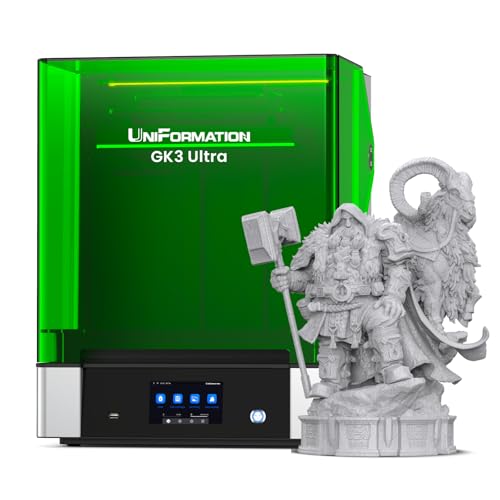
- 300 × 160 × 300mm build volume
- 16K LCD with 20 × 26μm pixels
- Automatic resin feeding and heating
Best For: Industrial prototyping, batch printing, and professional production
Best Mid-Size Detail Value

- 12K mono LCD at 19 × 24μm XY resolution
- 218.88 × 122.88 × 250mm build volume
- Compatible with multiple slicer workflows
Best For: Detailed hobby models and ambitious projects
Best for Fast, Automated Printing

- 16K resolution with up to 150mm/h speed
- 30°C smart tank heating
- Auto-leveling and AI monitoring camera
Best For: Fast, detailed, and low-intervention printing
Best for Huge Batch Prints

- 298 × 164 × 300 mm build volume
- 7K detail with 46 μm XY pixel size
- Automatic resin management and print checks
Best For: Large models and batch printing
Best for Speed and Fine Detail

- Up to 170 mm/h with high-speed resin
- 14K screen with fine XY resolution
- Automatic filling, recycling, and six checks
Best For: Fast, detailed prototyping
Best All-in-One Value

- 16K resolution and a large 8.33 × 4.66 × 8.66-inch build area
- Print speeds up to 150 mm/h with 30°C tank heating
- Includes a 7.5 L Mercury Plus V3.0 wash-and-cure station
Best For: Makers seeking a bundled large-format printing and post-processing setup
Best for Easy, Reliable Setup

- 14K detail from a 10.1-inch mono LCD
- Factory-calibrated auto-leveling and pre-print self-checks
- AI monitoring plus support for resins up to 8,000 cps
Best For: Advanced creators wanting automated setup and high-viscosity resin support
Best for Automated Resin Management

- 16K printing with a 211.68 × 118.37 × 200 mm build volume
- Up to 170 mm/h speed with a fixed, no-leveling build plate
- AFU system automates resin heating, recognition, feeding, and monitoring
Best For: Users prioritizing fast, repeatable printing with extensive resin automation
Best for High-Volume Production – UniFormation GK3 Ultra
For shoppers comparing large format resin printers, the UniFormation GK3 Ultra stands out with a 300 × 160 × 300mm build volume and a 16K LCD. Its generous capacity is suited to large models or multiple parts in one print, while the heated resin system and automatic feeder support longer, more consistent workflows.
Best For: Industrial prototyping, professional studios, small and medium-sized businesses, and high-volume production.
Pros:
- Large 300 × 160 × 300mm build volume for bigger or batch prints
- 16K resolution with 20 × 26μm pixel size for detailed models
- Automatic resin feeding and built-in heating for cold-weather printing
- Rigid KK60 Z-axis module with repeat positioning accuracy up to ±0.003mm
Cons:
- Large and heavy at 85.8 pounds
- Its extensive features may be more than casual users need
The GK3 Ultra is a strong choice when capacity, repeatability, and reduced hands-on resin management matter more than a compact footprint. Its quick-release vat, drip hanger, and carbon filter also make routine handling more convenient.
Best Mid-Size Detail Value – ELEGOO Saturn 3
The ELEGOO Saturn 3 is a practical entry in the large format resin printers category for users who want a spacious build area without moving to the largest machines. Its 12K mono LCD, 19 × 24μm XY resolution, and 218.88 × 122.88 × 250mm volume support detailed models and ambitious projects.
Best For: Detailed larger models, hobby projects, and users seeking flexible slicing options.
Pros:
- 12K mono LCD produces highly detailed models
- Generous 218.88 × 122.88 × 250mm build volume
- Uniform COB and Fresnel light source supports consistent curing
- Laser-carved build plate promotes print adhesion
Cons:
- Build volume is smaller than the 300mm-class options in this roundup
- Maximum listed printing speed is 70mm/h
Saturn 3 balances resolution and capacity in a relatively manageable 33-pound package. Support for Voxeldance Tango, CHITUBOX, Lychee Slicer, and the open-source GOO format adds useful software flexibility.
Best for Oversized Models – Anycubic Photon Mono M7 Max
The Anycubic Photon Mono M7 Max is designed for shoppers who need one of the roomier large format resin printers for full-size masks, cosplay props, game terrain, and other models that are inconvenient to split. Its 298 × 164 × 300mm build area combines with temperature control and automatic resin filling for a more streamlined large-print workflow.
Best For: Full-size masks, cosplay props, game terrain, and large models requiring fewer assembly steps.
Pros:
- Large 298 × 164 × 300mm printing area
- 13.6-inch display with LighTurbo 3.0 light source and over 90% uniformity
- Dynamic resin temperature control and automatic filling
- 1,300ml resin vat supports large models
Cons:
- Large 20.47 × 20 × 31-inch footprint
- At 52.8 pounds, it requires a sturdy setup location
- Listed maximum speed is 60mm/h
The M7 Max emphasizes practical capacity and resin management. Its flip-open cover, suspended post-print platform position, and integrated release film are useful touches for users regularly handling large-format prints.
Best for Fast, Automated Printing – ELEGOO Saturn 4 Ultra 16K
For users prioritizing automation and speed among large format resin printers, the ELEGOO Saturn 4 Ultra 16K combines high-resolution output with tilt release technology rated for speeds up to 150mm/h. Smart tank heating, auto-leveling, residue detection, and an AI camera reduce monitoring and setup work.
Best For: Users who want detailed prints, rapid workflows, and hands-off monitoring features.
Pros:
- 16K resolution for smooth surfaces and fine textures
- Smart tank heating maintains resin at 30°C
- Automatic leveling supports plug-and-play setup
- AI camera provides monitoring, alerts, lighting, and time-lapse features
Cons:
- AI detection results can vary with the environment, models, and resin types
- The supplied notes do not specify the build volume
The Saturn 4 Ultra 16K is a compelling fit when convenience is as important as detail. Its combination of tilt release, heating, automatic leveling, and safety alerts can help shorten the path from setup to repeatable printing.
Best for Huge Batch Prints – ANYCUBIC Photon Mono M7 MAX
For shoppers comparing large format resin printers, the ANYCUBIC Photon Mono M7 MAX stands out with a 298 × 164 × 300 mm build volume. Its 13.6-inch 7K screen is designed for detailed models, while the flip-top cover provides easier access during setup and cleanup.
Best For: Large single-piece models and batch production where automated resin handling is useful.
Pros:
- Large 298 × 164 × 300 mm build volume for oversized or multiple models
- 7K resolution with 46 × 46 μm XY pixel size for detailed surfaces
- Automatic resin management, temperature-controlled vat, and 1,300 ml tank
- Built-in inspections for resin levels, failed prints, and printer status
Cons:
- Large 60.9-pound machine requires substantial workspace
- 60 mm/h maximum speed is lower than the M7 Pro’s listed speed
The M7 MAX is a practical choice when build capacity and reduced resin intervention matter more than compact size. Its monitoring features and large tank support longer print sessions, while 7K detail keeps it suitable for visually demanding work.
Best for High-Resolution Large Builds – ELEGOO Jupiter 2
The ELEGOO Jupiter 2 is one of the large format resin printers to consider when fine detail is a priority. It combines a 302.4 × 161.98 × 300 mm build volume with a 16K resolution system and 20 × 26 μm XY resolution for detailed, full-size prints.
Best For: Makers who want a large build area, very fine resolution, and connected monitoring features.
Pros:
- 302.4 × 161.98 × 300 mm build volume supports large or multiple prints
- 16K resolution and 20 × 26 μm XY resolution target highly detailed results
- Smart tank heating maintains resin at a stated 30 °C
- Auto leveling, automated resin supply, camera monitoring, and Wi-Fi management
Cons:
- Heavy 63.8-pound design needs a sturdy, dedicated setup
- Its feature-rich system may mean more setup and maintenance than a simpler printer
The Jupiter 2 is a strong fit for users who want maximum stated resolution without giving up large-format capacity. Its heating, leveling, resin-supply, and monitoring systems are particularly useful for longer or more involved print jobs.
Best for Speed and Fine Detail – ANYCUBIC Photon Mono M7 PRO
Among large format resin printers, the ANYCUBIC Photon Mono M7 PRO is geared toward users who value rapid production and precise features. It reaches up to 170 mm/h with high-speed resin and pairs that performance with a 14K monochrome screen capable of handling fine details.
Best For: Fast prototyping and detailed models where automated resin handling can reduce interruptions.
Pros:
- Up to 170 mm/h with high-speed resin and 130 mm/h with standard resin
- 14K screen with 16.8 × 24.8 μm XY resolution
- Temperature-controlled vat with automatic filling and resin recycling
- Six detection systems, including build-plate installation and failed-print checks
Cons:
- Its supplied notes do not specify the build volume, making capacity comparisons harder
- Top speed depends on using high-speed resin and the stated 0.1 mm test conditions
- Tall 35-inch product dimensions may require careful placement
The M7 PRO is the most speed-focused option in this group, while its 14K screen supports detailed output. Choose it when throughput and automated resin features are more important than having the largest documented build volume.
Best All-in-One Value – ELEGOO Saturn 4 Ultra 16K
ELEGOO Saturn 4 Ultra 16K Resin 3D Printer and ELEGOO Mercury Plus V3.0 Wash and Cure Station
Check Price On AmazonFor shoppers comparing large format resin printers, the ELEGOO Saturn 4 Ultra 16K stands out as a bundled setup with a sizable build area and a dedicated wash-and-cure station. It combines 150 mm/h printing, smart tank heating to 30°C, and an 8.33 × 4.66 × 8.66-inch print volume.
Best For: Makers who want a large-format resin printer and wash-and-cure workflow in one package.
Pros:
- 16K resin printing with a large 8.33 × 4.66 × 8.66-inch build size
- Fast printing speed rated up to 150 mm/h
- Includes the Mercury Plus V3.0 wash and cure station with 7.5 L capacity
- Smart tank heating maintains resin at 30°C
Cons:
- The printer-and-station bundle requires more storage space than a printer alone
- The supplied notes do not specify automated leveling or monitoring features
This is a practical choice when you want high-resolution, larger-format output and a more complete post-processing setup without sourcing a separate wash-and-cure station.
Best for Easy, Reliable Setup – ANYCUBIC Photon P1 14K
The ANYCUBIC Photon P1 is a strong option among large format resin printers for users who prioritize automated setup and print monitoring. Its 14K screen, factory-calibrated auto-leveling, AI inspection, and Wave Release Technology are designed to reduce common setup and release problems.
Best For: Advanced creators who want high-detail printing with automatic leveling, inspection, and support for high-viscosity resins.
Pros:
- 14K 10.1-inch mono LCD with 13,312 × 5,120 resolution
- Factory-calibrated Smart Leveling 3.0 performs an automatic self-check before printing
- Wave Release Technology reduces plate release force by 60%
- Supports ultra-high-viscosity resins up to 8,000 cps
Cons:
- Its listed dimensions of 16.93 × 24.41 × 16.54 inches require substantial workspace
- At 29.7 pounds, it is not especially portable once installed
The Photon P1 is particularly appealing if minimizing manual leveling and catching potential print issues early matter more to you than choosing the simplest entry-level machine.
Best for Automated Resin Management – Creality Halot-X1 Combo
The Creality Halot-X1 Combo brings extensive automation to the large format resin printers category. It offers a 16K mono LCD, up to 170 mm/h speed, a 211.68 × 118.37 × 200 mm build volume, and an intelligent system for heating, identifying, feeding, and monitoring resin.
Best For: Users who want high-resolution production with automated resin handling and minimal leveling work.
Pros:
- 16K resolution with 14 × 19 μm pixel size
- Large 211.68 × 118.37 × 200 mm build volume and speeds up to 170 mm/h
- Fixed build plate design eliminates leveling and is ready to print out of the box
- AFU system provides resin heating, RFID parameter recognition, feeding, recycling, and weight monitoring
Cons:
- At 38 pounds, it is heavier than the other listed options
- The 16.93 × 16.54 × 21.06-inch design still requires considerable vertical space
- The combo’s added automation may be more than casual users need
Choose the Halot-X1 Combo if throughput and reduced hands-on resin management are priorities. Its fixed plate, dual-rail Z-axis, and automated material system make it especially suited to repeatable workflows.
How We Picked These Large Format Resin Printers
We focused on machines that combine a genuinely generous build area with the resolution and workflow features needed for reliable resin printing. The lineup includes 12K, 14K, and 16K models, as well as printers emphasizing speed, automatic leveling, larger vats, or bundled wash-and-cure equipment. We also considered practical factors such as connectivity, resin compatibility, calibration features, and the availability of replacement consumables.
Resolution is only one part of the evaluation. A printer with a slightly lower pixel count may be more useful if it offers a larger platform, faster exposure performance, simpler leveling, or a more convenient post-processing setup.
Quick Comparison
- Largest build requirements: Look first at the UniFormation GK3 Ultra, ELEGOO Jupiter 2, and Anycubic Photon Mono M7 MAX.
- High-detail printing: The 16K Saturn and Jupiter models prioritize fine surface detail, while 14K and 16K alternatives offer strong resolution in different chassis sizes.
- Faster workflows: The Anycubic Photon Mono M7 PRO is aimed at users who value higher print speeds and production throughput.
- Convenient setup: Auto-leveling and automated calibration can reduce setup time, especially for newer users.
- Complete post-processing: The Saturn 4 Ultra bundle includes a Mercury Plus V3.0 wash-and-cure station, reducing the need to buy accessories separately.
Key Buying Factors for Large Format Resin Printers
Build Volume and Vat Capacity
Check the actual X, Y, and Z dimensions rather than relying on the word “large.” A wider platform is useful for broad models and multiple parts, while additional Z height benefits statues, architectural pieces, and tall prototypes. A larger vat can also reduce interruptions when printing substantial batches.
Resolution Versus Real-World Detail
Higher pixel counts can improve edge definition, but optics, screen quality, exposure settings, resin, and model orientation affect the final result. Choose a resolution appropriate to the detail you can inspect and the production speed you need.
Speed, Reliability, and Automation
Fast printing claims usually depend on resin type, layer height, and exposure settings. Features such as automatic leveling, resin monitoring, mechanical sensors, and dependable platform alignment can be more valuable than peak speed alone.
Post-Processing and Running Costs
Resin printing requires washing, curing, ventilation, gloves, filters, and replacement film or screens over time. Include these costs in your budget. A bundled wash-and-cure station may cost more initially but can make a large printer easier to use consistently.
Who Should Buy Which Large Format Resin Printers?
Choose the biggest build platform available if you regularly print large figures, helmets, props, or many smaller parts at once. Pick a high-resolution Saturn or similar model if fine detail and a manageable footprint matter most. Production users should prioritize speed, vat capacity, repeatable leveling, and software workflow over headline resolution. Beginners may benefit from auto-leveling and a complete wash-and-cure bundle, while experienced makers can often save money by selecting the printer that best matches their existing post-processing equipment.