Aluminum profile racing simulator cockpits offer a strong, modular foundation for wheels, pedals, shifters, seats, and monitor mounts. Their adjustable-slot construction makes them especially useful when you expect to upgrade or change your driving position.
This roundup compares 10 cockpit options, including GT and F1-style designs, single- and triple-monitor configurations, and packages with racing seats. Focus on frame size, mounting hardware, fit, and available space before choosing.
Best 10 Aluminum Profile Racing Simulator Cockpits Picks for 2026
Marada 8040 Stability
Adjustable Racing Cockpit with Seat

- Rigid 40×80mm aluminum profile frame
- Sliding adjustment for multiple driving modes
- Includes adjustable ergonomic black seat
Best For: Sim racers wanting a sturdy, highly adjustable cockpit with a seat included
Anman Precision Fit
8040 Adjustable Sim Racing Stand
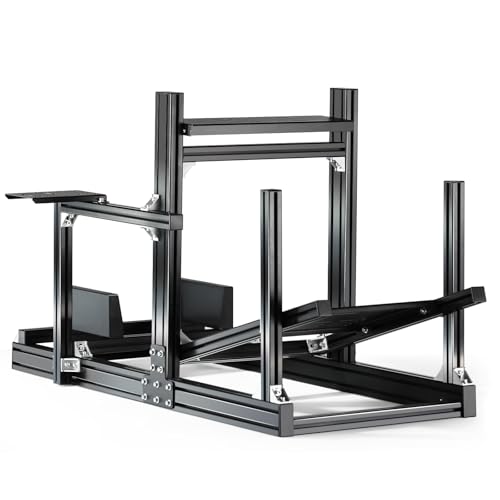
- Stepless seat, wheel, and pedal adjustment
- Reinforced anti-oxidation aluminum construction
- Supports DIY expansion with optional accessories
Best For: DIY-focused users building a customizable cockpit around existing gear
Fanatec Reinforced Frame
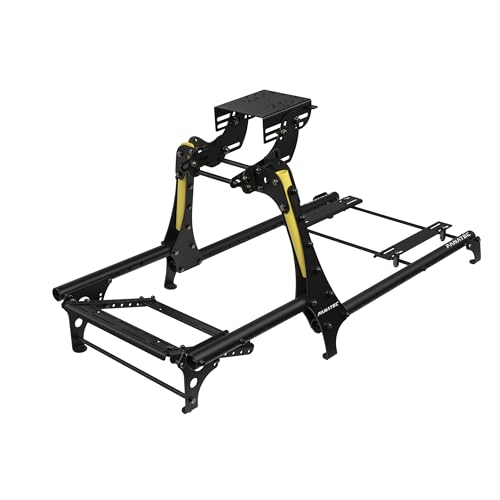
- Aluminum tubing with steel-reinforced brackets
- Universal, adjustable wheelbase mounting bracket
- Pedal plate supports load-cell brake forces
Best For: Fanatec users wanting a lightweight cockpit they can expand
Marada Display Ready
8040 Cockpit with Monitor Stand
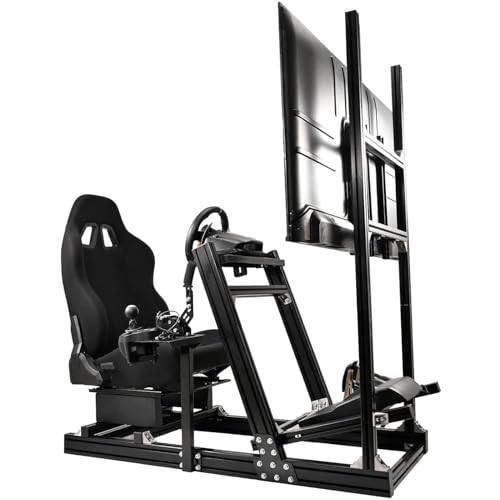
- Rigid 8040 aluminum frame with non-slip pads
- Adjustable stand fits 24–70-inch displays
- Includes ergonomic seat and broad posture adjustment
Best For: Home racers wanting a seat-and-monitor cockpit foundation
Heavy-Duty Triple-Screen Rig
Anman 8040 Triple Monitor Cockpit
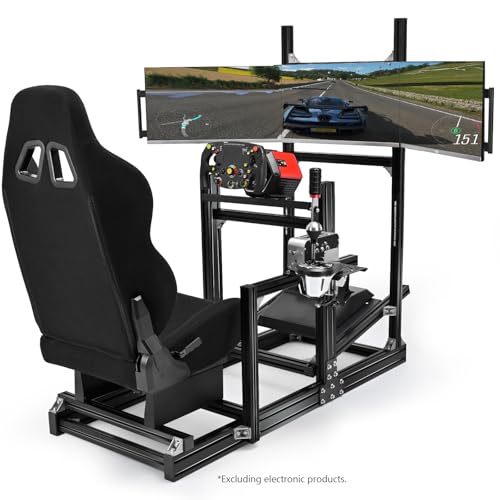
- 8040 frame supports up to 25Nm direct-drive torque
- Adjustable triple mount for 24–32-inch monitors
- Includes adjustable racing seat
Best For: High-torque, triple-screen sim racing setups
Adjustable Universal Setup
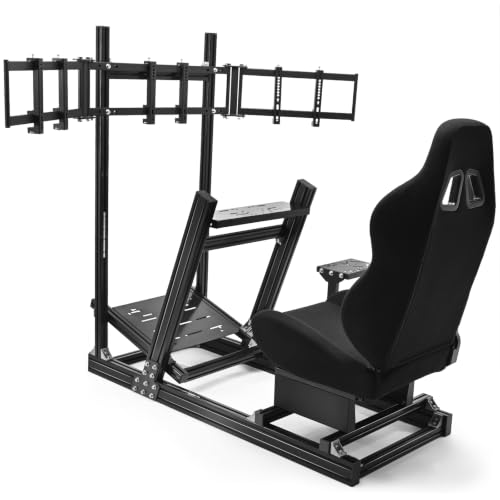
- Adjustable wheel, pedal, and seat positions
- Triple stand fits three 24–32-inch displays
- Supports direct-drive motors up to 12Nm
Best For: Flexible multi-brand cockpit configurations
Focused Frameless Driver Station

- Rigid 8040 aluminum profile frame
- Highly adjustable seat, wheel, and pedals
- Seat supports up to 287 pounds
Best For: Custom setups using an existing display and peripherals
Best Triple-Screen Pick
Anman 8040 Cockpit with Triple Monitor Mount
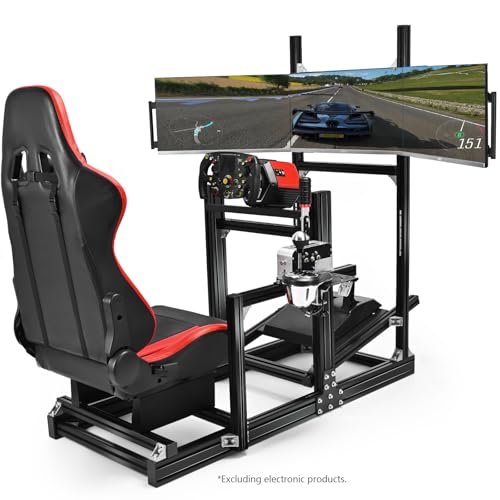
- 8040 aluminum frame with reinforced shifter support
- Triple-monitor stand for a more immersive view
- Adjustable seat, wheel, and pedal positions
Best For: Racers building a triple-screen, direct-drive simulator setup
Best Adjustability
Marada 8040 Cockpit with Monitor Mount

- Stable 8040 frame with non-slip base pads
- Adjustable 24–70-inch monitor bracket
- Stepless cockpit, seat, wheel, and pedal adjustments
Best For: Drivers who want extensive setup customization
Best Single-Monitor Value
Anman 8040 Cockpit with Monitor Stand

- 40×80mm aluminum profile frame
- Integrated stand for 27–65-inch monitors
- Adjustable black seat and racing controls
Best For: Racers building a sturdy single-monitor setup
Marada 8040 Stability – Adjustable Racing Cockpit with Seat
For shoppers comparing aluminum profile racing simulator cockpits, the Marada 8040 emphasizes a rigid 40×80mm frame, broad adjustability, and an included ergonomic seat. Its sliding rails and embedded slots support F1, truck, and off-road driving positions.
Best For: Sim racers who want a sturdy, adjustable cockpit with a seat included.
Pros:
- Solid 40×80mm aluminum profile construction supports stronger force-feedback motors.
- Sliding rails and slots allow extensive seat, wheel, and footrest adjustment.
- Compatible with popular Logitech, Thrustmaster, Moza, and Fanatec equipment.
- Adjustable ergonomic seat includes dual tracks and a reclining back.
Cons:
- Steering wheel, pedals, handbrake, and monitor are not included.
- At 104.7 pounds, it is not especially lightweight to reposition.
This is a substantial aluminum-profile option for users prioritizing stability and seating comfort. Its broad adjustability makes it practical for multiple driving styles, provided you already own the peripherals.
Anman Precision Fit – 8040 Adjustable Sim Racing Stand
The Anman 8040 is one of the aluminum profile racing simulator cockpits aimed at precise posture tuning. It provides stepless adjustment for the seat, steering wheel, and pedals, while its reinforced, anti-oxidation profiles are designed to support demanding direct-drive setups.
Best For: DIY-minded sim racers who want flexible positioning and a configurable cockpit foundation.
Pros:
- 8040 aluminum profiles combine low weight with high load-bearing rigidity.
- Quick-lock adjustments simplify one-person seat, wheel, and pedal positioning.
- Anti-oxidation treatment and reinforced connectors help limit wobble and corrosion.
- Supports many Logitech, Thrustmaster, Fanatec, Moza, and PXN peripherals.
Cons:
- Seat, monitor stand, wheel, pedals, handbrake, and shifter are not included.
- Its expansion-oriented design may require additional components for a complete setup.
This cockpit suits buyers who prefer to build around their existing equipment or expand over time. The adjustable, modular format is appealing, but budget for the missing seat and peripherals if needed.
Fanatec Reinforced Frame – CSL Cockpit V1.5
The Fanatec CSL Cockpit V1.5 offers a compact alternative among aluminum profile racing simulator cockpits, combining aluminum tubing with steel brackets. Its universal wheelbase mount, adjustable pedal plate, and cable-routing tubes make it a practical foundation for GT-style driving.
Best For: Fanatec users and sim racers seeking a lightweight, steel-reinforced cockpit with expansion options.
Pros:
- Trapeze chassis uses aluminum tubing and steel brackets for strength with lower weight.
- Universal wheelbase bracket offers height, angle, distance, and inverted mounting options.
- Pedal plate supports Fanatec and other major OEM pedal systems, including load-cell brakes.
- Optional holders and stands support future monitor, shifter, keyboard, and storage upgrades.
Cons:
- Seat, sliders, monitor holder, and other accessories are sold separately.
- The supplied notes do not indicate that a seat is included.
This is a flexible chassis for a staged sim-racing build, especially if you value wheelbase and pedal adjustability. Its accessory ecosystem can expand the setup, though the final cost rises as optional parts are added.
Marada Display Ready – 8040 Cockpit with Monitor Stand
For buyers seeking aluminum profile racing simulator cockpits with display support, this Marada model pairs an 8040 frame with an adjustable monitor bracket and included ergonomic seat. The stand accommodates 24–70-inch displays with common VESA patterns, helping consolidate the racing setup.
Best For: Home sim racers who want a complete seat-and-monitor foundation with broad adjustment.
Pros:
- Rigid 8040 aluminum frame and non-slip pads help resist movement during races.
- Monitor bracket adjusts vertically and front-to-back for viewing-distance tuning.
- Supports 24–70-inch displays and VESA patterns from 75×75 to 400×200.
- Seat, wheel, pedals, and shifter positions offer extensive adjustment, including three driving modes.
Cons:
- Steering wheel and pedals are not included.
- At 120.2 pounds, the assembled setup may be difficult to move frequently.
This is the most display-focused option in the group, with a built-in monitor stand and included seat. It is a strong fit for a dedicated home station, particularly if you want to adjust both driving posture and screen placement.
Heavy-Duty Triple-Screen Rig – Anman 8040 Triple Monitor Cockpit
For drivers seeking aluminum profile racing simulator cockpits with substantial rigidity and a wide field of view, the Anman combines an 8040 aluminum frame with a triple-monitor stand. Its broad adjustment range and included racing seat make it a strong option for immersive, multi-display setups.
Best For: Enthusiasts using three 24–32-inch monitors and higher-torque direct-drive wheels.
Pros:
- 8040 aluminum construction supports up to 25Nm of direct-drive torque.
- Triple-monitor mount offers height and front-to-back adjustment.
- Adjustable frame, wheel mount, pedal plate, seat rails, and backrest.
- Compatible with popular Logitech, Thrustmaster, Fanatec, Moza, and PXN equipment.
Cons:
- At 123 pounds, it is a substantial cockpit to position and assemble.
- The included monitor stand is designed for 24–32-inch displays, limiting larger-screen choices.
The Anman is the most heavy-duty choice here for users prioritizing frame stiffness and triple-screen immersion. Its extensive compatibility and seat adjustment also make it easier to tailor for different drivers.
Adjustable Universal Setup – Supllueer 8040 Racing Cockpit
The Supllueer is one of the more flexible aluminum profile racing simulator cockpits for drivers who want to tune wheel, pedal, and seating positions. It adds a height- and angle-adjustable triple-monitor stand while supporting a wide selection of wheel and pedal ecosystems.
Best For: Multi-brand sim racers wanting an adjustable cockpit for direct-drive equipment up to 12Nm.
Pros:
- Sturdy 8040 aluminum profiles provide a stable racing platform.
- Wheel and pedal height and angle can be adjusted to suit the driver.
- Shifter mounts can be positioned on either side, with handbrake support.
- Includes an ergonomic seat with slide rails and a 65–180° adjustable backrest.
Cons:
- Its listed direct-drive compatibility is up to 12Nm, below the Anman’s stated 25Nm capacity.
- The triple-monitor stand is limited to 24–32-inch displays.
This cockpit is a practical middle ground for users who value adjustability and broad hardware compatibility. The reversible shifter placement is especially useful for adapting the layout to different driving preferences.
Focused Frameless Driver Station – ARES WING 8040 Cockpit
The ARES WING offers a streamlined aluminum profile racing simulator cockpit centered on driver positioning rather than an included monitor stand. Its 8040 frame, racing seat, and broad adjustment range suit users building a personalized wheel-and-pedal setup.
Best For: Drivers who already have a display and want a stable, highly adjustable cockpit with an included seat.
Pros:
- Heavy-duty 8040 aluminum frame provides a solid foundation.
- Seat slides 8.7 inches and tilts ±6° for positioning flexibility.
- Wheel angle, height, and pedal angle offer extensive adjustment.
- Seat is rated for users up to 287 pounds and includes integrated T-nut channels for accessories.
Cons:
- Wheel, pedals, shifter, and TV are not included.
- No monitor stand is listed, so a separate display-mount solution may be needed.
The ARES WING is a focused choice for buyers assembling a cockpit around existing equipment. Its detailed seating and control adjustments are useful when finding a precise driving position matters more than an all-in-one display setup.
Best Triple-Screen Pick – Anman 8040 Cockpit with Triple Monitor Mount
For shoppers comparing aluminum profile racing simulator cockpits, this Anman model combines an 8040 aluminum frame with a triple-monitor stand and a red adjustable seat. Its reinforced shifter area and direct-drive compatibility make it suited to demanding racing setups.
Best For: Racers building a triple-screen, direct-drive simulator setup.
Pros:
- Triple-monitor stand supports adding up to three screens.
- Reinforced construction is designed to handle strong direct-drive force feedback.
- Adjustable wheel, pedal, seat, and cockpit positions support varied driving postures.
- Compatible with popular Logitech, Thrustmaster, Fanatec, Moza, and PXN equipment.
Cons:
- Electronic devices, including the wheel and pedals, are not included.
- The triple-screen configuration may require more room and additional displays.
- Warranty coverage is listed as three months.
This is a strong choice when immersion and expandability matter most. Choose it if you have space for multiple displays and want a rigid aluminum cockpit that can accommodate a broad range of racing hardware.
Best Adjustability – Marada 8040 Cockpit with Monitor Mount
This Marada is one of the more customizable aluminum profile racing simulator cockpits, with an 8040 frame, adjustable monitor bracket, and stepless positioning for the seat, wheel, pedals, and shifter. It is designed for stable support with high-torque direct-drive wheels.
Best For: Drivers who want extensive seating, monitor, and control-position adjustments.
Pros:
- Solid 8040 aluminum profile frame and non-slip base pads help limit shaking.
- Monitor bracket fits 24–70-inch displays and VESA patterns from 75×75 to 400×200.
- Seat, wheel, pedals, monitor, and shifter offer broad positioning adjustments.
- Padded PU leather seat includes lumbar and neck pillows, with a 90–180-degree reclining backrest.
Cons:
- Electronic equipment is not included.
- The larger frame and monitor range may require substantial floor space.
- Warranty coverage is listed as three months.
The Marada stands out for its fine-tuning options and comfort-focused seat. It is a practical pick for households where different drivers need to adjust the cockpit, or for users who want flexible monitor placement without modifying the frame.
Best Single-Monitor Value – Anman 8040 Cockpit with Monitor Stand
For a focused single-screen setup, this Anman cockpit offers a 40×80mm aluminum profile frame, an integrated 27–65-inch monitor stand, and a black adjustable seat. Its reinforced joystick support is intended to improve stability with stronger force feedback.
Best For: Racers who want a sturdy single-monitor cockpit with room to customize.
Pros:
- Integrated monitor stand supports displays from 27 to 65 inches.
- Reinforced support near the joystick position helps improve frame stability.
- Wheel, pedals, seat, and cockpit components are adjustable.
- Supports a wide selection of Logitech, Thrustmaster, Fanatec, Moza, and PXN hardware.
Cons:
- It supports one monitor rather than a triple-screen arrangement.
- Wheel, pedals, and other electronic devices are not included.
- Warranty coverage is listed as three months.
This model makes sense for buyers who want aluminum-profile construction and an integrated display mount without moving to a triple-monitor layout. Its DIY-friendly design also leaves room for personal setup adjustments.
How We Picked the Best Aluminum Profile Racing Simulator Cockpits
We evaluated these cockpits around the factors that matter most in a practical sim-racing setup: frame construction, adjustability, mounting flexibility, included accessories, monitor support, seating position, and compatibility with popular wheel and pedal systems. The list includes 8040 aluminum-profile designs, steel-reinforced constructions, and configurations intended for single or multiple displays.
Because included hardware and product listings can vary, confirm the latest specifications before ordering. Pay particular attention to whether the seat, monitor brackets, wheel deck, pedal plate, and shifter mount are included.
Quick Comparison
| Best For | Look For | Why It Matters |
|---|---|---|
| First complete setup | Frame, seat, and wheel mount bundle | Reduces compatibility questions and extra purchases |
| Triple-screen immersion | Triple monitor mount and sufficient width | Supports a wider field of view |
| Compact rooms | Single monitor mount and adjustable layout | Uses less floor and wall space |
| High-torque wheels | Rigid 8040 profiles and reinforced mounting | Helps limit flex under heavy force feedback |
Key Buying Factors for Aluminum Profile Racing Simulator Cockpits
Frame Rigidity and Profile Size
8040 profiles are popular because their larger cross-section can provide a stable base for demanding wheelbases. Check the overall frame layout, joint hardware, and wheel-deck support rather than judging strength by profile size alone.
Adjustability and Driving Position
Look for slotted profile connections and adjustable wheel, pedal, and seat positions. GT-style cockpits generally use a lower, more reclined layout, while F1-style designs place the driver farther back with more elevated legs.
Monitor and Accessory Support
A single monitor mount is usually simpler and more space-efficient. Triple mounts add immersion but require a wider desk area, stronger support, and screens with suitable size and weight. Also check for shifter, handbrake, keyboard, and cable-management provisions.
Compatibility and Included Equipment
Verify wheelbase bolt patterns, pedal spacing, seat rails, and the mounting method for your equipment. A cockpit described as universal may still require adapters or different fasteners for certain Logitech, Fanatec, or direct-drive components.
Who Should Buy Which Aluminum Profile Racing Simulator Cockpits?
Choose a complete cockpit with a bundled seat if you want the simplest path to a functional setup. A single-monitor model is better for smaller rooms or drivers who already own one display. Triple-monitor versions suit users prioritizing peripheral vision and have the space to position multiple screens properly.
For frequent upgrades, choose a modular aluminum design with accessible T-slot hardware and spare mounting room. Drivers using stronger force-feedback systems should prioritize a rigid frame and reinforced wheel mount. If you mainly race casually or use a lighter wheel, a simpler cockpit may provide better value without unnecessary bulk.