VR can make sim racing feel dramatically more immersive, placing you inside the cockpit with natural depth perception and a stronger sense of speed. The right headset can also improve your awareness of apexes, mirrors, and track positioning.
This roundup compares 10 VR headsets for sim racing, from accessible Meta Quest models to premium PC-powered headsets built for sharp visuals and wide fields of view. Consider your computer, preferred racing titles, comfort needs, and budget before choosing.
Best 10 Vr Headsets for Sim Racing Picks for 2026
Best All-Around Pick

- Sharp 2064 x 2208 resolution per eye
- Wireless standalone design with 512GB storage
- Supports mixed reality and refresh rates up to 120Hz
Best For: Versatile standalone VR for racing and general use
Best Renewed PC Option
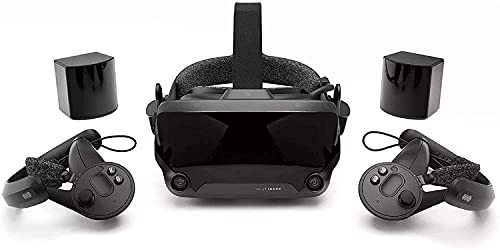
- Complete kit includes base stations and Knuckles controllers
- PC-focused headset with USB connectivity
- Renewed and professionally inspected
Best For: Budget-conscious PC users wanting a complete tracking setup
Best Budget Standalone Pick

- Wireless standalone VR with Snapdragon XR2 Gen 2
- Dual RGB cameras provide full-color passthrough
- 128GB storage and 1832 x 1920 resolution per eye
Best For: First-time VR buyers seeking a convenient standalone headset
Best Visual Fidelity for Sim Racing

- 3840 x 3840 resolution per eye
- Wide 140-degree field of view
- Eye tracking and QLED/Mini-LED display
Best For: Enthusiast PC sim racers prioritizing clarity and immersion
Best Wireless Value
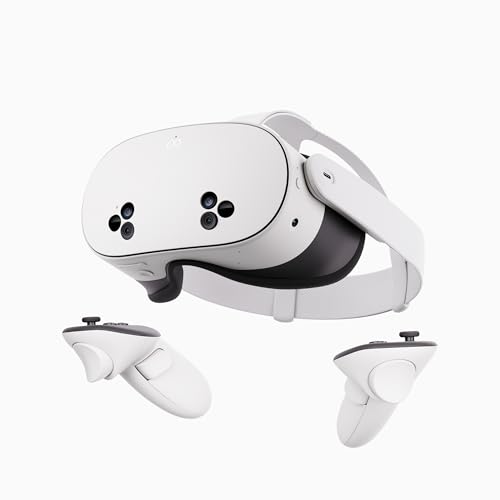
- Standalone wireless VR with no PC required
- Snapdragon XR2 Gen 2 and 8GB RAM
- Full-color passthrough and Touch Controllers
Best For: Wireless gaming and accessible VR
Best Lightweight PC VR

- 108-gram design for long sessions
- 2560 × 2560 micro-OLED resolution per eye
- Eye tracking and Dynamic Foveated Rendering
Best For: Dedicated SteamVR racing and flight simulators
Best for Comfort

- All-in-one VR without a PC or console
- 90Hz display with 3D positional audio
- Wireless design with included Touch Controllers
Best For: First-time buyers and portable standalone VR
Best Visual Detail
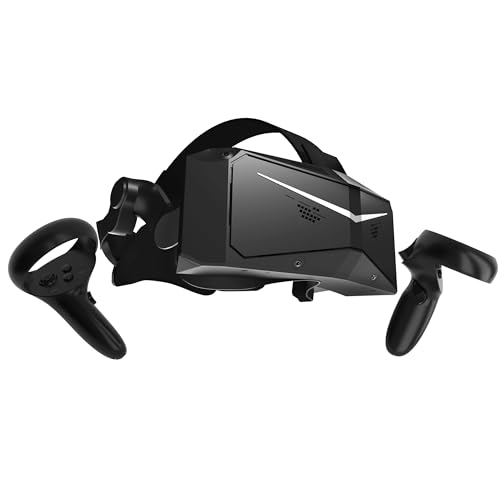
- 2880 x 2880 resolution per eye
- QLED with local dimming and HDR support
- Up to 120Hz refresh rate and SteamVR compatibility
Best For: PC sim racers focused on cockpit and track clarity
Best Versatile Setup
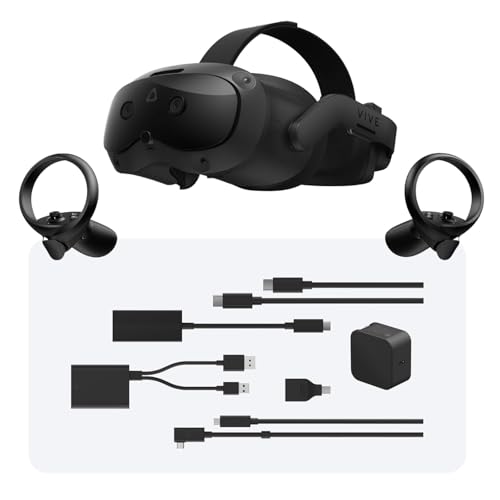
- Wired DisplayPort PC VR mode
- 2448 x 2448 resolution per eye
- Hot-swappable battery and auto-IPD adjustment
Best For: Users wanting PC VR plus standalone flexibility
Best Straightforward PC VR

- 2560 x 1440 PC VR display
- Inside-out Oculus Insight tracking
- Adjustable halo headband with Touch controllers
Best For: Entry-level PC VR users avoiding external sensors
Best All-Around Pick – Meta Quest 3
The Meta Quest 3 is a versatile choice among VR headsets for sim racing, especially if you also want a wireless headset for gaming, fitness, and mixed-reality experiences. Its 4K+ display, 120Hz refresh-rate support, and Snapdragon XR2 Gen 2 processor provide a strong all-purpose package, while the standalone design avoids a PC connection.
Best For: Buyers who want a capable standalone headset for sim racing and broader VR use.
Pros:
- Sharp 2064 x 2208 resolution per eye and support for refresh rates up to 120Hz
- Wireless standalone operation with 512GB of storage
- Full-color passthrough and mixed-reality support
- Includes two Touch Plus controllers and a 3-month Meta Horizon+ trial
Cons:
- Average battery life is listed at about 2.2 hours
- Standalone compatibility may not suit PC-only racing setups
The Quest 3 is a well-rounded recommendation when convenience matters as much as immersion. Its limited battery life is the main practical trade-off, but the high storage capacity and wireless design make it flexible beyond the racing cockpit.
Best Renewed PC Option – Valve Index VR Full Kit
The renewed Valve Index Full Kit is a PC-focused option for shoppers considering VR headsets for sim racing. It includes the headset, Knuckles controllers, and base stations, but its 1440 x 1600-per-eye resolution and 60Hz listed refresh rate are more modest than newer alternatives.
Best For: PC users seeking a refurbished, complete Valve Index setup with external base stations.
Pros:
- Complete kit includes headset, Knuckles controllers, and base stations
- Designed for personal-computer use
- Amazon Renewed products are inspected and tested by qualified suppliers
Cons:
- Lower listed resolution of 1440 x 1600 per eye
- Listed refresh rate is 60Hz
- Renewed unit includes a 90-day limited warranty
The Valve Index remains worth considering if the included tracking hardware and renewed pricing align with your setup. However, buyers prioritizing maximum visual sharpness or a higher listed refresh rate should compare newer PC VR models.
Best Budget Standalone Pick – Meta Quest 3S
The Meta Quest 3S is an accessible entry among VR headsets for sim racing, with wireless standalone operation, Snapdragon XR2 Gen 2 processing, and 8GB of RAM. Its 128GB storage and 1832 x 1920-per-eye display make it better suited to buyers who want convenient VR without moving to a higher-capacity model.
Best For: New VR buyers who want a wireless standalone headset for racing and casual gaming.
Pros:
- Standalone operation with wireless connectivity
- Snapdragon XR2 Gen 2 processor and 8GB of RAM
- Full-color passthrough through dual RGB cameras
- Includes two Touch Plus controllers and a 3-month Meta Horizon+ trial
Cons:
- 128GB storage is less than the Quest 3’s 512GB
- Listed resolution is 1832 x 1920 pixels per eye
- Battery life is listed at about 2.5 hours
The Quest 3S offers a practical way into standalone VR, but its lower storage and resolution make it a value-oriented choice rather than a visual-detail leader. It is a sensible fit for casual or occasional racing sessions.
Best Visual Fidelity for Sim Racing – Pimax Crystal Super
The Pimax Crystal Super is purpose-built for demanding PC users searching for VR headsets for sim racing. Its 3840 x 3840-per-eye QLED and Mini-LED display, 140-degree field of view, eye tracking, and DisplayPort connection prioritize clarity and peripheral awareness, though it requires a Windows 10 PC.
Best For: Enthusiast sim racers with a powerful Windows PC who prioritize resolution and a wide field of view.
Pros:
- Very high 3840 x 3840 resolution per eye
- Wide 140-degree field of view for greater peripheral awareness
- QLED and Mini-LED display with local dimming
- Eye tracking, inside-out tracking, and refresh rates up to 90Hz
Cons:
- Wired PC VR design requires DisplayPort and USB connections
- Requires a Windows 10 PC
- High-resolution output may demand substantial PC graphics performance
The Crystal Super is the specialist choice in this group for cockpit immersion and visual detail. Its wired PC requirement and demanding resolution make it less convenient than standalone headsets, but its wide view and high pixel density are compelling for serious simulation use.
Best Wireless Value – Meta Quest 3S
The Meta Quest 3S is a practical wireless pick among VR headsets for sim racing, especially if you want a standalone headset that can also handle gaming, video, and mixed-reality experiences. Its Snapdragon XR2 Gen 2 processor, 90Hz display, and included Touch Controllers provide a straightforward way to get into VR without a gaming PC.
Best For: Buyers who want an untethered, easy-to-use VR headset for general gaming and occasional sim-racing-style experiences.
Pros:
- Standalone operation means no PC or wired connection is required.
- Snapdragon XR2 Gen 2 processor and 8GB of RAM support responsive performance.
- Full-color passthrough, hand tracking, and Touch Controllers add versatility.
- Offers roughly 2 to 3 hours of battery life depending on use.
Cons:
- The 128GB storage capacity may limit how many large games you keep installed.
- Its LCD display and 96-degree field of view are less specialized than high-end PC VR options.
- Battery life is limited for extended racing sessions.
The Quest 3S is the flexible, lower-friction option in this group. It is best suited to shoppers prioritizing wireless convenience and broad standalone functionality over the highest-resolution PC sim-racing setup.
Best Lightweight PC VR – Bigscreen Beyond 2e
The Bigscreen Beyond 2e is a specialist choice among VR headsets for sim racing, built for PC VR users who want high-resolution visuals and minimal weight. Its 108-gram design, micro-OLED displays, eye tracking, and 116-degree field of view are aimed at long sessions in SteamVR racing and flight simulators.
Best For: Dedicated PC sim racers who already have a compatible Windows 11 computer and SteamVR tracking equipment.
Pros:
- Extremely light 108-gram headset is designed for extended sessions.
- 2560 × 2560 resolution per eye and micro-OLED displays provide detailed imagery.
- 116-degree field of view supports an expansive view in racing environments.
- Eye tracking enables Dynamic Foveated Rendering, while adjustable IPD helps fine-tune clarity.
Cons:
- Requires a PC, SteamVR, and separate SteamVR base stations for tracking.
- It is not a standalone or wireless headset.
- Its specialized PC setup may be more involved than an all-in-one headset.
The Beyond 2e is the most purpose-built option here for serious PC sim use. Its low weight and high-resolution micro-OLED panels are compelling, but the required tracking hardware and PC connection make it a poor fit for casual or portable VR.
Best for Comfort – Meta Quest 2
The Meta Quest 2 remains a simple entry point for shoppers comparing VR headsets for sim racing and general gaming. It works without a PC or console, includes Touch Controllers, and combines a 90Hz LCD display with built-in positional audio, hand tracking, and a broad VR content library.
Best For: First-time VR buyers seeking an affordable, portable standalone headset for gaming, fitness, entertainment, and occasional simulation use.
Pros:
- All-in-one design works without a PC or console.
- Wireless operation, built-in battery, and easy setup improve portability.
- 90Hz display, 3D positional audio, and included Touch Controllers support immersion.
- 128GB storage provides room for a selection of VR apps and games.
Cons:
- Its 1832 × 1920 display resolution per eye is lower than the Beyond 2e’s.
- Built-in battery life can restrict longer sessions.
- As a standalone headset, it is less specialized for demanding PC-based simulation than a SteamVR model.
The Quest 2 is a convenient starter headset with broad uses beyond racing. Choose it for accessible standalone VR and portability; choose a dedicated PC VR headset instead if maximum sim-racing display detail and simulator compatibility are your priorities.
Best Visual Detail – Pimax Crystal Light
For sim racers prioritizing cockpit detail, the Pimax Crystal Light is one of the most visually focused VR headsets for sim racing. Its 2880 x 2880 resolution per eye, QLED panel, local dimming, and glass aspheric lenses are designed to keep gauges and track scenery clear, while up to a 120Hz refresh rate supports fluid motion.
Best For: PC sim racers who want high resolution, strong contrast, and SteamVR compatibility.
Pros:
- 2880 x 2880 resolution per eye provides substantial image detail.
- QLED, HDR support, and local dimming aim for vivid colors and high contrast.
- Glass aspheric lenses provide edge-to-edge clarity with reduced distortion.
- Inside-out tracking and fixed foveated rendering support a streamlined PC VR setup.
Cons:
- At approximately 815 grams, it is relatively substantial for extended sessions.
- It is a PC VR headset, so it requires a compatible Windows PC and SteamVR setup.
The Crystal Light is the strongest choice here when visual clarity is the deciding factor. Its resolution and display features suit detailed racing environments, though its weight and PC-focused design are worth considering before purchase.
Best Versatile Setup – HTC Vive Focus Vision
HTC Vive Focus Vision Wired Bundle — XR Headset with DisplayPort PC VR Streaming Kit
Check Price On AmazonThe HTC Vive Focus Vision is a flexible option among VR headsets for sim racing, particularly for users who want both standalone and PC VR capability. Its wired DisplayPort mode is designed for lossless, high-fidelity PC visuals, while the 2448 x 2448-per-eye display, up to 120-degree field of view, and adjustable fit support immersive driving sessions.
Best For: Racers who want a versatile headset with wired PC VR, standalone functionality, and flexible tracking features.
Pros:
- DisplayPort mode provides a direct wired PC VR connection.
- 2448 x 2448 resolution per eye and up to a 120-degree field of view create an immersive view.
- Auto-IPD adjustment helps align the lenses for a personalized fit.
- Hot-swappable battery design supports longer play sessions.
Cons:
- The listed 90Hz refresh rate is lower than the maximum refresh rate of some competing models.
- Its broader mixed-reality and tracking feature set may be more than a dedicated sim racer needs.
Focus Vision stands out for flexibility rather than a single headline specification. Its DisplayPort PC mode, fit adjustment, and replaceable battery make it a practical choice for racers who also want standalone and mixed-reality features.
Best Straightforward PC VR – Oculus Rift S
The Oculus Rift S remains a straightforward PC option among VR headsets for sim racing. Its 2560 x 1440 display, 110-degree field of view, improved optics, and built-in Oculus Insight tracking provide a simple way to enter room-scale PC VR without external sensors.
Best For: PC users seeking a simple, sensor-free headset for entry-level VR gaming and sim-racing experimentation.
Pros:
- Oculus Insight tracking works without external sensors.
- The redesigned halo headband includes a fit wheel for adjustment.
- Improved optics are intended to reduce the screen-door effect and enhance color.
- Included Touch controllers support intuitive motion interaction.
Cons:
- Its 2560 x 1440 resolution is lower than the newer high-resolution options listed here.
- It is PC-powered and uses a USB 3.0 connection, limiting it to a wired computer setup.
- The product requires a Facebook account for login, according to the supplied specifications.
Rift S is best considered a simple, established PC VR entry point rather than a specification leader. It can suit users testing VR racing without external base stations, but detail-focused sim racers may prefer a newer, higher-resolution headset.
How We Picked the Best Vr Headsets for Sim Racing
We focused on the features that most affect racing immersion and usability: display resolution, lens clarity, field of view, refresh rate, tracking, connection method, comfort, software compatibility, and overall value. The selection includes standalone headsets that can also connect to a gaming PC, dedicated PC VR models, renewed devices, and premium options designed for demanding simulator setups.
Because sim racing can require long sessions, we also considered headset weight, balance, facial comfort, cable arrangements, and whether the device supports practical features such as eye tracking, dynamic foveated rendering, or wireless play.
Quick Comparison
- Best all-around standalone option: Meta Quest 3 512GB
- Best budget-friendly entry: Meta Quest 3S 128GB or Meta Quest 2
- Best premium visual detail: Pimax Crystal Super
- Best high-resolution PC VR value: Pimax Crystal Light
- Best lightweight design: Beyond 2e
- Best established PC VR ecosystem: Valve Index
- Best wired Quest alternative: HTC Vive Focus Vision Wired Bundle
Key Buying Factors for Vr Headsets for Sim Racing
Resolution and Lens Clarity
Higher resolution can make gauges, distant braking markers, and track details easier to read. Pancake or advanced lenses may provide a larger clear viewing area than older Fresnel designs, reducing the need to move your head constantly.
PC Requirements and Connection
High-end PC VR headsets need a capable graphics card and processor, especially at high resolutions. Wired DisplayPort connections typically offer dependable image quality and low latency, while wireless or USB streaming can provide a cleaner cockpit but may depend heavily on network quality and compression.
Field of View, Tracking, and Refresh Rate
A wider field of view can improve peripheral awareness, while accurate inside-out or base-station tracking helps maintain a stable cockpit position. A higher refresh rate may feel smoother, but your computer must render the simulator consistently to take advantage of it.
Comfort and Session Length
Weight distribution matters as much as listed weight. Check the strap, facial interface, eye-relief adjustment, ventilation, and cable placement. If you race for hours, budget for an upgraded strap or counterbalance when needed.
Game and Simulator Compatibility
Confirm support for your preferred titles, such as iRacing, Assetto Corsa, Assetto Corsa Competizione, Automobilista 2, or Dirt Rally 2.0. Also verify controller, wheel, USB, and software requirements before buying.
Who Should Buy Which Vr Headsets for Sim Racing?
Choose the Meta Quest 3 if you want a flexible headset for both standalone games and PC sim racing. The Quest 3S or Quest 2 suits newcomers prioritizing low cost, though their optical systems and resolution are less advanced.
Pick the Pimax Crystal Super for maximum visual ambition and a powerful gaming PC. The Pimax Crystal Light is a strong fit for racers who want sharp PC visuals without paying for every premium feature. Consider the Beyond 2e when low weight is your top priority.
The Valve Index remains worth considering for buyers invested in SteamVR and base-station tracking, while the HTC Vive Focus Vision Wired Bundle offers a modern PC streaming route. Older or renewed models can save money, but check warranty coverage, battery health, included accessories, and return policies carefully.