The best audio mixers for home studio use make it easier to combine microphones, instruments, playback devices, and computers without complicating your workflow. The right model depends on whether you prioritize multitrack recording, live streaming, portability, or hands-on control.
This roundup compares 10 options ranging from compact creator mixers to larger consoles with USB interfaces, Bluetooth, effects, and phantom power.
Best 10 Audio Mixers for Home Studio Picks for 2026
Best All-in-One Studio Hub

- 12-channel mixer with 12-in/10-out USB I/O
- Onboard compression, EQ, MIDI, and DAW control
- Dual headphone outputs with separate controls
Best For: Home studios needing an integrated mixer and recording hub
Best Creator Starter Bundle
TENLAMP G10 Audio Mixer Bundle

- Includes mixer, condenser microphone, and accessories
- Adds noise reduction, voice effects, and pitch control
- Works with computers, phones, and tablets
Best For: Beginner streaming, podcasting, gaming, and singing setups
Best Budget Multi-Input Console

- Eight inputs with 48V phantom power
- Bluetooth, MP3 playback, USB recording, and reverb
- Slim console for home or live-use setups
Best For: Basic recording, karaoke, meetings, and small live performances
Best Portable Creator Interface

- Up to 12 inputs and 24-bit/192 kHz recording
- Onboard EQ, compression, reverb, and scene memories
- Compact design with flexible power options
Best For: Mobile musicians and creators recording audio alongside video
Best Value Connectivity
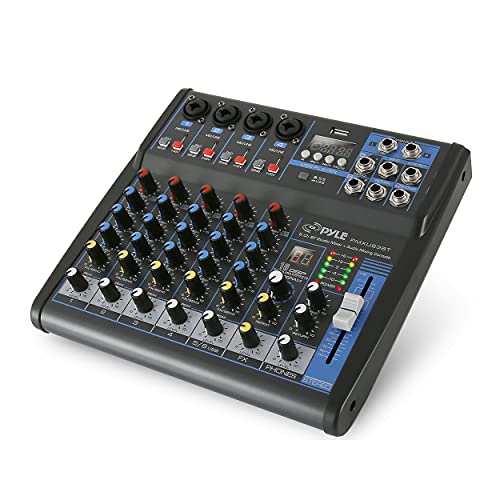
- Bluetooth, USB, flash-drive, and MP3 compatibility
- XLR and 1/4-inch inputs with 48V phantom power
- Three-band EQ and 16-bit DSP effects
Best For: Home studios, karaoke, and small live setups
Best for PC Recording

- Plug-and-play USB-B PC recording interface
- Three XLR inputs plus 1/4-inch and RCA connectivity
- Headphone monitoring, Bluetooth, and onboard effects
Best For: Podcasting, streaming, and compact PC recording
Best for Larger Setups

- Eight channels for multi-source mixing
- Bluetooth, USB MP3 playback, and DSP effects
- Three-band EQ and 48V phantom power
Best For: Larger home studios, small bands, and live gigs
Best All-Rounder

- Eight inputs for microphones and instruments
- USB, Bluetooth, and flash-drive playback or recording
- 3-band EQ, effects, and headphone monitoring
Best For: Home studios, podcasts, livestreams, and small performances
Best Compact Option

- Four XLR inputs with selectable 48V phantom power
- USB and Bluetooth playback or recording
- 16 DSP effects and 3-band channel EQ
Best For: Smaller studios, karaoke, streaming, and basic recording
Best for Expansion
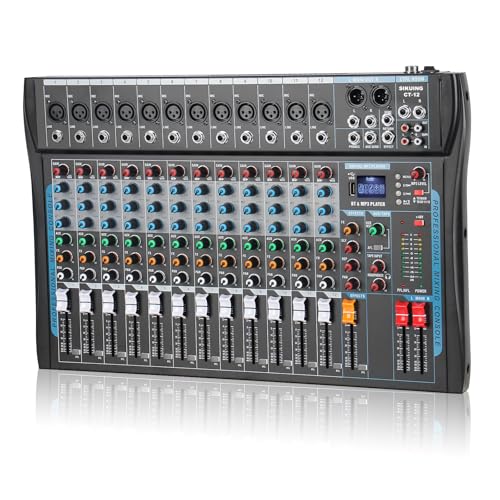
- Twelve inputs for larger multi-source setups
- USB and Bluetooth connectivity for mixing and recording
- 16 DSP effects, EQ, and +48V phantom power
Best For: Expanding home studios, interviews, streaming, and karaoke
Best All-in-One Studio Hub – Tascam Model 12
For home producers who want recording, mixing, and DAW control in one unit, the Tascam Model 12 is one of the more complete audio mixers for home studio setups. Its 12-channel design, USB connectivity, onboard processing, and multitrack workflow make it suited to a permanent studio desk.
Best For: Home studios needing a versatile mixer, USB audio interface, and multitrack recording hub.
Pros:
- 12-channel mixer with 12-in/10-out USB audio interface connectivity.
- Onboard MIDI functionality and DAW controller support.
- Each input module includes a one-knob compressor and three-band EQ.
- Dual headphone outputs offer individual volume and source selection.
Cons:
- Its 18-by-16-inch footprint may require substantial desk space.
- At 13.3 pounds, it is less convenient for portable setups.
The Model 12 is a strong choice when you want a central control surface rather than a compact interface alone. It offers useful hands-on features for recording and monitoring, though its size and weight favor a dedicated home-studio installation.
Best Creator Starter Bundle – TENLAMP G10 Audio Mixer Bundle
The TENLAMP G10 combines a two-channel mixer, condenser microphone, and accessories in a beginner-friendly package. Among audio mixers for home studio use, it is aimed more at streaming, podcasts, singing, and voice content than multitrack music production.
Best For: New streamers, podcasters, gamers, and singers who want an included microphone and simple controls.
Pros:
- Bundle includes an audio mixer, condenser microphone, and essential accessories.
- Provides noise reduction and real-time bass, treble, reverb, and pitch controls.
- Includes voice changer, sound effects, and a follow-singing mode.
- Supports PC, phone, and tablet connections through USB, Bluetooth, and auxiliary connectivity.
Cons:
- Only two channels are listed, limiting larger recording setups.
- Its battery-powered design and creator effects may be less suitable for traditional multitrack studio work.
The G10 is a practical way to start creating without assembling a separate mixer-and-microphone system. Its effects and device compatibility are useful for interactive content, while musicians seeking extensive routing or channel capacity should look elsewhere.
Best Budget Multi-Input Console – CT-80S 8-Channel Mixer
The CT-80S is a conventional eight-channel mixer with Bluetooth, USB, MP3 playback, reverb, and 48V phantom power. For audio mixers for home studio applications, it offers broad connection options in a relatively slim console suited to karaoke, live music, meetings, and basic recording.
Best For: Home users who need several microphone or instrument inputs plus Bluetooth playback and simple live-sound features.
Pros:
- Eight-channel layout supports wired, wireless, condenser-microphone, and instrument connections.
- Includes 48V phantom power for compatible microphones.
- Built-in Bluetooth 5.0, MP3 player, USB recording, and LED display.
- Thin 1.77-inch design helps conserve desk or event-table space.
Cons:
- The supplied specifications list a 110-volt American plug, which may limit use in other regions.
- At 3.3 kg, it is not especially lightweight for frequent transport.
- The notes provide limited detail about advanced DAW integration.
This mixer makes sense when input count and playback flexibility matter more than deep computer-production features. Its phantom power and USB functions broaden its usefulness, while the Bluetooth and MP3 tools are convenient for mixed live or home entertainment setups.
Best Portable Creator Interface – Roland GO:MIXER STUDIO
The Roland GO:MIXER STUDIO is a compact multi-channel mixer and audio interface for musicians and content creators. It stands out among audio mixers for home studio and mobile use with up to 12 input channels, 24-bit/192 kHz recording, onboard effects, and multiple power options.
Best For: Musicians and creators who need studio-grade capture with mobile, computer, and video-recording workflows.
Pros:
- Supports up to 12 input channels, six outputs, and two XLR mic or line inputs.
- Offers recording rates up to 24-bit/192 kHz with onboard EQ, compression, and reverb.
- Includes 48V phantom power, scene memories, Loop Back, and MIDI I/O.
- Compact 4.33-by-6.14-inch design with bus, adapter, or USB battery power options.
Cons:
- Mobile-device use with phantom power requires 15 watts of power.
- Computer support is specified for macOS and Windows, while the dedicated camera app is for iOS.
- Its small controls may be less comfortable for users wanting a full-size console.
The GO:MIXER STUDIO is particularly flexible for creators moving between a home desk, mobile recording, and video production. Its compact form and extensive routing are valuable, although its power requirements and platform-specific features deserve attention before purchase.
Best Value Connectivity – Pyle PMXU63BT 6-Channel Mixer
If you want audio mixers for home studio setups that also handle casual playback, the Pyle PMXU63BT combines six channels with Bluetooth, USB, flash-drive, and MP3 compatibility. Its XLR and 1/4-inch inputs, 48V phantom power, and three-band EQ provide a practical starting point for microphones, instruments, and simple recording or performance systems.
Best For: Home studios, karaoke, small live gigs, and users who want wireless or USB music playback.
Pros:
- Supports Bluetooth, USB, flash-drive, and MP3 playback or mixing.
- Provides XLR and unbalanced 1/4-inch inputs with switchable 48V phantom power.
- Includes three-band EQ on all channels and 16-bit DSP effects.
- Compact steel chassis with sealed rotary controls.
Cons:
- Six channels may be limiting for larger ensembles or complex routing.
- The supplied notes do not specify detailed computer-recording workflow or software support.
The PMXU63BT is a flexible, compact choice when convenience features matter as much as basic mixing control. It is especially appealing for a modest home studio that also doubles as a playback or small-event setup.
Best for PC Recording – Aveek 5-Channel USB Mixer
For audio mixers for home studio use with a straightforward computer connection, the Aveek five-channel mixer includes a built-in recording chip and USB-B PC recording. It also offers XLR, 1/4-inch, and RCA connectivity, making it suitable for combining microphones, instruments, computers, and other stereo sources.
Best For: Podcasting, live streaming, basic PC recording, online meetings, and compact microphone setups.
Pros:
- Built-in recording chip supports plug-and-play PC recording through USB-B.
- Includes three XLR inputs, stereo 1/4-inch inputs, and RCA inputs and outputs.
- Offers USB-drive playback and recording plus Bluetooth streaming.
- Provides 48V phantom power, headphone monitoring, echo, and delay effects.
Cons:
- Bluetooth, USB, and four/five-channel functions cannot be used simultaneously.
- Bluetooth operates within a stated 15-foot range.
- Its two-band EQ offers less frequency-shaping control than a three-band design.
The Aveek stands out for users who prioritize easy computer recording and monitoring in a small mixer. Its broad input selection adds flexibility, though the simultaneous-use limitation is important to consider before building a more involved setup.
Best for Larger Setups – Pyle PMXU83BT 8-Channel Mixer
Among audio mixers for home studio systems that need extra input capacity, the Pyle PMXU83BT provides eight channels with Bluetooth, USB MP3 playback, DSP effects, and multiple output formats. Its XLR and 1/4-inch inputs, 48V phantom power, and three-band EQ support a broader range of microphones and stereo sources than a smaller board.
Best For: Home studios with several sources, small bands, live gigs, karaoke, and users needing additional channels.
Pros:
- Eight channels provide more input capacity for multi-source setups.
- Includes Bluetooth streaming and a USB-A MP3 player.
- Offers 48V phantom power and three-band EQ on all channels.
- Features 16-bit DSP processing and XLR or 1/4-inch output options.
Cons:
- The supplied notes do not specify a dedicated computer-recording interface.
- No warranty is listed in the provided product details.
- Its larger channel count may be unnecessary for very simple two-source setups.
The PMXU83BT is the stronger fit when a home studio needs room for more microphones or line-level sources without moving to a much larger console. It emphasizes input capacity and practical playback features, while computer-recording requirements should be checked separately.
Best All-Rounder – 8-Channel USB Audio Mixer
For home studios that need room to connect several microphones and instruments, this 8-channel console offers a flexible starting point among audio mixers for home studio use. Its USB, Bluetooth, headphone-monitoring, and recording features also suit streaming, podcasting, and basic music production.
Best For: Home recording setups, podcasts, livestreams, and small performances needing multiple inputs.
Pros:
- Eight channels with XLR and unbalanced 1/4-inch input support.
- USB recording and playback, Bluetooth streaming, and flash-drive recording.
- 3-band EQ, gain controls, reverb, delay, and headphone monitoring.
- Includes LED peak indication and a slim, dust-resistant chassis.
Cons:
- It is corded electric rather than battery powered.
- Software update support is listed as unknown.
This is a practical choice when flexibility matters more than a minimal control layout. The combination of eight inputs and built-in playback, effects, and monitoring makes it adaptable for a growing home studio.
Best Compact Option – 6-Channel DSP Mixer
This 6-channel console is a compact option for audio mixers for home studio setups that use several microphones, instruments, or playback sources. It combines four XLR inputs with 48V phantom power, USB and Bluetooth connectivity, 3-band EQ, and a 16-effect DSP processor.
Best For: Smaller home studios, karaoke systems, streaming, and recording setups using up to six channels.
Pros:
- Four XLR inputs support condenser and dynamic microphones with selectable 48V phantom power.
- USB playback and recording support plus wireless Bluetooth streaming.
- Built-in 16-kind DSP effects processor with reverb and delay-style effects.
- Independent channel, master-volume, and effects faders.
Cons:
- Its six-channel capacity provides less expansion room than larger mixers.
- The listed manufacturer warranty is 90 days from purchase.
- Operation depends on correctly using the mixer controls; the listing warns that errors may cause no sound.
The smaller channel count keeps this mixer suited to straightforward setups, while its effects and wireless playback add versatility. It is worth considering when you want core studio functions without moving to a 12-channel board.
Best for Expansion – 12-Channel Bluetooth Mixer
With 12 microphone inputs, this console is aimed at home studios that expect to connect more sources over time. It combines Bluetooth and USB connectivity with 3-band EQ, independent gain and volume controls, 16 DSP effects, and +48V phantom power.
Best For: Larger home studios, multi-microphone recording, live streaming, interviews, and karaoke setups.
Pros:
- Twelve inputs provide substantial capacity for microphones and other sources.
- USB and Bluetooth connections support external-device mixing and recording.
- Includes 16 DSP effects, 3-band EQ, gain controls, and LED indicators.
- +48V phantom power supports condenser microphones.
Cons:
- The larger channel count may be more than a simple one- or two-microphone setup needs.
- Software update support is listed as unknown.
- It requires corded power.
This mixer makes the most sense for users who value input capacity and future expansion. Its monitoring output, effects, and device connectivity give it a broad feature set for recording, streaming, and home entertainment applications.
How We Picked the Best Audio Mixers for Home Studio Use
We evaluated these mixers by looking at channel count, input flexibility, USB or computer connectivity, recording support, monitoring controls, onboard effects, phantom power, and ease of use. We also considered how well each model suits common home-studio jobs, including music recording, podcasting, livestreaming, karaoke, and small live performances.
Because product specifications and included accessories vary, confirm the exact input types, software compatibility, and package contents before ordering. A higher channel count does not automatically mean better recording performance.
Quick Comparison
| Best For | Look For | Most Useful Features |
|---|---|---|
| Music production | Multitrack recording and dependable USB connectivity | DAW control, independent channel adjustment, track playback |
| Streaming and content creation | Simple routing and microphone support | USB interface, monitoring, Bluetooth, vocal effects |
| Podcasting | Clean mic inputs and straightforward controls | Phantom power, headphone monitoring, mute or level controls |
| Small live setups | More channels and flexible outputs | EQ, reverb, USB playback, multiple line inputs |
| Portable recording | Compact dimensions and minimal setup | Bus power or easy mobile connectivity |
Key Buying Factors for Audio Mixers for Home Studio
Channel Count and Input Types
Count the sources you will use at the same time, not just the inputs you may want someday. Microphones typically need XLR inputs, while keyboards, mixers, and other line-level devices often use 1/4-inch connections. Leave a few spare channels for expansion.
USB Recording and DAW Support
A USB audio interface lets the mixer send audio to a computer for recording, calls, or streaming. If you want to edit each microphone or instrument separately, verify that the mixer supports multitrack USB recording. Some models send only a stereo mix.
Phantom Power and Monitoring
Condenser microphones require 48V phantom power, but not every mixer provides it on every channel. Headphone volume control, low-latency monitoring, and clear level meters are also important for avoiding clipping while recording.
Effects, Bluetooth, and Playback
Reverb and other DSP effects can be useful for live vocals and casual streaming, while Bluetooth and built-in USB or MP3 playback are convenient for background audio. These features are less important if you plan to process everything inside a DAW.
Size and Workflow
Choose a compact mixer for a desk or mobile setup, and a larger console when you need more simultaneous sources and physical controls. Make sure the layout leaves room for cables and does not crowd your monitor or keyboard.
Who Should Buy Which Audio Mixers for Home Studio?
Choose the Tascam Model 12 if you want a more complete recording workstation with multitrack capabilities and hands-on production controls. A Roland GO:MIXER STUDIO is better suited to musicians and creators who value portability and quick connections.
For streaming, podcasting, and beginner setups, the TENLAMP, Aveek, and compact Pyle models offer accessible controls and useful connectivity. Larger Pyle and generic 8- or 12-channel consoles make more sense for karaoke, small live systems, or setups with several microphones and playback sources.
Before buying, list every device you plan to connect, decide whether you need separate tracks or only a stereo feed, and confirm the mixer’s operating-system and microphone requirements. That checklist will narrow the field more reliably than channel count alone.