Choosing the right wireless microphone system can make sermons, worship vocals, announcements, and special events easier to hear without restricting movement on stage.
This roundup compares 10 church-friendly UHF systems by channel count, microphone type, range, frequency flexibility, and setup needs.
Best 10 Wireless Microphones for Church Picks for 2026
Flexible Four-Mic Choice
innopow WM500 4-Channel Wireless System

- Four cardioid handheld microphones
- Auto scan and manual frequency pairing
- 14–17-hour stated battery life
Best For: Churches needing four adjustable handheld vocal channels
Simple Group Vocal Setup
Phenyx Pro PTU-5000-4H Wireless System

- Four cardioid handheld microphones
- Individual receiver volume controls
- Metal construction and memory switch
Best For: Fixed church setups needing a plug-and-go four-mic system
Most Versatile Mic Formats
TONOR TW362 Wireless Microphone System

- Two handheld and two bodypack setups
- Includes headset and lavalier microphones
- Up to 200-foot stated range
Best For: Churches needing hands-free and handheld microphone options
Best for Large Vocal Teams
Phenyx Pro PTU-6000-8H 8-Channel System

- Eight handheld microphones and channels
- 40 selectable frequencies per channel
- Auto scan, IR sync, and 328-foot stated range
Best For: Large worship teams and church events with many handheld users
Best Four-Handheld Value
innopow WM-400 4-Channel Wireless System

- Four metal handheld microphones with individual volume controls
- 14–17-hour battery life and 150–200-foot open-area range
- Four XLR outputs plus a mixed 1/4-inch output
Best For: Churches needing four handheld microphones for worship, presentations, or small events
Best for Frequency Flexibility
Phenyx Pro PTU-7000-4H Quad UHF System

- Auto scan and IR sync simplify frequency setup
- Four channels with 40 selectable frequencies each
- Up to 328-foot line-of-sight range with separate XLR outputs
Best For: Churches coordinating multiple handheld microphones in larger open spaces
Best Hands-Free Church Option
MELONARE MWM-41-4B Headset/Lapel System
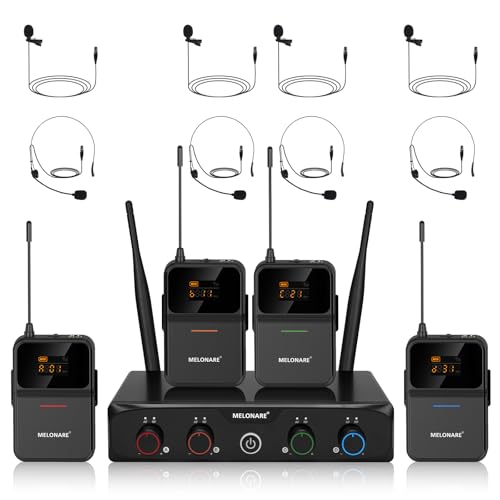
- Four headset/lapel microphone combinations for hands-free use
- 200-foot range with frequency hopping and 40 frequency options
- Compact receiver with mute buttons and color-coded bodypacks
Best For: Churches needing hands-free microphones for preaching, teaching, or worship leadership
Best Dual-Mic Value

- Auto Scan and 2 x 100 selectable UHF frequencies
- Two cardioid dynamic handheld microphones
- Up to 328 feet line-of-sight range
Best For: Worship teams and events needing two wireless handheld mics
Best for Large Teams

- Eight metal handheld microphones and channels
- Individual volume controls with LCD frequency display
- Up to 260 feet of wireless range
Best For: Large worship teams and fixed church audio setups
Best Flexible Two-Mic Setup

- 30 tunable frequency groups in the 500 MHz band
- Automatic pairing with frequency hopping
- Two XLR outputs plus mixed 1/4-inch output
Best For: Small-to-midsize worship services and church meetings
Flexible Four-Mic Choice – innopow WM500 4-Channel Wireless System
For churches seeking wireless microphones for church services, this innopow four-channel UHF system offers selectable frequencies, automatic scanning, and manual pairing. Its metal handheld microphones and multiple output options make it a practical fit for group vocals, worship events, and small stages.
Best For: Churches needing four handheld microphones with flexible frequency coordination and a longer stated battery runtime.
Pros:
- Four handheld dynamic microphones with cardioid pickup for clear vocals.
- Automatic scanning and manual frequency selection help manage interference.
- Offers individual XLR outputs plus a mixed 1/4-inch output.
- Stated battery life is approximately 14–17 hours.
Cons:
- Its stated open-area range is 180–240 feet, which may vary indoors.
- A power amplifier may be needed for the best sound output.
- It is a handheld-only kit, without headset or lavalier options.
The WM500 is a well-rounded choice when a church needs four handheld vocal channels and useful frequency controls. Confirm that your existing mixer or amplifier supports the included output connections.
Simple Group Vocal Setup – Phenyx Pro PTU-5000-4H Wireless System
This Phenyx Pro system is a straightforward option for churches comparing wireless microphones for church group vocals, speaking, and small performances. It includes four metal handheld microphones, individual volume controls, fixed UHF frequencies, and a receiver designed for quick setup.
Best For: Small churches and venues with a fixed audio setup that want four plug-and-go handheld microphones.
Pros:
- Four cardioid dynamic microphones are designed to capture vocals while rejecting unwanted noise.
- Individual volume controls support basic vocal balancing.
- Metal construction is intended for regular event use.
- Memory switch and snap-on BNC antennas simplify setup.
Cons:
- Fixed frequencies provide less coordination flexibility than selectable-frequency systems.
- The system is not intended for multiset operation.
- Its stated battery runtime is up to eight hours.
Choose the PTU-5000-4H when ease of use matters more than extensive frequency customization. It requires an amplifier or speaker system for sound output, so check your church’s existing equipment before buying.
Most Versatile Mic Formats – TONOR TW362 Wireless Microphone System
For churches that need more than handheld microphones, the TONOR TW362 combines two handheld mics with two bodypack transmitters, headsets, and lavalier microphones. Its 200-foot stated range and automatic pairing make it useful for services, lectures, meetings, and presentations.
Best For: Churches that need both handheld and hands-free microphone options for pastors, presenters, singers, or instructors.
Pros:
- Includes two handheld microphones, two headsets, and two lavalier microphones.
- Automatic pairing is designed to make setup easier.
- Offers a stated operating range of up to 200 feet.
- Bodypacks include a mute button for quick pauses.
Cons:
- AA batteries are required and are not included.
- The included connection is a 1/4-inch audio cable, so compatibility with your system should be checked.
- It provides fewer handheld microphones than the four-handheld systems in this roundup.
The TW362 stands out for flexible speaker placement and hands-free use. It is a strong fit when church services include presenters or leaders who need to move freely, provided your PA or powered speaker accepts the receiver’s connection.
Best for Large Vocal Teams – Phenyx Pro PTU-6000-8H 8-Channel System
Churches with large worship teams or multiple speakers may benefit from this eight-channel UHF system. Among these wireless microphones for church, it offers eight handheld microphones, 40 selectable frequencies per channel, auto scan, IR sync, and a stated line-of-sight range of up to 328 feet.
Best For: Larger churches, worship teams, and events requiring up to eight coordinated handheld microphones.
Pros:
- Eight independent channels provide room for larger group vocals and events.
- Each channel has 40 selectable frequencies, with auto scan for quicker coordination.
- IR sync and a lock function help simplify setup and prevent accidental changes.
- Handheld microphones include mute functions and replaceable mic heads.
Cons:
- It is a larger, more complex system than a four-microphone setup.
- The stated 328-foot range is line-of-sight and may be reduced by walls or venue conditions.
- It requires 16 AA batteries in total.
The PTU-6000-8H is the most scalable choice here for churches coordinating many handheld users. Its frequency tools are useful for larger setups, though buyers should allow for additional receiver space and battery management.
Best Four-Handheld Value – innopow WM-400 4-Channel Wireless System
For churches seeking wireless microphones for church services, this innopow system provides four handheld UHF microphones with individual channel volume controls. Its metal construction, 150–200-foot open-area range, and 14–17-hour battery life suit vocals, small worship spaces, and group events.
Best For: Churches needing four handheld microphones for worship, presentations, or small events.
Pros:
- Includes four durable metal handheld microphones with individual volume control.
- Offers 14–17 hours of use and a stated 150–200-foot open-area range.
- Provides four individual XLR outputs plus a mixed 1/4-inch output.
- Unidirectional dynamic cartridges are designed to reduce feedback and handling noise.
Cons:
- Fixed-frequency design cannot be used simultaneously with multiple units.
- The listed range applies to wide-open areas and may vary in a church building.
This is a straightforward, substantial four-mic package for churches that prefer handheld microphones and do not need advanced frequency coordination. Its fixed-frequency limitation is the main consideration for expanding a wireless setup.
Best for Frequency Flexibility – Phenyx Pro PTU-7000-4H Quad UHF System
This Phenyx Pro system is a strong option for wireless microphones for church use when setup flexibility matters. It combines auto scan, IR synchronization, four independent channels, and 40 selectable frequencies per channel, with a stated line-of-sight range of up to 328 feet.
Best For: Churches and event venues coordinating multiple handheld microphones across larger open spaces.
Pros:
- Auto scan helps identify a cleaner UHF frequency, while IR sync simplifies pairing.
- Four channels with 40 selectable frequencies each provide 160 total frequency options.
- Offers four individual XLR outputs and a mixed 1/4-inch output for mixers and PA systems.
- Includes mute controls, lock function, battery indicators, rack ears, and replaceable mic heads.
Cons:
- The advertised 328-foot range is specified for line-of-sight use.
- Frequency coordination is still needed when using multiple compatible systems.
With its broader frequency-selection options and guided setup features, this system is better suited than a fixed-frequency package for churches that expect more complex wireless coordination. The four handheld format remains practical for singers, speakers, and group services.
Best Hands-Free Church Option – MELONARE MWM-41-4B Headset/Lapel System
For churches that need speakers or worship leaders to keep their hands free, this MELONARE system offers four headset/lapel microphone combinations with bodypack transmitters. Its compact receiver, 200-foot range, frequency hopping, and color-coded bodypacks support presentations, services, and conferences.
Best For: Churches needing hands-free microphones for preaching, teaching, worship leadership, or conference speaking.
Pros:
- Includes four bodypacks and four headset/lapel microphone combinations for hands-free use.
- Uses 24-bit/48kHz digital transmission with EQ tuning intended for clear, balanced audio.
- Provides a stated 200-foot range, frequency hopping, and four groups of 10 frequencies.
- Compact half-rack receiver, built-in antenna, mute buttons, and color-coded bodypacks simplify operation.
Cons:
- Omnidirectional headset and lapel microphones may capture more surrounding sound than directional handhelds.
- It is designed around bodypacks rather than handheld microphones.
This is the most practical choice in the group for hands-free church communication. Its headset/lapel format supports movement and speaking, while the compact receiver and channel-coloring features help streamline routine services.
Best Dual-Mic Value – Phenyx Pro PTU-71-2H
For churches seeking wireless microphones for church services, the Phenyx Pro PTU-71-2H combines two handheld mics with auto scanning, selectable UHF frequencies, and a stated line-of-sight range of up to 328 feet. It is a practical option for worship vocals, announcements, and smaller event setups.
Best For: Worship teams, church announcements, karaoke, weddings, and events needing two wireless handheld microphones.
Pros:
- Auto Scan helps identify a lower-interference frequency, while 2 x 100 selectable frequencies support flexible setup.
- Cardioid dynamic microphones are designed to focus on vocals and reject ambient noise.
- Metal receiver and microphones, mute controls, replaceable mic heads, and included AA batteries add practical convenience.
- Offers up to 290–328 feet of line-of-sight operating range.
Cons:
- The system is limited to two handheld microphones.
- Its stated range depends on clear line-of-sight conditions.
- It requires a compatible mixer, PA system, speaker, or other audio equipment for output.
The PTU-71-2H is a strong fit when reliable frequency selection and two-mic flexibility matter more than supporting a large roster of performers. Its included accessories also make initial setup straightforward.
Best for Large Teams – Phenyx Pro PTU-4000-8H
Churches with multiple vocalists, speakers, or performers may appreciate the PTU-4000-8H, an eight-channel system with individual volume controls and eight metal handheld microphones. Its fixed-frequency design favors quick setup in a consistent venue.
Best For: Larger worship teams, churches with multiple speakers, conferences, lectures, and fixed audio installations.
Pros:
- Eight channels provide microphones for larger groups without requiring multiple separate systems.
- Each microphone uses a dynamic cardioid cartridge intended to capture vocals while rejecting unwanted noise.
- Individual volume controls and an LCD frequency display support easier vocal balancing.
- All-metal construction, memory switch, and snap-on BNC antennas are designed for durable, convenient operation.
Cons:
- Fixed frequencies provide less tuning flexibility than a tunable-frequency system.
- The system is not intended for multiset operation.
- It requires an amplifier, mixer, PA system, or speaker for sound output and weighs 13.6 pounds.
With eight microphones and eight XLR outputs, this system is geared toward organized, multi-person productions. It makes the most sense for churches that can use all eight channels and plan to keep the receiver in a stable setup.
Best Flexible Two-Mic Setup – Phenyx Pro PTU-52-2H
The Phenyx Pro PTU-52-2H is a straightforward choice for churches needing two wireless microphones with more frequency flexibility than a fixed-frequency system. It offers 30 tunable frequency groups, automatic pairing, and outputs for mixers, speakers, and amplifiers.
Best For: Small-to-midsize worship services, church meetings, live vocals, public speaking, and occasional outdoor events.
Pros:
- Thirty tunable frequency groups allow frequency changes when a preset is unsuitable.
- Frequency-hopping technology automatically connects the microphones and receiver within seconds.
- Cardioid capsules and enhanced circuitry are designed for clean, stable audio with reduced hiss, feedback, and dropouts.
- Includes two XLR outputs and one mixed 1/4-inch output for flexible connections.
Cons:
- The stated operating distance is up to 200 feet in open-space line-of-sight conditions.
- Only two handheld microphones are included.
- The system supports up to three units simultaneously, according to the supplied notes.
This model is a practical middle ground for churches that want simple automatic pairing while retaining the ability to adjust frequencies. Its dual XLR and mixed 1/4-inch outputs suit common church audio configurations.
How We Picked the Best Wireless Microphones for Church
We focused on practical features that matter in worship spaces and church event rooms: usable operating range, channel capacity, microphone format, frequency selection, build quality, and setup simplicity. The selection includes two-, four-, and eight-channel systems, along with handheld, headset, and lavalier options.
Because church environments vary widely, the advertised range should be treated as a best-case figure. Walls, people, lighting equipment, Wi-Fi devices, and other radio-frequency sources can reduce real-world performance. Systems with auto-scan or tunable channels generally offer more flexibility when interference is a concern.
Quick Comparison
- Best for larger productions: An eight-channel system gives worship teams, speakers, and guest performers more simultaneous microphone options.
- Best for typical services: A four-channel kit balances capacity, cost, and manageable setup.
- Best for sermons and presentations: Headset or lavalier systems keep the speaker’s hands free.
- Best for singers: Dynamic handheld microphones are practical for vocals and usually tolerate active stage use well.
- Best for crowded radio environments: Auto-scan or tunable systems make it easier to find cleaner frequencies.
Key Buying Factors for Wireless Microphones for Church
Channel Count
Count how many microphones may operate at the same time, not merely how many microphones your church owns. Leave some capacity for guest speakers, soloists, musicians, or overflow events. More channels also require careful frequency coordination.
Microphone Type
Handheld models suit singers, readers, and presenters who can hold a mic. Headsets and lavaliers are better for pastors, teachers, and speakers who need both hands free. A mixed system can cover different service roles, but check transmitter compatibility before expanding.
Frequency Control and Range
Fixed-frequency systems can be straightforward when the environment is quiet. Auto-scan and tunable systems are preferable when nearby wireless equipment may create interference. Prioritize stable reception throughout the actual stage, platform, and seating areas rather than relying only on maximum range claims.
Receiver Connections and Installation
Confirm that the receiver outputs match your mixer, amplifier, or church sound system. Also check whether the receiver needs a clear line of sight, how it will be powered, and whether the included cables fit your existing inputs.
Build Quality and Maintenance
Metal microphones and receivers can withstand frequent transport, while replaceable batteries and clearly labeled controls simplify weekly use. Label each transmitter and store microphones, antennas, and power supplies together to reduce setup mistakes.
Who Should Buy Which Wireless Microphones for Church?
Small churches and occasional events: Choose a dual-channel system if one speaker and one singer are the usual maximum. It keeps the setup compact and affordable.
Most worship services: A four-channel kit is a versatile choice for combining singers, readers, pastors, or guest presenters.
Churches with larger worship teams: Select an eight-channel system when several vocalists or speakers need simultaneous microphones. Plan frequency coordination and mixer inputs in advance.
Pastors and teachers who move frequently: Look for headset or lavalier microphones with bodypack transmitters, provided the capsule and fit suit the speaker’s voice and presentation style.
Churches upgrading an existing sound system: Prioritize frequency flexibility, receiver outputs, and compatibility with your mixer. Buying more channels than your current setup supports may add cost without improving sound until the rest of the system is upgraded.