The right projector screen can make presentations easier to see, reduce distracting glare, and give a conference room a more polished setup. The best choice depends on room size, viewing distance, projector placement, and whether the screen will stay installed.
We selected 10 screens ranging from compact manual models to large motorized and portable options, with formats suited to meetings, training sessions, classrooms, and presentations.
Best 10 Projector Screens for Conference Rooms Picks for 2026
Large Motorized Choice
120 Inch Electric Projector Screen

- Large 120-inch format for group presentations
- Remote-controlled motorized drop-down operation
- Matte surface with 160° viewing angle
Best For: Large conference rooms needing a permanently mounted screen
Simple Manual Value
Pyle 84-Inch Pull Down Projector Screen

- Auto-locking manual height adjustment
- Matte white surface with black border
- Wall, ceiling, or surface mounting
Best For: Smaller meeting rooms needing an adjustable manual screen
Portable Presentation Pick
100 Inch Tripod Projector Screen
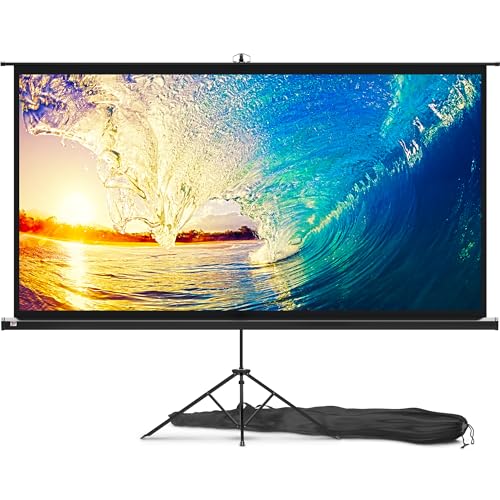
- Portable 100-inch 16:9 viewing area
- Adjustable tripod stand and quick assembly
- Carrying bag for indoor or outdoor transport
Best For: Mobile meetings and temporary presentation setups
Compact Motorized Format
92 Inch Motorized Projector Screen

- Remote-controlled automatic operation
- 80-by-45-inch 16:9 viewing area
- Wall- or ceiling-mount installation
Best For: Moderate-size rooms needing a motorized screen
Best Square-Format Value
VIVOHOME 120-Inch Pull-Down Screen

- Large 120-inch 1:1 display
- Self-locking manual retraction
- Wall or ceiling mountable
Best For: Conference rooms using square-format presentations
Best Portable Option
Pyle 60-Inch Tripod Projector Screen

- Foldable tripod setup
- Portable 60-inch 16:9 format
- Matte surface with black backing
Best For: Shared offices and mobile presentations
Best Motorized Upgrade
Kayle 120-Inch Electric Screen

- Powered 120-inch 16:9 display
- RF remote and wall-switch control
- Wall or ceiling installation kit included
Best For: Dedicated conference rooms needing convenient operation
Best with Extra Features
100-Inch Tripod Projector Screen

- 100-inch 16:9 PVC screen with 1.5 gain
- Height-adjustable tripod and carry bag
- Indoor/outdoor flexibility with included ground nails
Best For: Mobile presentations, training rooms, and shared-use spaces
Remote-Controlled Option
84-Inch Motorized Projector Screen

- Motorized retractable design with remote control
- Matte 16:9 surface with 160° viewing angle
- Wall- or ceiling-mount installation
Best For: Installed meeting rooms and low-effort presentations
Large Manual Value
100-Inch Pull-Down Projector Screen
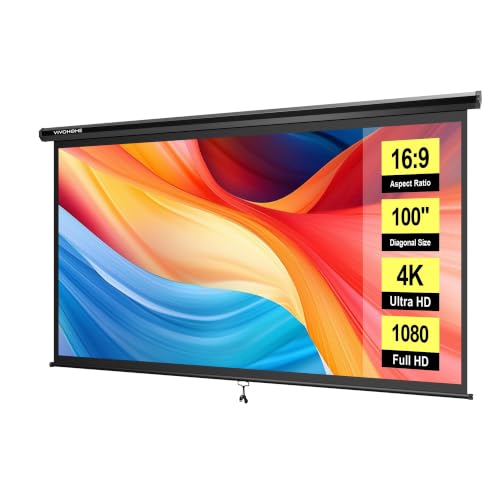
- Large 100-inch 16:9 display area
- Self-locking manual pull-down mechanism
- Matte surface with wall- or ceiling-mount options
Best For: Large conference rooms and classrooms with fixed mounting
Large Motorized Choice – 120 Inch Electric Projector Screen
For conference rooms that need a large, polished presentation surface, the DINAH 120-inch electric projector screen offers ceiling- or wall-mounted installation and convenient remote operation. Its matte finish, 160-degree viewing angle, and stated 4K 3D HD projection support make it suited to group viewing.
Best For: Large conference rooms, offices, classrooms, and presentations where remote-controlled deployment is useful.
Pros:
- Large 120-inch screen for group viewing.
- Motorized drop-down operation with included remote.
- Matte finish and 160-degree viewing angle.
- Two-year warranty is included.
Cons:
- Its 120-inch size requires substantial wall or ceiling space.
- Motorized installation may be more involved than a portable screen.
This is a strong fit when presentation visibility and hands-free operation take priority. Measure the mounting area carefully before choosing this large-format screen.
Simple Manual Value – Pyle 84-Inch Pull Down Projector Screen
The Pyle 84-inch pull-down screen is a practical option for conference rooms seeking a straightforward projector screen without motorized controls. Its matte white surface, auto-locking height adjustment, and wall- or ceiling-mount design support flexible meeting-room use.
Best For: Offices, classrooms, and smaller conference rooms that value adjustable manual setup and neat storage.
Pros:
- Auto-locking design can stop at different heights.
- Matte white surface with a black border for alignment.
- Supports wall, ceiling, or surface mounting.
- Retracts neatly after presentations.
Cons:
- Manual operation is less convenient than a motorized screen.
- Its 84-inch size may be limiting for larger rooms.
This screen keeps installation and operation uncomplicated. It is worth considering when the room has suitable mounting points and presenters do not need remote-controlled deployment.
Portable Presentation Pick – 100 Inch Tripod Projector Screen
For teams that move between rooms or venues, this 100-inch PropVue screen provides a portable alternative to fixed projector screens for conference rooms. It assembles in three steps, uses a tripod stand, and includes a fitted carrying bag for transport.
Best For: Mobile presentations, temporary conference setups, schools, offices, churches, and indoor or outdoor events.
Pros:
- Portable 100-inch 16:9 format.
- Tripod stand with adjustable height.
- Quick three-step assembly and carrying bag.
- Suitable for indoor and outdoor use.
Cons:
- Requires floor space for the tripod legs.
- Setup is less permanent and streamlined than a wall- or ceiling-mounted screen.
This is the most flexible choice for shared spaces and traveling presenters. Choose it when easy transport and fast setup matter more than a permanent installation.
Compact Motorized Format – 92 Inch Motorized Projector Screen
The Kshioe 92-inch motorized screen offers remote-controlled operation in a more compact 16:9 format, making it a practical projector screen for conference rooms with limited installation space. It supports wall or ceiling mounting and provides an 80-by-45-inch viewing area.
Best For: Conference rooms, classrooms, offices, and home theaters needing automatic operation in a moderate-size format.
Pros:
- Wireless remote supports operation from anywhere in the room.
- 16:9 format with an 80-by-45-inch viewing area.
- Wall- and ceiling-mount installation options.
- 160-degree viewing angle and stated 1.3 gain.
Cons:
- Smaller viewing area than the 100- and 120-inch alternatives.
- Listed glossy finish may reflect more light than a matte surface.
This model balances motorized convenience with a footprint suited to moderately sized rooms. Check the listed viewing dimensions against the seating layout before buying.
Best Square-Format Value – VIVOHOME 120-Inch Pull-Down Screen
For conference rooms that use square-format slides, this VIVOHOME screen provides a large 120-inch 1:1 display with a manual pull-down design. Its wall- or ceiling-mount options make it a practical fit for presentations, classrooms, and other fixed viewing spaces, provided you have room for its roughly 90-by-92-inch overall footprint.
Best For: Conference rooms, classrooms, and presentations that benefit from a large square image.
Pros:
- 120-inch diagonal 1:1 viewing area suits presentations and classroom content.
- Self-locking mechanism holds the screen at the selected height.
- Matte white, three-layer PVC surface supports 3D, 1080p, 4K, 8K, and Full HD content.
- Wall or ceiling mounting and a metal casing support long-term use.
Cons:
- Manual operation is less convenient than a motorized screen.
- Its large overall size requires careful room and mounting-space planning.
- Screws and L-brackets are not included.
Choose this model when square-format presentation compatibility and a large viewing area matter more than powered operation. The retractable design also allows the screen to be stored out of the way between meetings.
Best Portable Option – Pyle 60-Inch Tripod Projector Screen
If your conference room needs a screen that can move between rooms, this Pyle portable projector screen combines a 60-inch 16:9 display with a foldable tripod. It sets up on a flat floor or table and can also be used outdoors, making it useful for offices with shared presentation equipment.
Best For: Portable office presentations, classrooms, travel, and small meeting spaces.
Pros:
- Tripod design assembles and disassembles for convenient transport.
- 16:9 format works well for HD-style video and presentations.
- Matte fabric, black borders, and full black backing support clear, focused images.
- Adjustable stand extends from 50 to 83.46 inches.
Cons:
- The 60-inch screen is smaller than the fixed 120-inch alternatives.
- Freestanding placement requires available floor or table space.
- Manual setup is required for each use.
This is a sensible choice when flexibility outweighs maximum image size. The included stand and roll-up construction make it easier to deploy for occasional meetings, presentations, and movie use without permanent installation.
Best Motorized Upgrade – Kayle 120-Inch Electric Screen
For conference rooms where convenient operation is a priority, the Kayle motorized screen offers a 120-inch 16:9 display that lowers at the press of a button. It arrives assembled for plug-and-play installation and includes RF remotes, a detachable three-way wall switch, and hardware for wall or ceiling mounting.
Best For: Conference rooms and presentation spaces that need a large widescreen image with powered retraction.
Pros:
- Electric operation enables smooth, quiet screen deployment.
- 120-inch 16:9 format suits HD video, films, and presentations.
- 1.2 gain, 180-degree viewing specification, and black-backed three-layer material support bright viewing.
- Includes RF remotes, wall switch, installation kit, and a durable metal casing.
Cons:
- Requires access to power and a more involved permanent installation than a tripod screen.
- Its roughly 116.5-inch width demands substantial wall or ceiling space.
- Motorized operation adds complexity compared with a manual screen.
This model is the strongest fit when a conference room needs repeatable, low-effort setup and a modern widescreen format. Its assembled, wall- or ceiling-mount design is best suited to a dedicated presentation area.
Best with Extra Features – 100-Inch Tripod Projector Screen
For projector screens for conference rooms that may need to move between spaces, the Paris RHÔNE offers a portable 100-inch 16:9 display with a height-adjustable tripod. Its PVC surface, 1.5 gain, and 160° viewing angle are suited to presentations, classes, and group viewing indoors or outdoors.
Best For: Flexible conference rooms, training sessions, classrooms, and teams that need a screen they can transport.
Pros:
- Large 100-inch 16:9 screen with a 160° viewing angle.
- 1.5-gain, multi-layer PVC surface is designed for bright, color-accurate images.
- Adjustable tripod, support rods, carry bag, and ground nails support flexible indoor or outdoor use.
- One-person setup is advertised to take about two minutes.
Cons:
- Tripod placement requires floor space, which may not suit compact conference rooms.
- Manual setup is less convenient than a motorized retractable screen.
- The glossy finish may be less forgiving of reflections than a matte surface.
This is a practical choice when portability matters more than a permanently clean installation. The included stand and carry bag make it especially useful for organizations sharing one screen among multiple rooms.
Remote-Controlled Option – 84-Inch Motorized Projector Screen
Among projector screens for conference rooms, the VIVOHOME 84-inch motorized model is a convenient fit for spaces where the screen should retract after use. Its matte white 16:9 surface, wall or ceiling mounting, and long-distance remote control support polished meeting-room operation.
Best For: Permanent or semi-permanent conference rooms where remote operation and a retractable installation are priorities.
Pros:
- Motorized operation with a remote range of up to 82 feet.
- Matte white surface and 160° viewing angle are designed for bright, uniform images with reduced glare.
- Wall- or ceiling-mount installation supports flexible room layouts.
- Three-layer waterproof PVC fabric and an 8mm metal casing are designed for durability.
Cons:
- The 84-inch display area is smaller than the 100-inch alternatives in this roundup.
- Remote battery is not included.
- The listed overall dimensions require careful measurement before installation.
Choose this model when presentation convenience and a tidy retractable setup outweigh maximum screen size. Confirm the 82.1-by-50.4-inch overall footprint and available power placement before mounting.
Large Manual Value – 100-Inch Pull-Down Projector Screen
For projector screens for conference rooms needing a broad presentation area without motorized hardware, the VIVOHOME 100-inch pull-down model is a straightforward option. Its manual self-locking mechanism, matte white surface, and wall- or ceiling-mount design work well for meeting rooms, classrooms, and shared presentation areas.
Best For: Conference rooms and classrooms that need a large fixed screen with simple manual height adjustment.
Pros:
- 100-inch 16:9 display provides a large viewing area for group presentations.
- Self-locking pull-down mechanism holds the screen at the desired height.
- Matte white PVC surface offers a 160° viewing angle and helps minimize glare.
- Roll-up design supports storage, while wall- and ceiling-mount options add installation flexibility.
Cons:
- Manual operation is less convenient than a motorized screen.
- Screws and L-brackets are not included.
- The 92-by-57.5-inch overall size requires substantial mounting space.
This screen is a sensible choice for buyers who want maximum listed screen size and uncomplicated operation. Plan for the mounting hardware separately and verify the room dimensions before installation.
How We Picked the Best Projector Screens for Conference Rooms
We focused on the practical features that matter in business environments: screen size, aspect ratio, installation style, operation, portability, viewing-surface design, and compatibility with common projector setups. The selection includes motorized screens for permanent installations, pull-down models for lower-cost wall or ceiling mounting, and tripod or freestanding screens for flexible meeting spaces.
We also considered whether each design is suitable for presentations rather than only movie viewing. A screen should be easy to deploy, offer a consistent image surface, and fit the room without blocking doors, displays, lighting, or whiteboards.
Quick Comparison
| Screen type | Best for | Main advantage | Potential trade-off |
|---|---|---|---|
| Motorized | Dedicated conference rooms | Fast, convenient operation | Needs power and installation |
| Manual pull-down | Budget installations | Simple and affordable | Requires manual setup |
| Tripod or stand | Multi-use rooms | Portable and flexible | Uses floor space |
| Large 1:1 format | Mixed content and older presentations | Versatile image framing | Less optimized for widescreen video |
Key Buying Factors for Projector Screens for Conference Rooms
Screen Size and Viewing Distance
A larger screen is not automatically better. Choose a size that lets people in the back row read text comfortably while leaving adequate clearance around the screen. Screens around 84 to 100 inches often suit small and medium rooms, while 120-inch models can work well in larger spaces when projector brightness and viewing distance support them.
Aspect Ratio
A 16:9 screen is a strong all-purpose choice for modern laptops, video calls, streaming content, and widescreen presentations. A 1:1 screen can be more adaptable for older presentation formats or content that changes between landscape and portrait-oriented layouts, but unused areas may appear with widescreen images.
Installation and Operation
Motorized screens are convenient for rooms used frequently because they retract neatly and can often be controlled from a distance. Manual pull-down screens cost less and avoid motor maintenance. Portable tripod models are preferable when the room must serve several purposes or presentations move between locations.
Surface, Gain, and Room Lighting
Matte white surfaces generally provide broad viewing angles and predictable presentation quality. Consider the room’s ambient light, projector brightness, and seating arrangement together. A screen cannot fully compensate for strong light aimed directly at the image, so blinds, lighting controls, and projector placement remain important.
Build Quality and Fit
Measure the available wall or ceiling area, including the casing and drop length. Look for a stable frame or stand, smooth deployment, a surface that resists visible waves, and a return or warranty policy that provides protection if the screen arrives damaged or develops defects.
Who Should Buy Which Projector Screens for Conference Rooms?
- Choose a motorized screen for a dedicated conference room where quick, repeatable setup matters.
- Choose a manual pull-down screen for a permanent installation when you want reliable functionality at a lower price.
- Choose a tripod or stand model for shared rooms, traveling presenters, training sessions, or temporary events.
- Choose a 16:9 screen for current laptops, video conferencing, and multimedia presentations.
- Choose a 1:1 screen when presentation formats vary or compatibility with older content is a priority.
- Choose a 120-inch model only when the room has enough viewing distance and the projector can produce a bright, well-defined image at that size.
Before ordering, confirm the screen’s dimensions, mounting method, power requirements, and return policy. Matching those details to the room will usually matter more than choosing the largest available screen.