The right amplifier can give a home cinema system greater headroom, cleaner dynamics, and more convincing surround sound. However, channel count, speaker impedance, connectivity, and installation space all affect which model makes sense.
We compare 10 power amplifiers for home cinema, ranging from compact two-channel designs to high-output five-, seven-, and eight-channel models. Use the guide below to match amplifier power and features to your room, speakers, and AV processor.
Best 10 Power Amplifiers for Home Cinema Picks for 2026
High-Output Choice

- 5x210W at 4 ohms or 145W at 8 ohms
- XLR, RCA, and 12V trigger connections
- Channel status LEDs and five-year warranty
Best For: High-output five-channel home theater systems
Isolation-Focused Performer

- Five channels with 120W continuous output
- Balanced XLR and hum-rejecting RCA inputs
- Independent supplies and protection relays
Best For: Clean, flexible five-channel theater installations
Refined Five-Channel Option
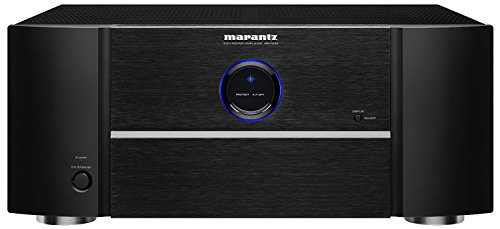
- 140W per channel into 8 ohms
- Current-feedback design with HDAM circuit
- XLR and RCA inputs across five channels
Best For: Marantz-based five-channel home theaters
Seven-Channel Powerhouse

- Seven channels at 150W into 8 ohms
- High-current toroidal transformer for dynamic peaks
- Balanced XLR and RCA inputs
Best For: Larger seven-channel home theater systems
Best Modular Power Amplifier

- 240W at 4 ohms per mono amplifier
- RCA, XLR, and 1/4-inch TRS inputs
- Scalable for AVR-based multichannel systems
Best For: Expandable passive-speaker home theater systems
Best Two-Channel Option

- Dedicated two-channel power amplifier
- Black finish for a conventional rack setup
- Includes a one-year warranty
Best For: Stereo systems or front-channel amplification
Best Multichannel Powerhouse
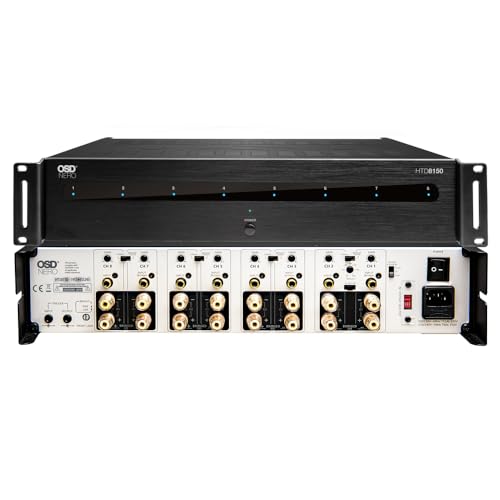
- Eight channels at up to 175W each at 4 ohms
- Bridging options up to 400W at 8 ohms
- Subwoofer crossover and level controls
Best For: Large home theaters and multi-room installations
Compact Dual-Channel Choice

- Two channels at 90 watts per channel
- RCA and XLR inputs
- Black finish
Best For: Two-channel home cinema setups needing flexible inputs
Five-Channel Theater Powerhouse
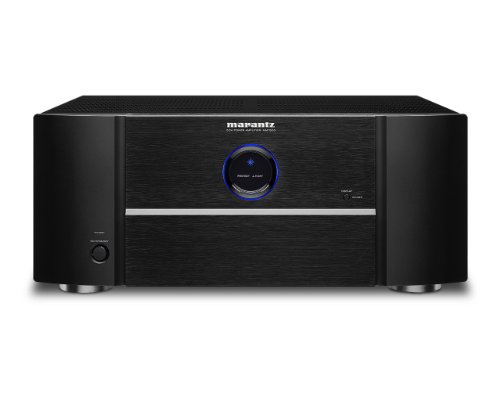
- 140 watts per channel into 8 ohms
- Five-channel design for surround sound
- XLR and RCA inputs with thermal tunnel cooling
Best For: High-output multichannel home theater systems
Feature-Packed Karaoke Amplifier

- 5.1-channel output with subwoofer channel
- Three microphone inputs for karaoke
- USB/SD playback and remote control
Best For: Casual home theaters and karaoke-focused gatherings
High-Output Choice – OSD Audio Nero HTA5200
For shoppers comparing power amplifiers for home cinema, the OSD Audio Nero HTA5200 is a practical five-channel option with substantial output, flexible connectivity, and useful status monitoring. It delivers 210 watts per channel into 4 ohms or 145 watts into 8 ohms with all channels driven.
Best For: Home theater systems needing strong five-channel output, XLR/RCA connectivity, and straightforward integration.
Pros:
- High-output Class AB design with 5x210W at 4 ohms.
- Balanced XLR, RCA inputs, and a 12V trigger support varied setups.
- Channel LEDs show operating, standby, or protection status.
- Includes a five-year warranty and 110 dB signal-to-noise ratio at full power.
Cons:
- Its 63-pound weight and roughly 6.3-inch height require substantial rack or shelf space.
- It provides five channels rather than seven.
The Nero HTA5200 stands out when output and integration flexibility matter more than compact size. Its long warranty and channel indicators add reassurance for a dedicated theater installation.
Isolation-Focused Performer – Outlaw Model 5000x
The Outlaw Model 5000x is a five-channel choice for power amplifiers for home cinema, emphasizing channel isolation and input noise rejection. It provides 120 watts of continuous power per channel and combines balanced XLR inputs with differential-sensing RCA circuitry.
Best For: Home theaters where clean signal handling, independent channel design, and flexible inputs are priorities.
Pros:
- Balanced XLR inputs use common-mode rejection to help reduce noise.
- RCA inputs are designed to reject input hum.
- Independent power rectification, modular channels, and separate protection relays support channel separation and safety.
- Five-year parts-and-labor warranty is included.
Cons:
- Its 18-inch depth with the power cord inserted may complicate shallow-rack placement.
- The supplied rating is 5×120 watts, lower than some higher-output alternatives.
The Model 5000x is a sensible fit for installations that value carefully isolated channels and flexible balanced or unbalanced connections. Check cabinet depth before purchasing.
Refined Five-Channel Option – Marantz MM7055
The Marantz MM7055 is a straightforward five-channel amplifier for home cinema systems seeking a refined component with 140 watts per channel into 8 ohms. Its current-feedback design, HDAM circuit, and XLR/RCA inputs support both performance-focused and flexible installations.
Best For: Marantz-centered home theater systems needing five channels and both balanced and unbalanced inputs.
Pros:
- Rated at 140 watts per channel into 8 ohms across five channels.
- Current-feedback amplification and a Marantz HDAM circuit are built in.
- Five-channel XLR and RCA input connectivity supports varied equipment.
- Gold-plated terminals and a detachable power cord add installation convenience.
Cons:
- It offers five channels, not seven, for larger surround layouts.
- The listed three-year parts-and-labor warranty is shorter than some competing options.
- Its 7.26-inch height may require careful shelf or rack planning.
The MM7055 is a polished fit for listeners who want Marantz design and processing architecture in a dedicated five-channel amplifier. Its connection options make it easy to pair with a range of preamp or AV components.
Seven-Channel Powerhouse – Marantz MM8077
For larger systems comparing power amplifiers for home cinema, the Marantz MM8077 adds seven channels with 150 watts per channel into 8 ohms and 180 watts into 6 ohms. It combines balanced and unbalanced inputs with a high-current toroidal transformer and discrete output stages.
Best For: Larger home theater layouts needing seven consistent channels and headroom for dynamic peaks.
Pros:
- Seven channels deliver 150W into 8 ohms or 180W into 6 ohms.
- Identical output-stage topology supports consistent channel performance.
- XLR and RCA inputs provide flexible system configuration.
- High-current toroidal transformer, copper-plated chassis, and gold-plated terminals support demanding installations.
Cons:
- Its 40-pound chassis and 7.29-inch height require substantial placement space.
- The listed warranty is three years, shorter than some alternatives.
- It is a seven-channel design, which may be more amplifier capacity than smaller theaters need.
The MM8077 is the strongest match here for a full seven-channel theater that values uniform amplification and dynamic headroom. Auto-standby and remote power control also support convenient everyday use.
Best Modular Power Amplifier – Fosi Audio V3 Mono
The Fosi Audio V3 Mono is a flexible choice among power amplifiers for home cinema, especially when you want to add dedicated amplification to individual channels or supplement an AV receiver. Its mono design delivers up to 240W at 4 ohms and supports both balanced and single-ended connections.
Best For: Home theater systems using passive speakers that need scalable, channel-by-channel amplification.
Pros:
- Up to 240W at 4 ohms from each mono amplifier.
- Works with AVR systems and can support 2-, 3-, 4-, or 5-channel configurations.
- Offers RCA, XLR, and 1/4-inch TRS inputs, plus selectable gain.
- Includes PFFB technology, premium internal components, and an efficient heat-dissipation design.
Cons:
- Its mono format means multiple units may be needed for a complete multichannel system.
- The supplied notes do not identify onboard volume control or speaker protection features.
The V3 Mono stands out for its expandability and connection flexibility. It is a practical fit for enthusiasts building a high-power home cinema system incrementally, though buyers should plan around its single-channel-per-unit design.
Best Two-Channel Option – EVERSOLO AMP-F2
The EVERSOLO AMP-F2 is a straightforward two-channel option to consider when comparing power amplifiers for home cinema. Its compact product description focuses on stereo amplification, making it a potentially suitable match for front-channel or dedicated two-channel listening setups.
Best For: Buyers seeking a branded two-channel power amplifier for a stereo or front-speaker application.
Pros:
- Dedicated two-channel design.
- Simple black finish suited to conventional audio racks.
- Includes a one-year product warranty.
Cons:
- The supplied notes do not specify output power, input types, or impedance ratings.
- It may require additional amplification for a full multichannel home cinema system.
The AMP-F2 may appeal to shoppers who want a simple two-channel amplifier, but its limited supplied specifications make system matching more difficult. Confirm power, connectivity, and speaker compatibility before choosing it for a demanding theater setup.
Best Multichannel Powerhouse – OSD Audio Nero 8-Channel
The OSD Audio Nero HTX-8150 is built for complex home cinema and distributed-audio systems. With eight channels, 100W per channel at 8 ohms, and 175W at 4 ohms, it offers the channel count and bridging flexibility many larger installations need.
Best For: Sophisticated home theaters, multi-room audio systems, and setups requiring flexible bridged output.
Pros:
- Eight-channel design with 100W at 8 ohms or 175W at 4 ohms per channel.
- Supports multiple bridging configurations, including up to 400W at 8 ohms.
- Two channels can be bridged for subwoofer use with crossover and level controls.
- Includes RCA inputs, a 12V trigger, and individual channel-status LEDs.
Cons:
- At 24.6 pounds and 17 x 18 x 5 inches, it requires substantial rack or shelf space.
- Its many configuration options may require careful planning during installation.
The Nero HTX-8150 is the most installation-oriented choice in this group. Its eight channels and configurable bridging make it well suited to expandable theaters, multi-room systems, and applications that need dedicated subwoofer amplification.
Compact Dual-Channel Choice – Monolith M2100X
The Monolith M2100X is a straightforward option among power amplifiers for home cinema, offering two channels rated at 90 watts per channel. RCA and XLR inputs provide flexibility when connecting compatible home theater equipment.
Best For: Home cinema systems needing a two-channel amplifier with both RCA and XLR connectivity.
Pros:
- Delivers 90 watts per channel across two channels.
- Supports both RCA and XLR inputs.
- Simple black finish suits many theater setups.
Cons:
- Two-channel design may not suit larger surround systems.
- The supplied notes provide limited information about additional features.
Choose the M2100X when your system calls for focused two-channel amplification and flexible input options rather than a multichannel solution.
Five-Channel Theater Powerhouse – Marantz MM7055
The Marantz MM7055 is built for listeners who want a dedicated five-channel amplifier for home cinema. It provides 140 watts per channel into 8 ohms, with balanced XLR and unbalanced RCA inputs for flexible system integration.
Best For: Multichannel home theaters seeking substantial output, flexible connections, and dedicated thermal management.
Pros:
- Five channels rated at 140 watts per channel into 8 ohms.
- Offers both balanced XLR and unbalanced RCA inputs.
- Gold-plated, four-way binding posts support secure speaker connections.
- Thermal tunnel cooling is designed to draw heat away from the output stages.
Cons:
- Dedicated cooling is required to manage heat generation.
- Its five-channel layout may be more than a basic stereo setup needs.
The MM7055 is a strong fit for a serious surround system, particularly when you value high channel output and the option to expand a compatible Marantz-based setup.
Feature-Packed Karaoke Amplifier – Viprh 5.1-Channel Amp
The Viprh 5.1-channel amplifier combines home cinema playback with party and karaoke features. It includes an independent subwoofer channel, USB and SD playback, three microphone inputs, a remote control, and RCA connections for TVs, computers, CD players, active subwoofers, or active speakers.
Best For: Casual home theaters, karaoke nights, and small gatherings that need multiple entertainment functions in one amplifier.
Pros:
- Provides 5.1-channel surround output with an independent subwoofer channel.
- Includes three microphone inputs with adjustable mixing.
- Supports USB and SD card playback plus a remote control.
- Built-in protection features and eight dual-tube amplifier modules support stable operation.
Cons:
- Audio output is intended for active subwoofers or active speakers only.
- The supplied specifications list 1,500 watts of output but do not clarify the operating rating behind the 3,000-watt peak claim.
- Its karaoke-focused features may be unnecessary for a dedicated movie-only system.
This model makes the most sense when versatility matters as much as cinema sound. Verify that your speakers and subwoofer are active before choosing it for your setup.
How We Picked These Power Amplifiers for Home Cinema
We focused on models suited to dedicated theaters, media rooms, and serious home audio systems. Our comparison considers continuous power claims, channel count, compatibility with common 4- and 8-ohm speakers, input options, amplifier topology, and installation flexibility.
We also included different system approaches: multichannel amplifiers for complete surround setups, two-channel models for front-stage or stereo use, and flexible designs that can support larger speakers or future upgrades. Published wattage is only one part of performance, so buyers should also consider current delivery, ventilation, sensitivity, and the capabilities of their preamp or AV receiver.
Quick Comparison
- Five-channel amplifiers: A practical match for 5.1 systems and many front-stage upgrades.
- Seven- and eight-channel amplifiers: Better suited to immersive formats, multiroom audio, or expansion plans.
- Two-channel amplifiers: Useful for powering left and right speakers, height channels, or a separate stereo zone.
- Class D designs: Often provide high efficiency and a compact chassis, with less heat than many traditional designs.
- RCA and XLR inputs: RCA works with most consumer processors, while XLR can help with balanced connections and longer cable runs.
Key Buying Factors for Power Amplifiers for Home Cinema
Channel Count and System Layout
Choose enough channels for the speakers you run now, while allowing room for planned expansion. A five-channel unit can power the main bed layer, whereas a seven- or eight-channel model may simplify Dolby Atmos, DTS:X, or multi-zone installations.
Power, Impedance, and Headroom
Match the amplifier to your speakers’ impedance and sensitivity. Higher output can improve dynamics in large rooms, but sustained power handling and stable operation are more useful than an isolated peak-wattage number. Check whether ratings are continuous, per channel, and measured with all channels driven.
Connections and Integration
Confirm that the amplifier accepts the outputs on your AV processor or receiver. RCA inputs are common; balanced XLR inputs are valuable when supported by the rest of the system. Trigger inputs, bridge modes, and independent channel controls can also simplify installation.
Size, Cooling, and Noise
Measure the rack or shelf before buying. Leave ventilation space around the chassis, particularly for conventional high-power amplifiers. If the equipment sits close to the seating area, fan noise and transformer hum deserve attention.
Who Should Buy Which Power Amplifiers for Home Cinema?
Choose a five-channel amplifier for a conventional 5.1 theater or a receiver upgrade focused on the front three speakers and surrounds. Choose seven or eight channels if you are building an immersive theater, powering several zones, or want expansion flexibility.
Choose a two-channel model for a stereo listening system, dedicated left-and-right power, or incremental upgrades to an existing surround setup. Choose a compact Class D amplifier when efficiency, low heat, and easier placement matter most. For large rooms or demanding speakers, prioritize strong continuous output, stable impedance handling, and balanced connectivity over headline peak power.