Choosing among the best PC fan controllers for water cooling can make a major difference in pump and radiator-fan management. The right controller provides enough power, reliable PWM control, and the connectivity your motherboard or ecosystem requires.
We selected 10 options ranging from compact multi-port hubs to feature-rich RGB and software-controlled controllers, covering custom loops, high-airflow cases, and budget-focused builds.
Best 10 PC Fan Controllers for Water Cooling Picks for 2026
Best Overall
ARCTIC 10-Port PWM Fan Controller

- Individual PWM control across 10 ports
- Up to 2 A per port and 4.5 A total
- Windows and Linux support with flexible mounting
Best For: Complex multi-fan builds needing independent control
Best for RGB Ecosystem Flexibility

- Supports ARGB PWM and iCUE LINK devices
- Two channels support up to six fans each
- Custom curves and synchronized RGB through iCUE
Best For: Mixed CORSAIR fan and lighting ecosystems
Best Standalone Power Option
12V Adjustable Fan Speed Controller

- Adjustable 3–12V DC output
- 36W maximum power with up to 3A output
- Includes a four-way 3-pin/4-pin splitter
Best For: External, standalone fan-power setups
High-Power PWM Pick

- Supports six 4-pin PWM fans
- 60W total output with dual 12V input options
- 10-step PWM adjustment with voltage indicators
Best For: Multi-fan 4-pin PWM cooling setups
Adjustable Plug-and-Play Option
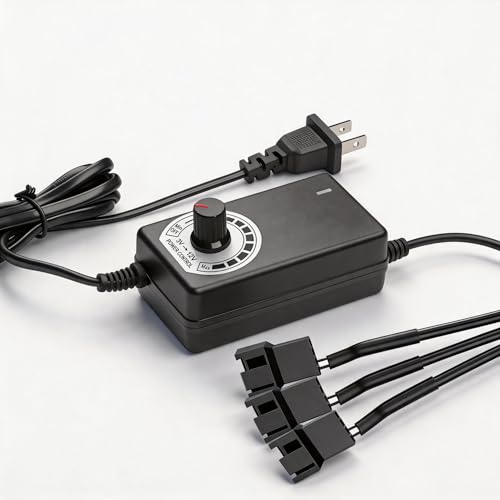
- Adjustable 3-12V output
- Supports 2-, 3-, and 4-pin devices
- Includes a three-device splitter and US plug
Best For: DIY cooling setups with mixed fan or pump connectors
ARGB and PWM Expansion Pick

- Supports 12 groups of PWM and ARGB devices
- Uses SATA power for expanded connectivity
- Includes IR lighting remote and cable-management design
Best For: Multi-fan, 5V ARGB desktop builds
USB-C PWM Control Hub

- 0–100% manual PWM adjustment
- Supports compatible fans and water pumps
- USB-C power with included five-way hub
Best For: DIY multi-fan and water-cooling setups
ARGB Expansion Hub
Thermalright 8-Port Fan and ARGB Hub

- Connects up to eight fan groups
- Supports 5V 3-pin ARGB devices
- SATA-powered cable-management solution
Best For: Expanding compatible fan and ARGB connections
Independent Knob Control
SinLoon 8-Channel 4-Knob Fan Hub

- Four independent speed-control knobs
- Eight-channel 12V fan hub
- PCI-position installation saves space
Best For: Manual control of multi-fan water-cooling systems
Best Overall – ARCTIC 10-Port PWM Fan Controller
For builders seeking versatile pc fan controllers for water cooling, the ARCTIC Fan Controller offers individual PWM control across 10 ports. Its high per-port capacity, broad operating-system support, and flexible mounting make it suitable for complex cooling layouts.
Best For: Multi-fan PC builds that need independent speed control and tidy cable management.
Pros:
- Provides individual PWM control for up to 10 fans.
- Supports up to 2 A per port and 4.5 A total.
- Offers native Windows and Linux Kernel 7.2+ support.
- Magnetic or adhesive mounting helps simplify installation.
Cons:
- It is primarily a fan-control device and does not list RGB control.
- The total 4.5 A limit still requires attention in high-load setups.
Choose this model when granular fan control matters more than lighting integration. Its centralized connections can also reduce the need for extensions and Y-splitters.
Best for RGB Ecosystem Flexibility – CORSAIR Commander Duo
The CORSAIR Commander Duo is a strong option among pc fan controllers for water cooling when both fan performance and lighting coordination matter. It combines ARGB PWM support with iCUE LINK compatibility and brings both ecosystems into one interface.
Best For: CORSAIR-focused systems using mixed ARGB PWM and iCUE LINK devices.
Pros:
- Supports both ARGB PWM fans and iCUE LINK devices.
- Provides two PWM and ARGB channels.
- Each channel supports up to six daisy-chained fans.
- iCUE enables custom fan curves and synchronized RGB lighting.
Cons:
- It requires a System Hub for iCUE LINK devices.
- Its feature set may be more than needed for systems without RGB lighting.
This controller stands out for users who want one streamlined software environment for cooling and lighting. Verify your existing devices and required hub before buying.
Best Simple Hub – ASUS TUF Gaming ARGB PWM Fan Hub
The ASUS TUF Gaming ARGB PWM Fan Hub is a straightforward choice for pc fan controllers for water cooling when you need to connect and synchronize a modest number of fans. It combines PWM and RGB connections with magnetic mounting and dual SATA power input.
Best For: Builds with up to six PWM fans that also need synchronized ARGB lighting.
Pros:
- Connects up to six case fans.
- Combines PWM fan and RGB connections.
- Magnetic mounting simplifies attachment to a metal case surface.
- Dual SATA power connectors provide stable input under full load.
Cons:
- It supports fewer fans than the 10-port ARCTIC controller.
- The supplied notes do not indicate individual control for each fan.
For a compact setup, this hub offers a practical balance of cooling and lighting connectivity. Its power indicators and two-year warranty add useful convenience for everyday builds.
Best Standalone Power Option – 12V Adjustable Fan Speed Controller
This 12V controller takes a different approach to pc fan controllers for water cooling by supplying adjustable DC power rather than relying on a motherboard header. Its included four-way splitter can run multiple 3-pin or 4-pin fans at an adjustable 3–12V output.
Best For: Standalone fan setups or electronics that need adjustable external DC power.
Pros:
- Adjustable 3–12V DC output supports speed tuning.
- Provides up to 36W and 3A of output.
- Includes a splitter for four 3-pin or 4-pin fans.
- Accepts 100–240V AC input for broad voltage compatibility.
Cons:
- It does not list motherboard, software, or individual fan control.
- It is an external AC-to-DC adapter rather than a case-mounted hub.
- The notes do not specify RGB functionality.
Consider this model when independent software control is unnecessary and adjustable external power is the priority. Its cable length and included splitter make it flexible, but it is less integrated than an internal PWM controller.
High-Power PWM Pick – 6-Fan PWM Speed Controller
For PC fan controllers for water cooling, this compact hub is a practical choice when you need dedicated 4-pin PWM control for several fans. It supports up to six fans, accepts either Type-C 12V or DC 5521 power, and provides adjustable duty-cycle control.
Best For: Users running multiple 4-pin PWM fans who want flexible power input and up to 60W of total output.
Pros:
- Supports up to six 4-pin PWM fans.
- Offers Type-C PD3.0/QC3.0 and DC 5521 12V input options.
- Provides up to 60W total output, with a 2A limit per port.
- Displays adjustable 10-step PWM control and input-voltage status.
Cons:
- Not compatible with 2-pin or 3-pin fans.
- Fans and power supply are not included.
- Combined output must remain within the 5A total limit.
This controller suits a PWM-focused cooling setup, especially when six fans and higher total power capacity are useful. Confirm your fans use 4-pin PWM connectors before buying.
Adjustable Plug-and-Play Option – 3-12V Fan and Pump Controller
If you need PC fan controllers for water cooling that can also handle different connector types, this Delinx kit combines an adjustable 3-12V power supply with a three-device splitter. Its plug-and-play design is aimed at straightforward fan or pump speed adjustment without motherboard setup.
Best For: DIY cooling projects, water-cooling accessories, and mixed 2-, 3-, or 4-pin fan setups requiring adjustable voltage.
Pros:
- Adjusts output from 3V to 12V for control over speed, noise, and airflow.
- Supports 2-pin, 3-pin, and 4-pin fan devices through the included cable.
- Allows operation of up to three devices.
- Uses a 100-240V AC input and includes built-in safety protection.
Cons:
- Limited to 2A and 24W total output.
- Uses a US plug design.
- Voltage-based control is different from motherboard PWM synchronization.
This is a flexible standalone option for simple cooling projects and devices with varied fan connectors. Its 24W limit makes it better suited to modest loads than large multi-fan systems.
ARGB and PWM Expansion Pick – Thermalright X12 Fan Hub
For PC fan controllers for water cooling with both lighting and fan-management needs, the Thermalright X12 adds 12 groups of PWM and 5V 3-pin ARGB connectivity. SATA power input helps expand a motherboard’s available fan and lighting connections while keeping cables organized.
Best For: Desktop builds using multiple PWM fans and 5V ARGB devices that need synchronized control and cleaner cable routing.
Pros:
- Supports up to 12 groups of CPU fans and ARGB devices.
- Combines 4-pin PWM fan and 3-pin 5V ARGB connections.
- Uses direct SATA power input for expanded fan and lighting connectivity.
- Includes an IR lighting remote and a top linear ARGB design.
Cons:
- 12V 4-pin RGB devices are not supported.
- Only the fan connected to the red interface has its speed recognized by the motherboard.
- Requires compatible 5V 3-pin ARGB and 4-pin PWM hardware.
The X12 is a strong expansion hub when lighting synchronization matters as much as fan control. Carefully distinguish 5V 3-pin ARGB from unsupported 12V 4-pin RGB before connecting devices.
USB-C PWM Control Hub – 12V 5-Way Fan Controller
For PC fan controllers for water cooling, this compact USB-C model combines manual PWM adjustment with a five-way 4-pin hub. Its built-in boost circuit converts 5V USB input to 12V output, making it a practical option for DIY cooling setups using compatible 12V fans or pumps.
Best For: DIY water-cooling and multi-fan builds needing straightforward knob-based control.
Pros:
- Supports 12V four-wire fans and water pumps.
- Provides 0–100% PWM speed adjustment through a manual knob.
- Includes a five-way fan hub and USB-C power cable.
- Can power multiple fans simultaneously.
Cons:
- Designed for 12V four-wire devices rather than every fan type.
- USB-powered output is rated at 8 watts, so system load should be considered.
- Plastic construction may be less substantial than metal alternatives.
This controller is a good fit when you want an affordable, hands-on way to regulate several compatible cooling devices without adding a larger control system.
ARGB Expansion Hub – Thermalright 8-Port Fan and ARGB Hub
Among PC fan controllers for water cooling, this Thermalright hub is mainly an expansion and cable-management solution. It supports up to eight groups of compatible fans and 5V 3-pin ARGB devices, with SATA power, PWM fan regulation support, and adhesive or magnetic-style mounting features.
Best For: Builds that need more fan and 5V ARGB connections with tidier cable routing.
Pros:
- Provides eight fan connection groups for larger builds.
- Uses SATA power for direct, stable power delivery.
- Supports 5V 3-pin ARGB fans and light bars.
- Includes strong double-sided adhesive and convenient chassis mounting.
Cons:
- Does not independently control fan speed or lighting effects.
- 12V 4-pin RGB devices are not supported.
- Only the fan connected to the designated red port has its speed recognized.
Choose this hub when expansion and organization matter more than standalone controls. Verify that your lighting hardware uses 5V 3-pin ARGB before installation, since the wrong connection can damage equipment.
Independent Knob Control – SinLoon 8-Channel 4-Knob Fan Hub
This SinLoon unit is a practical choice among PC fan controllers for water cooling when you want physical, independent adjustments. It provides four knobs for managing cooling across an eight-channel 12V fan hub, installs in a PCI chassis position, and accepts 4-pin fans as well as compatible 3-pin connections.
Best For: Water-cooling and PC builds where separate manual fan adjustments and a space-saving installation are priorities.
Pros:
- Offers four independent speed-control knobs.
- Provides eight fan channels for broader cooling setups.
- Works with 4-pin fans and allows 3-pin connections.
- PCI-position installation helps conserve internal case space.
Cons:
- Uses a 4-pin power interface rather than USB or SATA.
- There is no display for monitoring settings.
- The plastic-and-metal design is functional but basic.
Its direct knob control makes it useful for balancing noise and temperature manually: reduce speed during light workloads and increase it when components are under load.
How We Picked These PC Fan Controllers for Water Cooling
We focused on the practical requirements of liquid-cooled PCs: fan and pump compatibility, available ports, power delivery, speed-control method, installation flexibility, and ecosystem support. The selection includes motherboard-connected PWM hubs, standalone controllers with physical knobs, and RGB-capable devices that integrate with popular control software.
Because power requirements vary widely, we also considered per-channel and total output information where manufacturers provided it. A controller suitable for several low-power case fans may not be appropriate for multiple high-draw radiator fans or a pump.
Quick Comparison
- Best for software control: CORSAIR Commander Duo iCUE Link.
- Best for many independent PWM channels: ARCTIC 10-port controller.
- Best for RGB-focused builds: ASUS TUF Gaming ARGB PWM Fan Hub or a Thermalright ARGB hub.
- Best for standalone adjustment: the 12V adjustable power-supply controllers and SinLoon knob controller.
- Best for compact powered expansion: the Type-C or SATA-powered PWM hubs.
Key Buying Factors for PC Fan Controllers for Water Cooling
PWM and Connector Compatibility
Four-pin PWM control is generally the most useful choice for radiator fans because it allows the motherboard or controller to adjust speed smoothly. Three-pin fans can often run from compatible headers, but their control method may differ. Check whether the controller passes a tachometer signal and whether it supports the fan type in your build.
Power Capacity
Do not judge a controller by port count alone. Compare the rated amperage or wattage per channel and for the entire hub. High-performance fans and pumps can draw substantial current, particularly during startup. SATA, Molex, DC-barrel, or USB-C power inputs may provide more capacity than a motherboard header alone.
Pump and Radiator Placement
A controller mounted behind the motherboard tray can simplify cable routing, while a knob-based unit may be preferable when you want direct manual adjustment. Keep pump power independent when the pump manufacturer recommends a dedicated motherboard or power-supply connection.
RGB and Software Support
ARGB lighting uses different voltage and connectors from fan power. Confirm whether a hub supports 5V 3-pin ARGB or 12V 4-pin RGB before connecting anything. Ecosystem controllers can offer profiles and monitoring, but they may require proprietary cables or software.
Who Should Buy Which PC Fan Controllers for Water Cooling?
Choose the ARCTIC controller if you need many individually managed PWM channels and broad operating-system support. CORSAIR’s option makes more sense for users already invested in iCUE LINK hardware and software. ASUS and Thermalright hubs suit builders prioritizing ARGB expansion alongside fan control.
For a simple workstation, test bench, or system without a convenient motherboard header, an adjustable 12V controller can provide straightforward manual control. Type-C and DC-powered hubs are useful when you need flexible external power, while the SinLoon model fits users who prefer several physical speed knobs. Before buying, total your fan and pump loads, verify connector standards, and reserve adequate power headroom.