Choosing the right 3D scanner for jewelry means balancing fine detail, accuracy, scanning range, color capture, and workflow speed. The best option depends on whether you are digitizing rings and settings, preparing files for 3D printing, or creating accurate references for custom design.
We compared ten current scanners across precision, tracking, portability, ease of use, and jewelry-friendly features to help you narrow the field.
Best 10 3d Scanner for Jewelry Picks for 2026
Professional Precision Pick
Matter and Form THREE 3D Scanner

- 0.033mm claimed accuracy with dual 13MP autofocus cameras
- No tracking dots required for feature-based alignment
- Works across major desktop and mobile operating systems
Best For: Jewelry and mixed-size scanning in a stable workspace
Small-Object Detail Pick
3DMakerpro Seal Lite 3D Scanner

- Up to 0.02mm claimed accuracy from blue LED light
- Designed for objects measuring 10–300mm
- Includes tripod and turntable for controlled scanning
Best For: Indoor jewelry and small-object scanning
Portable Color Pick
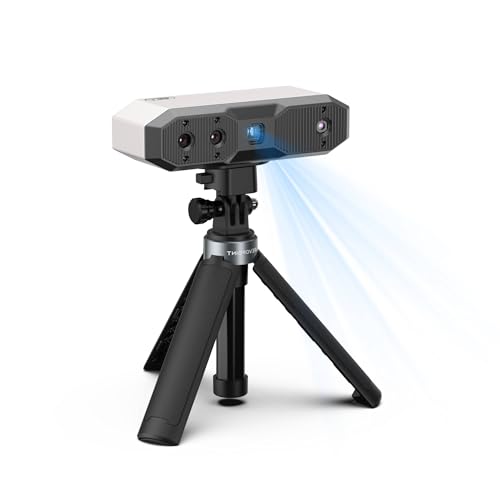
- 175g handheld design with USB-C and Wi-Fi 6
- Up to 0.02mm precision and 16fps capture
- RGB camera and flash LEDs support color detail
Best For: Portable, color-capable scanning of detailed small objects
Most Versatile Wireless Pick
Creality Pika Portable 3D Scanner

- 260g portable design with Wi-Fi 6 and touchscreen
- Blue laser mode offers claimed 0.03mm accuracy
- Designed to scan dark and metallic surfaces without spray
Best For: Portable jewelry scanning plus varied object sizes
Best All-in-One Choice

- Near mode for fine small-object details
- Up to 0.04 mm point-cloud accuracy
- Portable, self-contained scanning with color capture
Best For: Jewelry makers needing portable detail scanning and measurement features
Best Value for Dark and Shiny Pieces

- 0.05 mm accuracy at up to 30 fps
- Scans dark and metallic surfaces without spray
- 24-bit color capture with cross-platform software
Best For: Scanning reflective jewelry and other small objects without surface coating
Best for Precision Measurement

- Up to 0.01 mm single-frame precision
- Blue laser scanning for shiny or dark surfaces
- Automated turntable and multiple tracking modes
Best For: Professional jewelry modeling, inspection, and dimensional measurement
Best Precision Pick
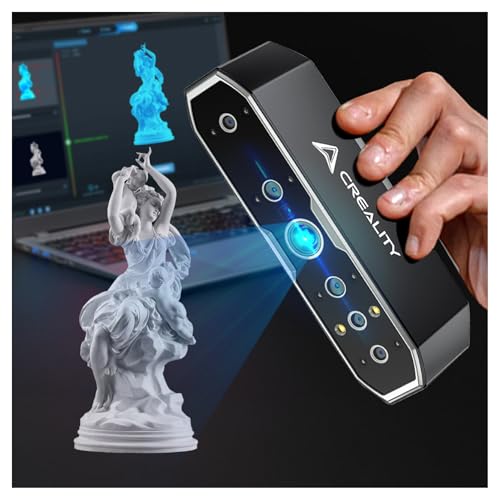
- Up to 0.02mm stated accuracy
- Small-object lenses for detailed scans
- Scans black and metal without spray
Best For: Jewelry makers and designers prioritizing fine detail
Best Speed and Detail
Creality Raptor Pro 3D Scanner

- Up to 0.02mm lab-condition accuracy
- Up to 60 FPS scanning speed
- Captures objects from 5mm to 2000mm
Best For: Advanced users scanning intricate jewelry and small parts
Best Portable Starter

- Lightweight 105g portable design
- Wireless phone and computer scanning
- Not suitable for highly detailed jewelry
Best For: Beginners scanning larger objects on the go
Professional Precision Pick – Matter and Form THREE 3D Scanner
For shoppers seeking a 3d scanner for jewelry that can also handle larger projects, the Matter and Form THREE combines dual 13MP autofocus cameras with claimed 0.033mm accuracy. Its feature-based alignment avoids tracking dots, while the included software supports a broad range of devices and operating systems.
Best For: Jewelry makers, engineers, artists, and users who want one scanner for small objects through large mechanical parts.
Pros:
- Dual autofocus cameras help maintain sharp detail at different distances.
- Feature-based alignment eliminates the need for tracking stickers.
- Supports Windows, Mac, Linux, iOS, Android, and Chromebooks without subscriptions.
- 20cm–100cm capture distance accommodates objects from jewelry to engine blocks.
Cons:
- At 9.46 pounds, it is substantially less portable than handheld alternatives.
- The wide object range may be more capability than jewelry-only users need.
The THREE is a versatile choice when jewelry scanning is only part of the brief. Its autofocus and marker-free workflow are especially practical, while the larger desktop design favors a stable workspace over portability.
Small-Object Detail Pick – 3DMakerpro Seal Lite 3D Scanner
The 3DMakerpro Seal Lite is designed specifically for small-format work, making it a focused option for anyone comparing a 3d scanner for jewelry. Its blue LED light source is rated for up to 0.02mm accuracy, and the included turntable and tripod can help create a more controlled scanning setup.
Best For: Indoor scanning of jewelry, small models, and other objects measuring approximately 10–300mm.
Pros:
- Blue LED structured light is designed to capture fine dents and edge textures.
- Small-format range suits jewelry and other compact objects.
- Includes a tripod, turntable, charger, and data cable.
- JMStudio exports OBJ, STL, PLY, and ASC files and receives lifetime free updates.
Cons:
- Captures mono texture only rather than full color.
- Windows and macOS compatibility is narrower than some competing models.
- The handheld workflow has a learning curve and may require a relatively powerful PC.
Choose the Seal Lite when small-object accuracy matters more than color capture or broad size flexibility. It is a purpose-built jewelry-friendly option, but buyers should plan for indoor use and some practice before expecting consistent results.
Portable Color Pick – Revopoint MINI 2 3D Scanner
The Revopoint MINI 2 is a lightweight option for shoppers who want a portable 3d scanner for jewelry with color capability. Its industrial-grade blue light system offers up to 0.02mm single-frame precision, while the RGB camera and flash LEDs are intended to improve texture and color capture.
Best For: Portable scanning of small detailed objects when full-color models and flexible USB or Wi-Fi 6 connections are useful.
Pros:
- 175g design is easy to hold and carry.
- Up to 0.02mm single-frame precision and capture speeds up to 16fps.
- RGB camera and flash LEDs support texture and color detail.
- Exports to formats including PLY, OBJ, STL, 3MF, GLTF, and FBX.
Cons:
- Results can vary with the material and color of the object; scanning spray may help.
- Very large or extremely tiny objects fall outside the recommended scanning range.
- Revo Design is paid separately and is Windows-only.
The MINI 2 balances detail, portability, and color better than a strictly desktop-oriented scanner. It is attractive for jewelry work that moves between locations, provided the object surface and computer setup are compatible.
Most Versatile Wireless Pick – Creality Pika Portable 3D Scanner
Creality’s Pika is a versatile choice for a 3d scanner for jewelry when portability, wireless use, and broad scanning modes are priorities. It combines seven-line blue laser scanning for fine details with NIR structured light, plus a built-in touchscreen and AI tools for hole filling and retexturing.
Best For: Users who want a portable scanner for jewelry, collectibles, mechanical parts, and occasional larger objects.
Pros:
- Compact 260g body includes Wi-Fi 6, a 3-inch touchscreen, and swappable batteries.
- Blue laser mode is rated for up to 0.03mm accuracy and 0.1mm 3D resolution.
- Claims direct scanning of dark and metallic surfaces without spray.
- Supports marker-free scanning in wired PC mode and exports STL, OBJ, PLY, and ASC.
Cons:
- Its advanced AI and dual-mode features may be unnecessary for simple jewelry scans.
- Battery-powered wireless operation adds charging and setup considerations.
- Warranty coverage is listed as one year.
The Pika stands out for flexibility: it is compact enough to travel with yet supports objects from tiny items to life-size scans. For jewelry, its metallic-surface claim and blue laser mode are compelling, while the broader feature set suits users with varied scanning projects.
Best All-in-One Choice – MIRACO Plus
The Revopoint MIRACO Plus is a versatile 3d scanner for jewelry and other objects when you want portable, self-contained scanning with detailed capture. Its Near mode is suited to small parts, while the integrated photogrammetric kit helps maintain measurement accuracy on larger projects.
Best For: Jewelry designers, makers, and professionals who need detailed scans, color capture, and a portable workflow.
Pros:
- Near mode captures fine details on small objects, including tiny screws and jewelry-scale parts.
- Up to 0.04 mm single-point cloud accuracy and photogrammetric length accuracy of 0.02 mm + 0.05 mm × L(m).
- Integrated processing, 48MP RGB color capture, broad export support, and up to two hours of battery life.
Cons:
- Revo Design for scan-to-CAD conversion is sold separately.
- Some software features are compatible only with x86 systems.
The MIRACO Plus stands out for combining small-detail scanning, measurement features, color capture, and onboard processing in a 750g handheld unit. It is a strong fit when portability and workflow flexibility matter as much as scan detail.
Best Value for Dark and Shiny Pieces – Otter Lite Basic
The Creality Otter Lite Basic is a practical 3d scanner for jewelry when dark or metallic surfaces are part of your workflow. Its DOE structured light system is designed to scan black, shiny, and metallic objects without powder or spray, while 0.05 mm accuracy supports detailed work.
Best For: Jewelry hobbyists and creators scanning metallic pieces, small objects, prototypes, or full-color products.
Pros:
- 0.05 mm accuracy and scanning speeds up to 30 frames per second.
- Scans dark and metallic surfaces directly without scanning spray.
- Captures 24-bit color textures and supports marker, geometry, and texture alignment.
- Works with Windows, macOS, iOS, and Android through CrealityScan 4.
Cons:
- The optional Scan Bridge handle is sold separately.
- Its broad 0.8-inch-to-78-inch size range may be more capability than jewelry-only users need.
For jewelry work where reflective surfaces are a concern, the Otter Lite Basic offers a useful combination of fine accuracy, no-spray scanning, and color capture. Its cross-platform software support also makes it accessible for mixed-device workflows.
Best for Precision Measurement – MetroX Pro
The Revopoint MetroX Pro is a precision-focused 3d scanner for jewelry and intricate components where dimensional accuracy is the priority. Blue laser modes capture shiny or dark surfaces without scanning spray, while the turntable mode can automate scans of complex objects.
Best For: Professional jewelry design, inspection, reverse engineering, and precision modeling.
Pros:
- Up to 0.01 mm single-frame precision and 0.02 mm single-frame accuracy.
- Blue laser modes handle flat, shiny, and dark surfaces without scanning spray.
- Four scanning modes include full-field structured light and one-click turntable scanning.
- Supports feature, marker, and global marker tracking for different object shapes.
Cons:
- Revo Design and Revo Measure are paid separately and support Windows only.
- The 14.82-pound package weight and PC-oriented workflow are less convenient for casual handheld use.
The MetroX Pro is the most measurement-oriented option in this lineup. Its high stated precision, laser modes, and automated turntable workflow make it especially compelling for professional jewelry modeling and inspection rather than occasional scanning.
Best Precision Pick – Creality Otter 3D Scanner
If you need a 3d scanner for jewelry and other detailed objects, the Creality Otter stands out for its stated 0.02mm accuracy and dedicated lenses for small-item scanning. It also handles black and metal surfaces without scanning spray, though your computer should meet the listed requirements.
Best For: Jewelry makers, designers, and studios needing detailed scans with color capture and broad size flexibility.
Pros:
- Up to 0.02mm scanning accuracy for sharp contours and fine details.
- Long-focal lenses support small objects, including items as small as 10mm.
- Scans black and metal objects without spraying.
- 24-bit full-color capture with built-in supplemental lighting.
Cons:
- Requires a relatively capable Windows or Mac computer.
- May be more scanner than casual users need.
The Otter is the strongest fit here when detail and material versatility matter most. Its accuracy, small-object lens setup, and no-spray handling make it particularly practical for jewelry work, provided you have compatible hardware.
Best Speed and Detail – Creality Raptor Pro 3D Scanner
The Creality Raptor Pro is a high-speed option for a 3d scanner for jewelry when intricate geometry and efficient capture are priorities. Its blue-laser configuration, 0.02mm laboratory-condition accuracy, and wireless Scan Bridge support make it suited to demanding scanning workflows.
Best For: Professional users and makers scanning detailed jewelry, small parts, and objects across a wide size range.
Pros:
- Up to 0.02mm accuracy under laboratory conditions.
- Scans at up to 60 frames per second and 660,000 points per second.
- Supports objects from 5mm to 2000mm.
- Wireless scanning is supported with the included Scan Bridge, plus color mapping and marker-based alignment.
Cons:
- The stated 0.02mm accuracy applies to laboratory conditions.
- Its 12.17-pound package weight suggests a less travel-friendly setup.
With the smallest stated scanning range of this group and the fastest capture rate, the Raptor Pro is compelling for detailed, repeatable work. It is best matched with users who can take advantage of its advanced workflow rather than occasional hobbyists.
Best Portable Starter – Creality CR-Scan Ferret Pro
The CR-Scan Ferret Pro is an accessible 3d scanner for jewelry-adjacent projects, with wireless operation, phone support, and a lightweight design. However, its supplied specifications specifically say it is not suitable for very small or highly detailed items such as jewelry, so it is better for larger models and general 3D-printing work.
Best For: Beginners and mobile creators scanning medium-to-large objects rather than fine jewelry details.
Pros:
- Lightweight 105g design with a portable all-in-one kit.
- Wireless scanning works with Windows, macOS, Android, iOS, and Wi-Fi 6.
- Offers 24-bit full-color scanning and up to 0.1mm accuracy.
- Exports OBJ, STL, and PLY files.
Cons:
- Not suitable for very small or highly detailed items like jewelry.
- Reflective, transparent, and very dark surfaces can reduce results.
- Accuracy is lower than the Otter and Raptor Pro specifications.
The Ferret Pro is convenient and beginner-friendly, especially when portability and phone-based scanning matter. For actual jewelry detail, choose a scanner designed for smaller objects; use this model for larger forms, prototypes, and general-purpose scans.
How We Picked the Best 3d Scanner for Jewelry
We focused on specifications and features that matter when scanning small, detailed objects. Accuracy claims were considered alongside camera or sensor design, tracking method, lighting technology, and the scanner’s intended object size. We also looked for practical workflow advantages, including color capture, wireless operation, autofocus, anti-shake tracking, texture scanning, and software features that can reduce cleanup time.
Because jewelry often includes reflective metal, polished stones, thin edges, and intricate surfaces, no scanner is ideal for every piece. A model with excellent stated accuracy may still require careful lighting, a turntable, markers, or a removable scanning spray depending on the material and geometry.
Quick Comparison
- Small, detailed pieces: Matter and Form Three, 3DMakerpro Seal Lite, and Revopoint MINI 2 are natural starting points for compact objects.
- Portable scanning: Creality Pika, Revopoint MIRACO Plus, and CR-Scan Ferret Pro are useful when a computer-free or wireless workflow matters.
- Color and texture capture: Revopoint MINI 2, Creality Otter Lite, and Creality Otter emphasize full-color scanning.
- Higher-speed or advanced work: Revopoint MetroX Pro and Creality Raptor Pro target users who prioritize scanning modes, precision, or throughput.
Key Buying Factors for a 3d Scanner for Jewelry
Accuracy and Resolution
Look beyond the headline accuracy number. Fine jewelry details depend on point resolution, camera quality, calibration, and the scanner’s performance at close range. Higher precision is especially valuable for prongs, filigree, engraved surfaces, and components that must fit together.
Tracking and Object Size
Small, symmetrical, or shiny pieces can be difficult to track. Marker-free tracking is convenient, but markers or a turntable may improve reliability. Confirm that the scanner supports the dimensions of your typical work; some compact scanners are better suited to jewelry than general-purpose handheld models.
Reflective Materials and Surface Capture
Polished gold, silver, gemstones, and transparent materials can confuse optical sensors. Check whether the workflow supports scanning spray, controlled lighting, or multiple scanning modes. If appearance matters, choose a model with dependable color or texture capture rather than relying only on geometry.
Software and Export Workflow
Make sure the included software can align scans, remove unwanted data, fill holes, and export the formats used by your CAD or 3D-printing program. A scanner that produces usable meshes quickly can be more valuable than one with better specifications but a difficult workflow.
Portability and Speed
Wireless and standalone scanners are convenient for studio visits, trade shows, and on-site work. Faster frame rates can help with moving subjects and larger objects, while a slower, more controlled scan may be preferable for tiny jewelry components.
Who Should Buy Which 3d Scanner for Jewelry?
Choose a compact precision model if your priority is rings, settings, small sculptures, or detailed CAD references. Choose a color-focused scanner if you need visual documentation, realistic previews, or texture-rich presentations. Choose a wireless or standalone model if you work away from a desk or need a portable setup. Choose an advanced laser or multi-mode scanner if you scan frequently, need greater control over difficult surfaces, or want faster production workflows.
Before buying, verify current software support, included accessories, minimum object size, and whether your materials require removable coating. The best 3d Scanner for Jewelry is the one that produces clean, repeatable geometry within your existing design and manufacturing process.