The best voice recorders for musicians make it easier to capture rehearsals, songwriting ideas, live performances, and professional takes without relying on a phone. The right model balances audio quality, portability, inputs, storage, and workflow.
This roundup includes compact Zoom recorders, multitrack options, field-ready models, and affordable dictation devices. Use the guide below to match your recording style and budget with the features that matter most.
Best 10 Voice Recorders for Musicians Picks for 2026
Best Clip-Free Flexibility

- 32-bit float recording helps avoid clipping
- Three mics offer nine recording patterns
- USB microphone and SD backup recording
Best For: Rehearsals, stereo performances, and mobile field recording
Best Simple Everyday Recorder

- One-touch recording and saving
- Seven-level gain with noise reduction
- 64GB storage with voice activation
Best For: Song ideas, lessons, interviews, and everyday notes
Best for Bands and External Mics

- Six-track 32-bit float recording
- Four XLR/TRS combo inputs
- USB interface with simultaneous SD backup
Best For: Bands, multitrack sessions, and external microphones
Best for AI Notes and Transcription

- Transcription available in 113 languages
- AI summaries, mind maps, and speaker identification
- 128GB storage with wired OTG transfer
Best For: Lessons, rehearsals, interviews, and organized spoken notes
Professional Clip-Free Pick

- 32-bit float recording helps prevent clipped takes
- Two locking XLR/TRS inputs for secure connections
- Low-noise preamps and flexible power options
Best For: External-mic recording in demanding field and music setups
Compact Practice Recorder

- Built-in noise-canceling microphone
- Voice activation and MP3/WAV recording
- Large 128GB storage with password protection
Best For: Lessons, rehearsal notes, songwriting ideas, and spoken recordings
Versatile Multitrack Pick

- 32-bit float capture for music and live performances
- Stereo microphones plus two XLR/TRS inputs
- Four-track recording and USB-C audio-interface support
Best For: Musicians recording performances, multitrack projects, and streams
Best Bundle for Portable Recording
Zoom H1essential Recorder Bundle
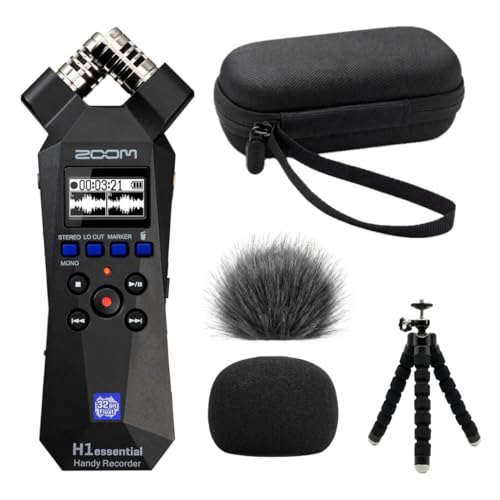
- 32-bit float recording helps prevent clipping
- Includes case, windscreens, and flexible tripod
- USB microphone mode for computer and mobile use
Best For: Portable rehearsal, songwriting, interview, and field recording kits
Best for Multitrack Recording
Zoom H5 4-Track Handheld Recorder
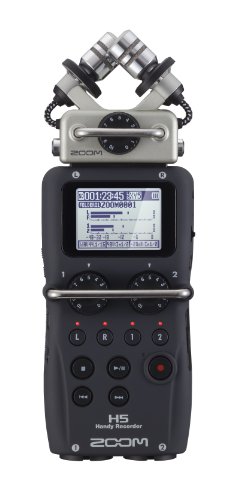
- Records four tracks simultaneously
- Two XLR/TRS inputs with phantom power
- Works as a multichannel USB audio interface
Best For: Bands and performers recording multiple microphones or instruments
Best Compact Recorder for Musicians

- Compact stereo recorder with 32-bit float audio
- USB-C microphone mode for calls and content
- Designed for rehearsals, songwriting, and performances
Best For: Lightweight everyday recording of musical ideas and spoken content
Best Clip-Free Flexibility – Zoom H2 Essential
The Zoom H2 Essential is a versatile choice among voice recorders for musicians, especially when you need to capture rehearsals, room sound, interviews, or wide stereo recordings without constantly adjusting gain. Its 32-bit float recording, selectable microphone patterns, and USB microphone mode make it useful in both mobile and computer-based setups.
Best For: Musicians recording rehearsals, live ambience, stereo performances, and flexible field sessions.
Pros:
- 32-bit float recording helps prevent clipped audio at changing volume levels.
- Three built-in microphones provide nine selectable recording patterns.
- Can work as a USB microphone while recording a backup to an SD card.
- Offers spoken menu navigation in seven languages.
Cons:
- Uses two AA batteries rather than a built-in rechargeable battery.
- Its built-in microphone design is less suited to multi-microphone instrument setups than a recorder with XLR inputs.
The H2 Essential stands out for musicians who value quick, low-fuss recording and multiple stereo or surround capture options. It is a particularly practical pick for mobile recording when levels may change unexpectedly.
Best Simple Everyday Recorder – EVISTR L357 64GB
The EVISTR L357 is a straightforward option for shoppers comparing voice recorders for musicians who also need a compact device for lessons, songwriting notes, interviews, or meetings. It combines one-touch recording with adjustable gain, voice activation, WAV or MP3 support, and a 64GB storage capacity.
Best For: Musicians who want an affordable, easy-to-operate recorder for ideas, lessons, and spoken notes.
Pros:
- One-touch controls make starting and saving recordings simple.
- Adjustable seven-level gain and noise reduction support clearer recordings.
- Voice activation can reduce silent sections and conserve storage.
- 64GB storage and up to 32 hours of continuous recording support extended use.
Cons:
- It is designed primarily as a compact voice recorder rather than a multitrack music recorder.
- Its feature set is less oriented toward connecting external microphones or instruments.
The L357 is best when convenience matters more than advanced music-production connectivity. Its simple controls, playback features, and voice activation make it useful for capturing musical ideas and spoken material without a complicated setup.
Best for Bands and External Mics – Zoom H6 Essential
The Zoom H6 Essential is a strong choice among voice recorders for musicians who need to capture several sources at once. It combines six-track 32-bit float recording with four XLR/TRS combo inputs, built-in X/Y microphones, and USB audio-interface functionality for band sessions, live events, and more structured recording workflows.
Best For: Bands, instrumentalists, vocalists, and creators recording multiple microphones or external sources.
Pros:
- Six-track 32-bit float recording helps protect recordings from distortion.
- Four XLR/TRS inputs support vocals, instruments, and other external sources.
- Built-in X/Y microphones capture up to 135 dB SPL.
- Works as a USB audio interface while recording to an SD card for backup.
Cons:
- Its larger 450 g body and four-AAA-battery setup are less pocket-friendly.
- Optional interchangeable capsules may add expense if you want more recording patterns.
For musicians recording more than one source, the H6 Essential offers considerably more input flexibility than a basic handheld voice recorder. It is the better fit for bands and serious home or live recording setups that need external microphone connections.
Best for AI Notes and Transcription – EVISTR L359 128GB AI Recorder
The EVISTR L359 is aimed at users who want more than basic recording from voice recorders for musicians. Along with 128GB of storage and voice-activated recording, it connects to the AI DVR Link app for transcription, summaries, mind maps, speaker identification, and other tools that can help organize rehearsals, lessons, meetings, or songwriting discussions.
Best For: Musicians and students who want recordings converted into searchable notes and summaries.
Pros:
- AI tools support transcription in 113 languages and smart summaries.
- 128GB storage can hold extensive recordings, while the recorder weighs 65 g.
- Voice activation and noise reduction help focus on spoken content.
- Wired OTG transfer supports direct phone connection without Bluetooth.
Cons:
- AI transcription and summaries depend on the AI DVR Link app workflow.
- Its mono, speech-focused design is less suited to detailed stereo music capture.
- Battery life is listed at up to 33 hours of continuous recording.
The L359 makes the most sense when the value of a recording includes what you can do with it afterward. For musical conversations, lessons, and planning sessions, its transcription and organization tools may be more useful than traditional recorder features alone.
Professional Clip-Free Pick – Zoom F3 Field Recorder
For musicians seeking dependable voice recorders for musicians, the Zoom F3 is built around clean, clip-resistant capture. Its 32-bit float recording, dual A/D converters, and two locking XLR/TRS inputs make it especially practical for demanding sessions, field work, and setups using external microphones.
Best For: Musicians and recordists who need reliable external-mic recording in unpredictable environments.
Pros:
- 32-bit float recording helps handle quiet sounds and sudden peaks without constant level adjustments.
- Two locking XLR/TRS inputs help keep connected microphones and instruments secure.
- Ultra-low-noise preamps support clean recordings in less-controlled conditions.
- Battery-powered, USB, and wireless-control workflows add flexibility for location recording.
Cons:
- It is designed around external microphones rather than convenient built-in stereo recording.
- The two-input configuration may be limiting for larger multi-microphone rigs.
The F3 is a focused professional recorder rather than an all-purpose handheld device. Choose it when recording quality, secure connections, and protection from clipping matter more than built-in microphones or extensive track counts.
Compact Practice Recorder – EVIDA 128GB Voice Recorder
For simple musical ideas, lessons, and spoken notes, the EVIDA recorder offers a compact option among voice recorders for musicians. It includes a built-in noise-canceling microphone, voice activation, multiple recording formats, and 128GB of storage for keeping many recordings organized.
Best For: Musicians who want an inexpensive, pocket-friendly recorder for rehearsals, lessons, songwriting notes, and interviews.
Pros:
- Built-in microphone supports convenient recording without additional gear.
- Voice activation can reduce silent sections and whispering snippets.
- Records in MP3 or WAV formats, including up to 1536kbps WAV.
- 128GB storage, password protection, bookmarks, and four-folder organization add practicality.
Cons:
- Mono operation is less suitable for capturing a spacious stereo performance.
- There is no headphone jack for monitoring directly from the recorder.
- Its 54-hour listed recording time is shorter than the available storage capacity may suggest.
The EVIDA is best viewed as a convenient note-taking and voice-capture device rather than a full studio recorder. It makes sense for musicians prioritizing portability, storage, and easy playback over multi-input recording or stereo detail.
Versatile Multitrack Pick – Zoom H4 Essential Recorder
The Zoom H4 Essential is a strong choice for musicians comparing voice recorders for musicians with broader creative needs. It combines built-in stereo microphones, two XLR/TRS inputs, four-track recording, 32-bit float capture, and USB-C connectivity for music, live performances, podcasts, and video production.
Best For: Musicians who need stereo recording, external inputs, multitrack flexibility, and USB audio-interface capability.
Pros:
- 32-bit float recording helps capture quiet material and loud performances with less concern about clipping.
- Built-in stereo microphones allow quick standalone recording.
- Two XLR/TRS inputs accommodate external microphones, instruments, mixers, or soundboards.
- Four-track recording and USB-C support expand its usefulness for larger creative projects and streaming.
Cons:
- Its listed digital recording time is 10 hours, so storage and file-management needs should be considered.
- The recorder requires two AA batteries for battery-powered use.
- Its wider feature set may be more than musicians need for simple voice memos.
The H4 Essential is the most flexible option here for musicians recording performances or building more involved projects. Its combination of stereo microphones, external inputs, four tracks, and USB connectivity makes it a capable bridge between handheld recording and a computer-based workflow.
Best Bundle for Portable Recording – Zoom H1essential Recorder Bundle
For musicians seeking voice recorders for musicians with useful travel accessories included, this Zoom H1essential bundle combines a compact stereo recorder with a protective case, two windscreens, and a flexible tripod. Its 32-bit float recording is designed to help prevent clipping during unpredictable takes, while the X/Y microphones support recordings up to 120 dB SPL.
Best For: Musicians who want an all-in-one kit for rehearsals, songwriting sessions, interviews, field recording, and portable content creation.
Pros:
- 32-bit float recording helps protect against clipping and distortion.
- Includes a hard EVA case, furry and foam windscreens, and an octopus tripod.
- Works as a USB microphone with computers and compatible mobile devices.
- Records WAV audio to an SD card at sample rates up to 96 kHz.
Cons:
- Requires two AAA batteries.
- The included accessories add value but may be unnecessary for musicians who already own a case or stand.
This is a practical starter bundle for musicians who record in changing environments. The accessory package makes it especially convenient for portable use, while the 32-bit float format provides useful recording headroom for live or spontaneous performances.
Best for Multitrack Recording – Zoom H5 4-Track Handheld Recorder
Musicians who need more input flexibility may prefer this Zoom H5 over simpler voice recorders for musicians. It records up to four tracks simultaneously, includes two XLR/TRS combo inputs with selectable phantom power and a pad, and accepts interchangeable Zoom input capsules for adaptable recording setups.
Best For: Bands, solo performers, and filmmakers who need multiple microphones or instrument inputs in a portable recorder.
Pros:
- Four-track simultaneous recording supports layered performances and multichannel sessions.
- Two XLR/TRS combo inputs include phantom power and a -20 dB pad.
- Interchangeable input capsules expand microphone and recording options.
- Can function as a multichannel or stereo USB audio interface.
Cons:
- Records to SD or SDHC cards up to 32 GB.
- Its broader input and capsule system may be more capability than a basic voice recorder user needs.
The H5 is the strongest choice here for musicians building a more involved mobile recording setup. Its XLR inputs, four-track capability, and capsule compatibility make it more suitable for multiple sources than a compact stereo-only recorder.
Best Compact Recorder for Musicians – Zoom H1essential Recorder
The Zoom H1essential is a straightforward option for musicians who want voice recorders for musicians that are easy to carry and ready for quick takes. Its X/Y stereo microphones, 32-bit float recording, USB-C microphone mode, and claimed 10-hour battery life cover rehearsals, songwriting, acoustic performances, lessons, and everyday content creation.
Best For: Songwriters, students, podcasters, and performers who want a lightweight stereo recorder for spontaneous recording.
Pros:
- 32-bit float recording is designed for clip-free audio capture.
- X/Y stereo microphones record rehearsals, performances, ambience, and conversations.
- USB-C microphone mode supports calls, livestreams, voiceovers, and computer or mobile recording.
- Compact 92-gram design and a stated 10-hour battery life suit portable use.
Cons:
- It uses built-in X/Y microphones rather than the H5’s XLR input system.
- Requires two AAA batteries.
This model is a good fit when simplicity and portability matter more than expandable inputs. It offers a focused set of features for capturing musical ideas, rehearsals, and spoken content without adding the complexity of a multitrack recorder.
How We Picked the Best Voice Recorders for Musicians
We focused on the features that affect real-world music recording: microphone quality, input flexibility, recording formats, portability, battery operation, storage, and ease of transferring files. Models with 32-bit float recording received special consideration because they provide extra protection against clipped takes when recording unpredictable performances.
We also included different categories rather than treating every recorder as interchangeable. Compact stereo recorders suit demos and rehearsals, while multitrack units and field recorders are better for microphones, instruments, and more controlled production. General-purpose digital voice recorders are included for spoken notes and songwriting ideas, but they may not match dedicated music recorders for detail or connectivity.
Quick Comparison
| Best For | Look For | Typical Advantage |
|---|---|---|
| Song ideas and practice | Small size, built-in stereo microphones | Fast setup and easy carrying |
| Rehearsals and live rooms | Wide stereo capture, low-noise recording | More natural room sound |
| External microphones | XLR/TRS inputs, phantom power | Better control over sources |
| Multitrack projects | Several tracks, overdubbing, monitoring | More flexible arrangements |
| Spoken notes and interviews | Voice activation, playback, large storage | Convenient speech capture |
Key Buying Factors for Voice Recorders for Musicians
Microphones and Input Options
Built-in X/Y or stereo microphones are convenient for acoustic instruments, rehearsals, and room recordings. If you plan to use dynamic or condenser microphones, choose a recorder with compatible XLR or combo inputs, gain control, and phantom power where required.
Recording Format and Headroom
WAV recording is preferable for editing and mixing. 32-bit float models can simplify gain management by preserving usable detail from recordings made too quietly or loudly, although microphone placement and room acoustics still matter.
Tracks, Monitoring, and Connectivity
Two-channel stereo is enough for many demos. Choose a multitrack recorder if you need separate sources, overdubs, or independent mixing. A headphone output, reliable level meters, USB connectivity, and an audio-interface mode can also improve the workflow.
Power, Storage, and Handling
Check battery type and expected runtime before recording away from an outlet. Removable memory is useful for long sessions, while wind protection, a tripod mount, a case, and a secure grip help when recording outdoors or at performances.
Who Should Buy Which Voice Recorders for Musicians?
Choose a compact stereo recorder if you mainly capture songwriting ideas, rehearsals, acoustic instruments, or quick demos. These are the easiest options to carry and operate.
Choose a multitrack Zoom recorder if you record several microphones, want overdubbing, or need more control during production. Extra inputs and tracks are worth the added size for serious home and mobile recording.
Choose a professional field recorder if clean preamps, locking inputs, dependable level control, and 32-bit float recording matter more than built-in convenience.
Choose a general-purpose digital voice recorder if your priority is lectures, interviews, spoken reminders, or transcribed notes. These models can complement a music recorder, but they are not usually the best choice for detailed instrumental recording.