Semi-modular synthesizers make experimental sound design more approachable by combining prewired signal paths with hands-on patch points. That gives beginners a usable starting point while leaving room for deeper exploration.
We selected 10 options spanning compact desktop instruments, keyboard synths, percussion-focused designs, Eurorack-compatible units, and essential patch cables. Use the guide below to match features, workflow, and budget to the way you make music.
Best 10 Semi Modular Synthesizers Picks for 2026
Affordable Analog Explorer

- Pure analog signal path with 3340-style VCO
- 24 dB ladder filter with resonance
- 32-step sequencer in a compact design
Best For: Accessible analog sequencing and hands-on sound design
Patchbay Essential
5-Color Modular Patch Cable Pack

- Five 27-inch 3.5mm TS mono cables
- Five colors help trace signal paths
- Male-to-male design for compatible modular gear
Best For: Organizing patches on compatible semi-modular systems
Expandable Moog Classic
Moog Mother-32 Semi-Modular Synthesizer

- Analog VCO, noise source, and Moog ladder filter
- 32-step sequencer with up to 64 sequences
- Tabletop or 60HP Eurorack operation
Best For: Expandable analog synthesis and live sequencing
Hybrid Engine Workhorse
Behringer Grind Hybrid Synthesizer

- 24 digital oscillators and 10 percussion/noise engines
- 14 synth engines for broad tonal variety
- Analog ladder filter, LFO, and 32-step sequencer
Best For: Hybrid sound design and pattern-based production
Classic Keyboard Workstation

- 32 velocity-sensitive full-size keys
- 256-note sequencer and spring reverb
- 41 patch points with MIDI and USB
Best For: Keyboard players wanting a playable, expandable Moog instrument
Compact Eurorack Explorer

- 40HP East Coast-style analog synth
- Multi-mode filter, envelope, and LFO
- Eurorack compatibility with MIDI
Best For: Modular users seeking a compact core synth voice
Polyrhythmic Sound Laboratory

- Two VCOs with four subharmonic generators
- Four rhythm generators and dual sequencers
- Tabletop or 60HP Eurorack operation
Best For: Experimental musicians creating complex polyrhythmic patterns
Hands-On Rhythm Lab
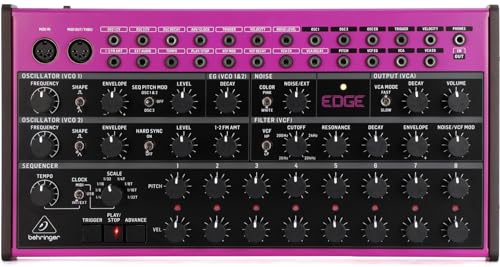
- Analog, gritty percussion voice
- 15 x 10 I/O patch matrix
- Two 8-step sequencers
Best For: Rhythmic patching and analog percussion
Build-and-Patch Explorer

- Fully analog Moog oscillator and filter
- Wavefolder and full ADSR
- Standalone or Eurorack-ready
Best For: DIY-minded analog sound design
Experimental Beat Machine

- Two analog oscillators and white noise
- 8-step sequencer for rhythmic ideas
- 24-point patch bay and 60HP Eurorack support
Best For: Experimental analog rhythm creation
Affordable Analog Explorer – Behringer CRAVE
The Behringer CRAVE is a compact choice for musicians seeking semi modular synthesizers with an analog signal path and hands-on sound shaping. Its 3340-style VCO, classic ladder filter, and 32-step sequencer cover a useful range of basses, leads, and sequences.
Best For: Beginners and producers who want an accessible analog semi-modular synthesizer for sound design and sequencing.
Pros:
- Pure analog signal path with VCO, VCF, and VCA designs.
- Pulse and sawtooth oscillator outputs support varied tones.
- 24 dB ladder filter includes resonance and switchable low/high-pass modes.
- Built-in 32-step sequencer supports pattern-based performance.
Cons:
- Its compact 3.94-inch dimensions may limit hands-on control space.
- The listed connector type is a 2.5mm jack, which may require attention when planning connections.
CRAVE is a practical entry point into analog semi-modular synthesis, especially if you value a fat oscillator sound, a familiar ladder filter, and an onboard sequencer in a small metal-bodied unit.
Patchbay Essential – 5-Color Modular Patch Cable Pack
This five-pack of 3.5mm TS mono patch cables is a practical accessory for semi modular synthesizers and modular setups. The 27-inch length and five-color assortment make it easier to organize and follow signal paths while patching.
Best For: Synth users who need clearly color-coded cables for connecting compatible modular instruments.
Pros:
- Includes five flexible 27-inch cables.
- 3.5mm TS mono male-to-male connectors suit compatible modular equipment.
- Green, blue, red, orange, and purple colors help identify signal paths.
- Designed specifically for modular synthesizer patching.
Cons:
- These are patch cables rather than a synthesizer, so they add no sound-generation features.
- Compatibility depends on equipment using 3.5mm TS connections.
For anyone expanding a semi-modular setup, this pack offers a straightforward way to add multiple patch leads and bring visual organization to a patch. Verify your instrument’s connector requirements before buying.
Expandable Moog Classic – Moog Mother-32 Semi-Modular Synthesizer
The Moog Mother-32 is a premium-feeling option among semi modular synthesizers, combining a raw analog signal path with a 32-step sequencer and extended patchbay. It can work as a tabletop instrument or as a 60HP Eurorack module, giving it room to grow with a modular system.
Best For: Musicians who want Moog-style analog sound, sequencing, and a clear path into Eurorack expansion.
Pros:
- Analog VCO, white noise generator, Moog ladder filter, and external audio input.
- 32-note step sequencer offers two modes and up to 64 onboard sequences.
- Can be used standalone or installed as a 60HP Eurorack module.
- Includes MIDI In, CV connectivity, an extended patchbay, and patch cables.
Cons:
- Its 12.57-inch width takes more tabletop space than especially compact options.
- Adding Eurorack capability requires an appropriate modular system or installation setup.
Mother-32 stands out when long-term expandability matters. Its built-in sequencing keeps it approachable, while the patchbay, MIDI, CV, and Eurorack flexibility support more advanced performance and sound-design workflows.
Hybrid Engine Workhorse – Behringer Grind Hybrid Synthesizer
The Behringer Grind takes a different approach to semi modular synthesizers by combining digital oscillator and percussion engines with an analog ladder filter. Its 14 synth engines, LFO, and 32-step sequencer make it suited to users who want broad timbral options in a single hybrid instrument.
Best For: Producers and performers seeking a hybrid synthesizer with multiple digital engines, percussion sounds, analog filtering, and sequencing.
Pros:
- Combines 24 digital oscillators with 10 percussion/noise engines.
- Includes 14 synth engines for varied sound creation.
- Analog ladder filter adds an analog filtering stage.
- Provides an LFO and 32-step sequencer for modulation and patterns.
Cons:
- Its hybrid architecture may be less appealing to buyers seeking an entirely analog signal path.
- The supplied specifications list MIDI connectivity but do not detail the full patchbay or CV layout.
Grind is a strong fit for players who prioritize variety over strictly traditional analog architecture. The combination of digital engines, percussion resources, analog filtering, and sequencing gives it a broad production-oriented toolkit.
Classic Keyboard Workstation – Moog Grandmother
The Moog Grandmother is a strong choice for shoppers seeking semi modular synthesizers with a familiar keyboard format and hands-on analog control. It combines two oscillators, a white-noise generator, an external input, onboard sequencing, arpeggiation, and spring reverb in a standalone instrument that can also connect to modular gear.
Best For: Keyboard players and producers who want a full-size, playable semi-modular instrument with extensive patching options.
Pros:
- 32 velocity-sensitive, full-size keys provide expressive playability.
- Includes a 256-note sequencer, arpeggiator, and analog spring reverb.
- Offers 41 modular patch points plus MIDI, USB, and audio connectivity.
- Can integrate with Moog modular instruments and Eurorack systems.
Cons:
- Its monophonic design is intended for one-note-at-a-time playing.
- At 22.99 inches wide and 7.25 kg, it is less compact than a small desktop module.
The Grandmother stands out among semi modular synthesizers for combining classic Moog-style sound sources with a substantial keyboard and built-in performance features. It is especially practical if you want one instrument that works without patching but can expand into a larger modular setup.
Compact Eurorack Explorer – Cre8audio East Beast
The Cre8audio East Beast is a compact option for shoppers comparing semi modular synthesizers for a modular-focused setup. This 40HP East Coast-style analog synth includes a multi-mode filter, envelope generator, LFO, MIDI, and Eurorack compatibility in a metal-bodied format.
Best For: Beginners and modular enthusiasts who want a relatively compact semi-modular voice with Eurorack integration.
Pros:
- 40HP format suits space-conscious modular setups.
- Supports Eurorack compatibility for expansion and integration.
- Includes a multi-mode filter, envelope generator, LFO, and MIDI.
- Metal body provides a durable enclosure design.
Cons:
- The supplied specifications do not indicate a built-in keyboard or sequencer.
- Its 40HP size still requires dedicated modular or desktop space.
The East Beast focuses on the essentials of an East Coast-style semi-modular voice rather than a keyboard workstation. Choose it when compact Eurorack compatibility and core synthesis modulation are more important than onboard performance controls.
Polyrhythmic Sound Laboratory – Moog Subharmonicon
The Moog Subharmonicon is aimed at experimental musicians looking for semi modular synthesizers built around unusual rhythm and harmony relationships. Its two voltage-controlled oscillators, four subharmonic generators, four rhythm generators, and dual four-step sequencers create a focused environment for developing evolving polyrhythmic patterns.
Best For: Experimental performers and producers who want generative-feeling polyrhythms, subharmonic tones, and patch-based exploration.
Pros:
- Six tonal sources combine two VCOs with four subharmonic generators.
- Four rhythm generators can drive either or both sequencers.
- Dual four-step sequencers support complex rhythmic and harmonic interactions.
- Works as a tabletop instrument or a 60HP Eurorack module.
Cons:
- The two sequencers are limited to four steps each.
- Its specialized polyrhythmic design may be less suitable for straightforward traditional sequencing.
- It is more focused on experimental sound design than general-purpose keyboard performance.
The Subharmonicon is one of the more distinctive semi modular synthesizers for musicians who want rhythmically complex, evolving results. Its patch bay, MIDI support, and Eurorack flexibility make it easier to incorporate into a broader setup, while the subharmonic architecture gives it a specialized sonic identity.
Hands-On Rhythm Lab – Edge Percussion Synth
The Behringer Edge is a practical choice for musicians exploring semi modular synthesizers with a percussion-first focus. Its analog sound profile, patch matrix, noise sources, envelope generator, MIDI support, and built-in sequencer make it suited to hands-on rhythmic experimentation.
Best For: Electronic musicians and producers who want gritty analog percussion sounds with sequencing and flexible patching.
Pros:
- Analog, gritty, percussive sound profile.
- 15 x 10 I/O patch matrix supports flexible signal routing.
- Includes two 8-step sequencers, white/pink noise, and an envelope generator.
- MIDI channel voice priority selection adds performance flexibility.
Cons:
- Its percussion-oriented design is less suited to melodic synthesis.
- The plastic body may feel less substantial than metal alternatives.
The Edge is a focused semi-modular instrument for building rhythmic patterns and sculpting punchy analog textures. Choose it when percussion and patch-based experimentation matter more than a broad keyboard-style sound engine.
Build-and-Patch Explorer – Moog Mavis Analog Synth
The Moog Mavis is a compact semi modular synthesizer kit built around a fully analog signal path. With two oscillators, a ladder filter, wavefolder, full ADSR, sample and hold, and a built-in keyboard, it offers an unusually broad set of sound-design tools in a small format.
Best For: Synth enthusiasts who enjoy assembling an instrument and want standalone operation with Eurorack integration.
Pros:
- Fully analog oscillator and Moog ladder filter circuits.
- Includes wavefolding, two oscillators, full ADSR, sample and hold, attenuators, mixer, and mults.
- Built-in keyboard includes glide and keyboard scaling.
- Can be used standalone or removed from its case for Eurorack connectivity.
Cons:
- Assembly is required before playing.
- The compact 44HP format may not suit players wanting a larger integrated keyboard.
Mavis stands out for buyers who want both a build project and a capable analog patching instrument. Its wavefolder and Eurorack compatibility broaden its palette beyond a basic compact synthesizer.
Experimental Beat Machine – Moog DFAM Percussion Synth
The Moog DFAM is a semi modular synthesizer designed for immediate, experimental percussion and rhythm creation. Its two analog oscillators, white-noise generator, ladder filter, 8-step sequencer, and 24-point patch bay provide a direct route from sound shaping to evolving rhythmic patterns.
Best For: Producers and performers who want hands-on analog percussion, unconventional rhythms, and Eurorack expansion.
Pros:
- Fully analog engine with two voltage-controlled oscillators and white noise.
- Moog ladder filter supports weighty, shaped percussion tones.
- Built-in 8-step sequencer encourages immediate rhythmic experimentation.
- Works standalone or as a 60HP Eurorack module.
Cons:
- Its 8-step sequencer is focused on compact rhythmic patterns.
- The percussion-centered design may be limiting for traditional melodic parts.
DFAM is a strong fit for users who want semi-modular synthesis to feel physical and performance-oriented. It requires no cables for basic operation, yet its patch bay and Eurorack compatibility leave room for deeper expansion.
How We Picked the Best Semi Modular Synthesizers
We evaluated the selection across sound architecture, patch-bay flexibility, sequencing, performance controls, connectivity, expandability, and intended use. The list includes analog, hybrid, melodic, percussion, and polyrhythmic instruments so different types of musicians can find a suitable starting point.
We also considered whether each instrument works well on its own, integrates with MIDI or Eurorack systems, and offers a practical learning path. The patch-cable pack is included as an accessory option because semi-modular workflows depend on reliable 3.5mm connections.
Quick Comparison
| Best For | Look For | Typical Format |
|---|---|---|
| Beginners | Prewired routing, clear controls, and built-in sequencing | Compact desktop or keyboard |
| Melodic performance | Keyboard, MIDI, oscillator control, and expressive modulation | Keyboard or desktop |
| Experimental composition | Multiple sequencers, unusual oscillators, or flexible patching | Desktop |
| Rhythm production | Dedicated percussion voice, sequencer, and trigger inputs | Desktop |
| Eurorack expansion | Compatible voltage standards and a suitable case or mounting option | Desktop or Eurorack-ready |
Key Buying Factors for Semi-Modular Synthesizers
Signal Path and Sound Sources
Check how many oscillators, filters, envelopes, and modulation sources are available. A straightforward voice is easier to learn, while multiple engines, wavefolders, or subharmonic sections can provide more unusual textures.
Patch Bay and Modulation
More patch points do not automatically mean a better instrument. Look for useful destinations such as filter cutoff, oscillator pitch, envelope amount, clock, and external audio. Confirm the connector size and whether the included or separately purchased cables match.
Sequencing and Performance
A built-in sequencer or arpeggiator can make a compact synth feel complete. Consider step length, pattern storage, clock synchronization, MIDI support, and whether the controls are comfortable for live performance. Keyboard players should also check key count and velocity response.
Connectivity and Expansion
Review MIDI, USB, clock, trigger, and audio connections before buying. If Eurorack integration matters, verify power, mounting, signal levels, and the manufacturer’s requirements rather than assuming every semi-modular unit fits directly into a case.
Who Should Buy Which Semi Modular Synthesizers?
Choose a compact analog desktop model if you want an affordable introduction to patching and sequencing. A keyboard-based instrument is the better choice for players who want immediate hands-on melodies, chords, and performance control.
Producers focused on basses, leads, and evolving textures should prioritize a flexible oscillator-filter-envelope path with MIDI and broad modulation access. Experimental composers may prefer instruments with multiple sequencers, unusual synthesis sections, or extensive patch bays. For rhythm-first setups, a dedicated semi-modular percussion synthesizer can add movement and variation that conventional drum machines may not provide.
Finally, budget for cables and accessories, especially when combining several instruments. The best choice is the one whose workflow you will use regularly—not necessarily the model with the largest feature list.