The right desktop microphone preamp can give a low-output microphone more usable gain while keeping hiss, distortion, and signal problems under control. It can also add practical features such as phantom power, EQ, filtering, or direct computer connectivity.
We selected 10 desktop-friendly options for different recording setups, from compact inline boosters for dynamic microphones to full-featured preamps with multiple inputs and studio-oriented controls. Use the guide below to match gain, connectivity, and microphone compatibility to your workflow.
Best 10 Desktop Microphone Preamps Picks for 2026
Transformer Character Pick

- Single-channel mic and instrument preamp
- Ultra-high-speed input stage
- Transformer-balanced output
Best For: Solo studio recording chains
Maximum Gain Flexibility Pick
RO-04 Mic Preamp with Hi-Z Input

- 0–72 dB adjustable gain range
- Advertised -120 dBV EIN
- Mic, Hi-Z, 48V, HPF, and phase features
Best For: Flexible recording and streaming rigs
Two-Channel Dynamic Mic Booster

- Two channels for dynamic or passive ribbon mics
- Adds a stated +25 dB gain boost
- Compact phantom-powered XLR design
Best For: Dual-mic setups needing extra clean gain
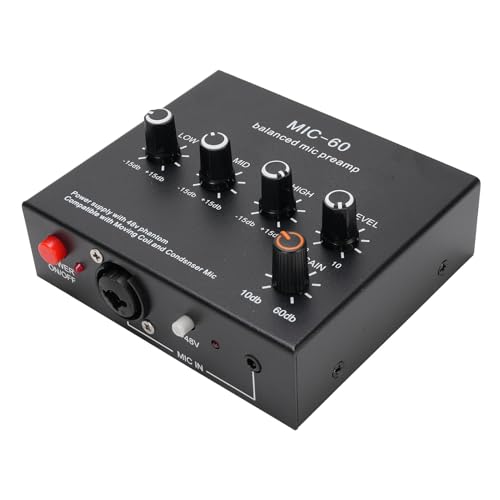
Flexible Desktop Tone Shaper

- Three-band EQ for hands-on tone shaping
- Gain and level controls for signal management
- Switchable 48V phantom power
Best For: Home studios, podcasts, streaming, and desktop vocal setups
Low-Noise Gain Specialist

- 19–66 dB variable gain range
- Claimed -120 dBV EIN low-noise performance
- Type-C power and 1MΩ instrument input
Best For: Portable vocal, ribbon, and instrument recording
Dynamic Mic Signal Booster

- Adds 25 dB of gain
- Balanced XLR input and output
- Compact metal housing
Best For: Dynamic and passive ribbon microphones
Best Versatile Desktop Mic Preamp
- Up to +60dB gain
- Supports dynamic and condenser mics
- XLR, 3.5mm, and 6.35mm connectivity
Best For: Flexible home studios, vocal recording, and live streaming
Best Dynamic-Mic Booster
StudioMan DPM1 29dB XLR Preamp

- Adds +29dB clean gain
- Designed for dynamic and ribbon mics
- Requires 48V phantom power
Best For: Podcasters and creators using low-output dynamic microphones
Best Compact Desktop Mic Preamp

- Provides 20dB balanced gain
- Works with dynamic and condenser mics
- Compact metal housing
Best For: Simple home studio, vocal, podcasting, and streaming setups
Transformer Character Pick – Auteur DT Desktop Preamp
The Black Lion Audio Auteur DT is a focused choice for desktop microphone preamps when you want a dedicated, single-channel unit for microphone or instrument recording. Its ultra-high-speed input stage and transformer-balanced output are designed for a serious studio signal path.
Best For: Solo recording setups that need one microphone or instrument channel and a transformer-balanced output.
Pros:
- Dedicated single-channel microphone and instrument preamp.
- Uses an ultra-high-speed input stage.
- Transformer-balanced output supports professional signal routing.
Cons:
- Only one channel is available.
- The desktop unit weighs 5.1 pounds and has a relatively large footprint.
The Auteur DT makes the most sense when channel count is less important than having a purpose-built desktop preamp with transformer-balanced output for a streamlined recording chain.
Portable USB Conversion Pick – Shure MVX2U Gen 2 XLR-to-USB-C
The Shure MVX2U Gen 2 combines XLR microphone connectivity with USB-C convenience, making it a versatile alternative to traditional desktop microphone preamps for computer, tablet, or smartphone recording. It adds up to 60 dB of clean gain, 48V phantom power, and onboard processing in a compact 100-gram interface.
Best For: Portable podcasting, streaming, and recording with an XLR dynamic or condenser microphone.
Pros:
- Works with desktop, smartphone, and tablet setups through USB-C.
- Provides up to +60 dB clean gain and 48V phantom power.
- Includes Auto Level Mode, real-time denoiser, and Digital Popper Stopper processing.
- Supports sample rates up to 192 kHz and MFi-certified connectivity.
Cons:
- Offers one XLR channel only.
- Its onboard processing and settings rely on compatible Shure MOTIV apps for management.
Choose the MVX2U Gen 2 if flexibility and portability matter as much as preamp gain. It is especially practical for users moving between desktop recording and mobile content creation.
Maximum Gain Flexibility Pick – RO-04 Mic Preamp with Hi-Z Input
The RO-04 is a versatile option among desktop microphone preamps, pairing a 0–72 dB adjustable gain range with an advertised -120 dBV EIN. It also includes dedicated microphone and instrument inputs, 48V phantom power, dual output levels, and USB-C or power-bank operation.
Best For: Recording, podcasting, or streaming setups that need substantial gain range, instrument input, and flexible power options.
Pros:
- Wide 0–72 dB adjustable gain range for low-output microphones and quieter sources.
- Dedicated mic and Hi-Z instrument inputs with separate impedance designs.
- Includes 48V phantom power, HPF, and phase controls.
- Dual outputs support desktop and mobile-oriented signal levels.
Cons:
- It is a single-channel preamp.
- At 2.42 pounds, it is less lightweight than compact USB microphone interfaces.
The RO-04 stands out for users who need more than a basic gain boost. Its broad gain range, instrument support, and power-bank compatibility make it adaptable across fixed desktop and mobile streaming configurations.
Two-Channel Dynamic Mic Booster – StudioMan CL-200 XLR Preamp
The StudioMan CL-200 is a compact two-channel gain booster for dynamic and passive ribbon microphones. Rather than serving as a full-featured preamp for every microphone type, it adds 25 dB of gain using phantom power from a compatible mixer, interface, or preamp.
Best For: Two-microphone setups using dynamic or passive ribbon microphones that need additional clean gain.
Pros:
- Two channels can process two microphone signals simultaneously.
- Adds a stated +25 dB of clean gain.
- Compact metal housing with balanced XLR input and output connections.
- Powered directly by standard 48V phantom power.
Cons:
- Not compatible with condenser microphones because it cannot pass phantom power through.
- Gain is fixed at 25 dB rather than adjustable.
- Requires a phantom-power-equipped mixer, interface, or preamp.
The CL-200 is best viewed as a straightforward signal booster for compatible passive microphones. Its dual-channel design is useful when two weak mic signals need help without pushing the main interface gains to their limits.
Flexible Desktop Tone Shaper – MIC-60
The MIC-60 is a practical choice for desktop microphone preamps when you want hands-on control before your signal reaches a mixer, recorder, or interface. Its dedicated gain, level, and three-band EQ controls make it useful for quickly shaping vocals, podcasts, streams, and home-recording setups.
Best For: Desktop users who want microphone gain, basic tone shaping, and switchable phantom power in one compact unit.
Pros:
- Three-band low, mid, and high EQ provides direct tonal adjustment.
- Dedicated gain and level controls help manage the incoming mic signal.
- Switchable 48V phantom power supports compatible condenser microphones.
- Metal enclosure and compact dimensions suit desktop setups.
Cons:
- It has one output channel.
- Its 6.35mm and XLR connectivity may require checking cable compatibility with your equipment.
The MIC-60 stands out among desktop microphone preamps for its simple, tactile workflow. Choose it if physical EQ controls matter more to you than a feature-heavy interface.
Low-Noise Gain Specialist – RO03
The RO03 targets recording situations where clean gain and flexible connections are priorities. This desktop microphone preamp offers a 19–66 dB gain range, a claimed -120 dBV EIN, Type-C power, and support for dynamic, condenser, ribbon, and instrument sources.
Best For: Users seeking portable, low-noise gain for microphones or instruments and who can connect through the appropriate interface input.
Pros:
- 19–66 dB variable gain range is designed for practical real-world use.
- Claimed -120 dBV EIN supports a low-noise signal path.
- 1MΩ instrument input impedance is suited to instrument recording.
- Type-C power improves portability for mobile recording scenarios.
Cons:
- The two input ports cannot operate simultaneously.
- The manufacturer recommends connecting to an audio interface’s TRS line input for the lowest noise.
- Cable and input matching require more attention than with a simple plug-and-play booster.
The RO03 is the most specification-focused option here, especially for users who need substantial gain without obvious added noise. It is a strong fit when your setup can accommodate its recommended TRS connection.
Dynamic Mic Signal Booster – StudioMan CL-100
The StudioMan CL-100 is a focused option among desktop microphone preamps, built to add 25 dB of gain to dynamic and passive ribbon microphones. Its balanced XLR input and output, compact metal housing, and phantom-power compatibility make it easy to place between a low-output microphone and an audio interface or mixer.
Best For: Dynamic-mic and passive-ribbon users who need a straightforward XLR signal boost for podcasts, streaming, live sound, or recording.
Pros:
- Provides a dedicated +25 dB gain boost for low-level dynamic and passive ribbon microphones.
- Balanced XLR input and output support common audio interfaces and mixers.
- Compact metal chassis offers desk-friendly placement and EMI/RFI shielding.
- 10 Hz–20 kHz frequency response supports full-range audio capture.
Cons:
- It is designed specifically for dynamic and passive ribbon microphones rather than a broad range of source types.
- It offers fixed 25 dB gain instead of variable gain control.
- It does not include the three-band EQ found on some larger desktop preamps.
The CL-100 keeps the job simple: add clean gain to a compatible microphone through an XLR connection. It makes the most sense when you already have an interface or mixer and need a compact booster rather than a full control surface.
Best Versatile Desktop Mic Preamp – 3-Input 48V Gain Booster
For shoppers comparing desktop microphone preamps, this compact three-input model stands out for its flexible connectivity and up to 60dB of gain. It supports dynamic and condenser microphones, making it useful for recording, podcasting, streaming, and small mixing setups.
Best For: Home studios, vocal recording, live streaming, and users who need multiple microphone and output options.
Pros:
- Provides up to +60dB of gain with a fully balanced circuit designed for low-noise operation.
- Includes 48V power and supports both dynamic and condenser microphones.
- Offers XLR balanced, 3.5mm, and 6.35mm microphone and line outputs.
- Compact metal housing helps reduce interference and is easy to transport.
Cons:
- The broad range of inputs and outputs may be more than needed for a simple single-mic setup.
- Its supplied feature set is focused on connectivity and gain rather than advanced onboard processing.
This is a flexible pick when your desktop microphone preamp needs to handle different microphones and connection types. Its three-input design and high gain rating make it especially practical for users building a versatile recording or streaming station.
Best Dynamic-Mic Booster – StudioMan DPM1 29dB XLR Preamp
Among desktop microphone preamps, the StudioMan DPM1 is a focused inline solution for low-output dynamic and ribbon microphones. It adds 29dB of clean gain between the microphone and an interface or mixer, helping users avoid turning up a noisier input preamp.
Best For: Podcasters, streamers, vocalists, and stage users with compatible dynamic or ribbon microphones.
Pros:
- Adds +29dB of clean, transparent gain to low-output dynamic and ribbon microphones.
- Its inline XLR design is plug-and-play with compatible interfaces, mixers, and microphones.
- Metal construction helps provide durability and interference shielding.
- Includes a stated one-year manufacturer warranty and technical support.
Cons:
- It is strictly not for condenser microphones.
- Requires 48V phantom power from the connected interface or mixer, which is not included.
- Provides a single inline XLR path rather than multiple inputs or outputs.
The DPM1 is best viewed as a targeted signal booster rather than a full desktop preamp unit. Confirm that your microphone is dynamic or ribbon and that your interface supplies phantom power before choosing it.
Best Compact Desktop Mic Preamp – 20dB 48V Vocal Booster
This compact desktop microphone preamp provides a straightforward way to add 20dB of balanced gain to dynamic or condenser microphones. Its low-noise circuit, 48V power, and XLR output suit basic recording, podcasting, and streaming setups.
Best For: Users who want a small, simple preamp for home or professional studio recording and vocal applications.
Pros:
- Delivers 20dB of clean, transparent gain through balanced amplification circuitry.
- Supports both dynamic and condenser microphones with 48V power.
- Fully balanced design is intended to provide low noise without added sonic coloration.
- Lightweight black metal case helps with portability and interference reduction.
Cons:
- Offers less gain than the 60dB model in this roundup.
- The supplied information lists an XLR output but does not indicate multiple output formats.
- Its simple design may be limiting for users who need multi-channel routing.
Choose this model when you want a compact, uncomplicated desktop microphone preamp for clean gain and broad microphone compatibility. It is a practical fit for smaller workstations where portability and a low-noise design matter more than extensive I/O.
How We Picked These Desktop Microphone Preamps
We focused on products suited to desktop recording, streaming, podcasting, voiceover, and compact home studios. The selection covers single-channel and two-channel designs, inline XLR boosters, traditional microphone preamps, and models that connect an XLR microphone directly to a computer.
Our comparisons emphasize useful specifications rather than appearance alone: available gain, noise performance, phantom-power support, input and output formats, controls, portability, and compatibility with dynamic, condenser, ribbon, and instrument sources. Because product configurations can vary, confirm the current specifications and included cables before ordering.
Quick Comparison
| Best For | Look For | Most Suitable Type |
|---|---|---|
| Low-output dynamic microphones | Clean gain boost and low self-noise | Inline XLR preamp |
| Condenser microphones | Reliable 48V phantom power | Full microphone preamp |
| Computer recording | USB-C connectivity and device compatibility | XLR-to-USB interface |
| Two microphones | Two independent channels | Dual-channel preamp |
| Voice shaping | EQ, high-pass filtering, or phase controls | Feature-rich desktop preamp |
Key Buying Factors for Desktop Microphone Preamps
Gain and Noise
Choose enough gain for your microphone without running the control at its limit. Dynamic and ribbon microphones often benefit from more available gain, while a low equivalent input noise rating helps preserve quiet sources. Extra gain does not automatically mean better sound if the circuit becomes noisy or clips easily.
Microphone and Phantom-Power Compatibility
Check whether the unit supports your microphone type. Condenser microphones generally require 48V phantom power; many dynamic microphones do not. Passive ribbon microphones require particular care, so verify the manufacturer’s guidance before enabling phantom power or using an inline booster.
Connections and Controls
Match the inputs and outputs to the rest of your system. XLR-to-XLR units work with an audio interface, mixer, or recorder, while USB-C models can simplify direct computer recording. Gain controls are essential, but EQ, a high-pass filter, phase reversal, and multiple outputs can be valuable for more advanced setups.
Size and Power
Measure the available desk space and check how the preamp is powered. Inline models are portable and discreet, whereas feature-rich desktop units may need an external adapter. A compact design is convenient, but it should not compromise access to gain, phantom-power, or output controls.
Who Should Buy Which Desktop Microphone Preamps?
Choose an inline XLR booster if you have a quiet dynamic microphone and already own an audio interface but need additional clean gain. Choose a full-featured desktop preamp if you want filtering, EQ, phase controls, or broader microphone support. Choose a dual-channel model for interviews, two-microphone podcasts, or stereo recording. Choose an XLR-to-USB-C interface if you want the simplest direct connection to a computer or mobile device.
Before buying, confirm the preamp’s gain range, noise specification, phantom-power behavior, connector type, and power requirements. Those details matter more than a high maximum-gain number when building a dependable desktop recording chain.